
The selected bass this week features a short scale design with a great story. Jake writes:
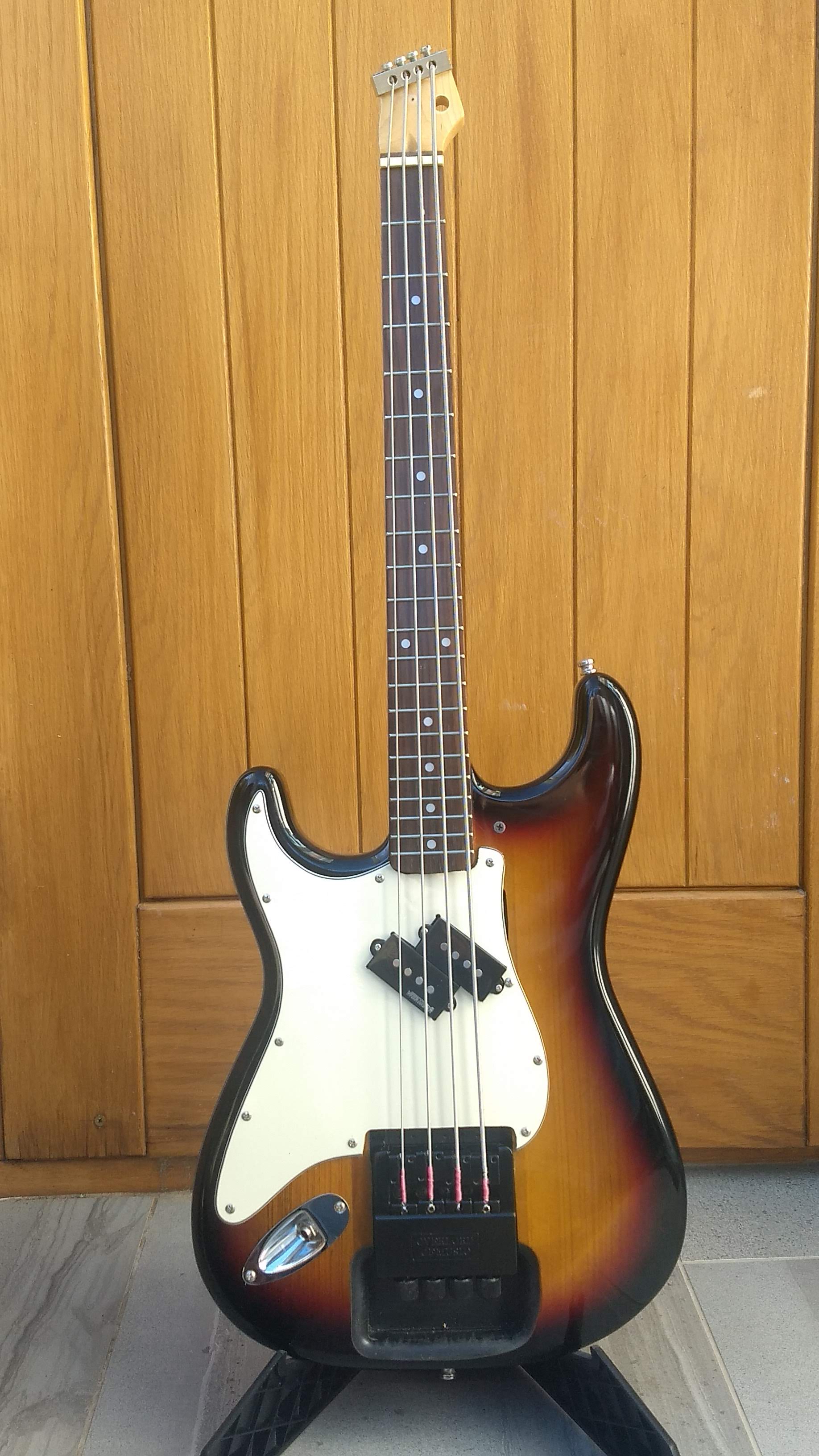
This bass was the result of lying in bed wondering about what was possible. “Why are bass necks so long? Was it just because Leo Fender thought that was how they should be?” I’ve had a couple of short-scale basses, but what about a REALLY short scale?
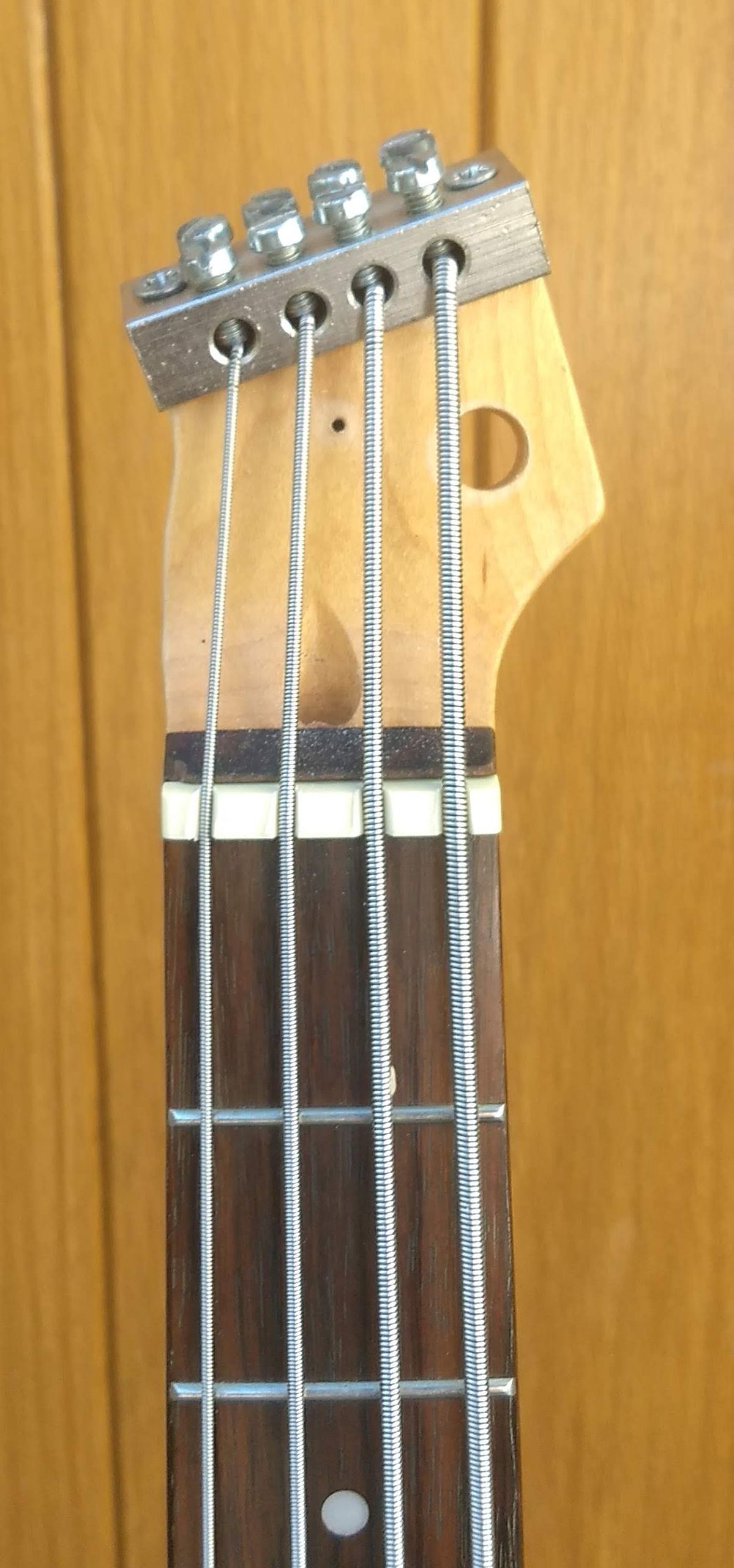
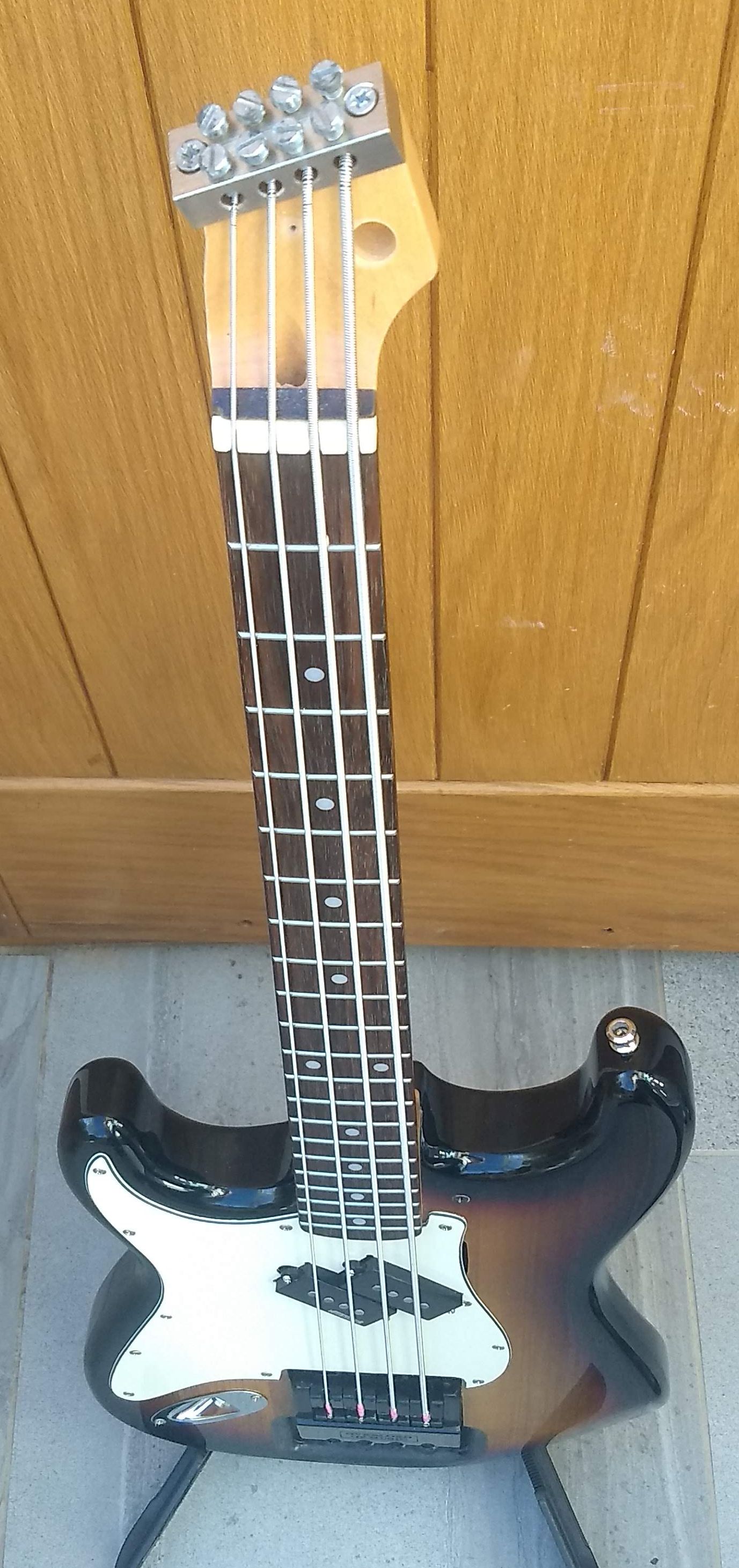
When I discovered that the scale length of a guitar is almost exactly the length of a bass up to the fifth fret, the idea of a guitar-length bass, using the bottom four strings of a 5-string set, made a lot of sense. It would have to be headless (to get rid of the extra length of string), but I’m used to that.
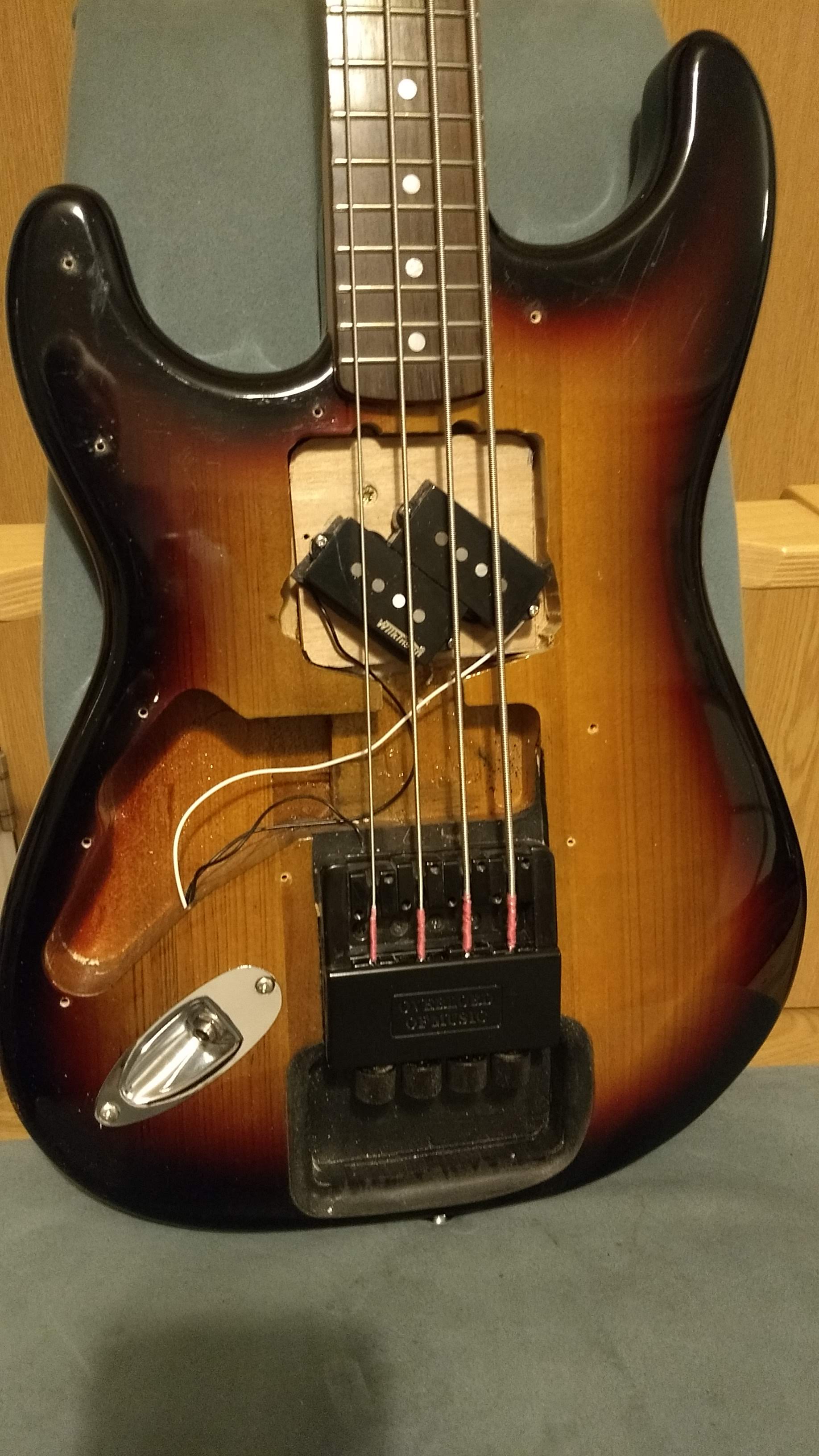
I searched eBay for a suitable victim, but then found a brand-new (though strangely ‘distressed’) Stagg Strat copy in a local shop for a very reasonable price. It was missing a few bits, and has odd tyre-tracks up the back, but was perfect for my project.
There are lots of cheap sets of headless tuners and string clamps on eBay, but NO left-handed ones. Hipshot make a lovely L-H headless head, but that was about twice the total budget, so maybe next time. Modifying a R-H head looked to be too much work for an unsatisfactory outcome, so I bought an earthing block that looks suitably brutal, and works very well.
This is very much an experimental project, and absolutely NOT a showcase for my woodworking skills (or passion for beautiful detailing), but it has scratched an itch, and produced an interesting, very playable instrument, that nearly answers my initial question. All the components were chosen on price – next time I’ll come to BestBassGear and get some quality bits, and take a lot more care with the construction!
I first tried it with a soapbar pickup, but that was a big disappointment; not sure if it was a duff pickup, or some other problem, so I went for a Wilkinson P-bass pickup, in a Vintage Cream blank scratchplate. I don’t like controls on a bass – just getting as much tone out of the instrument, and doing all the EQ on the amp works for me. Unfortunately the routing for the soapbar is just visible beyond the scratchplate, but again – that’s for next time.
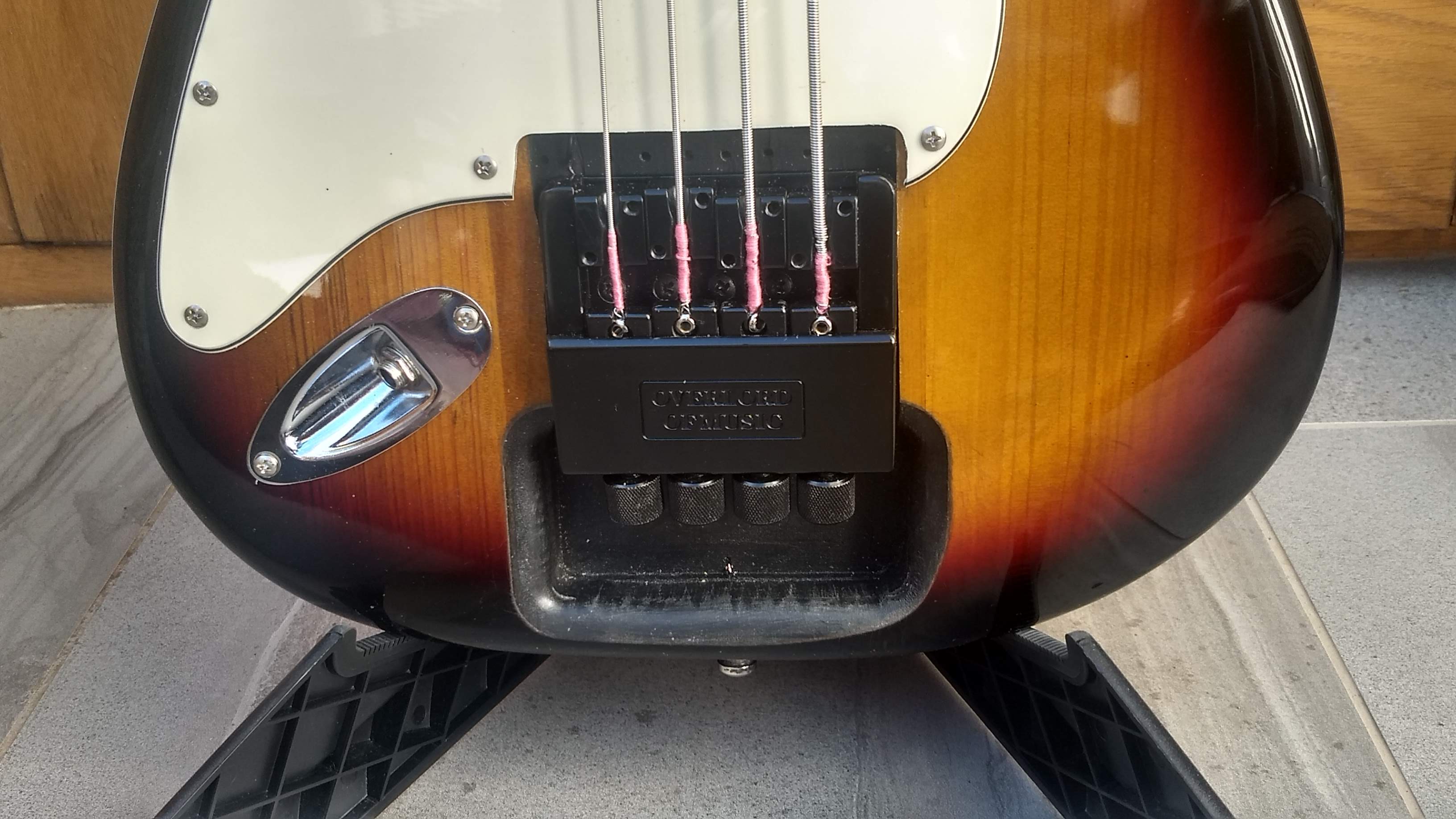
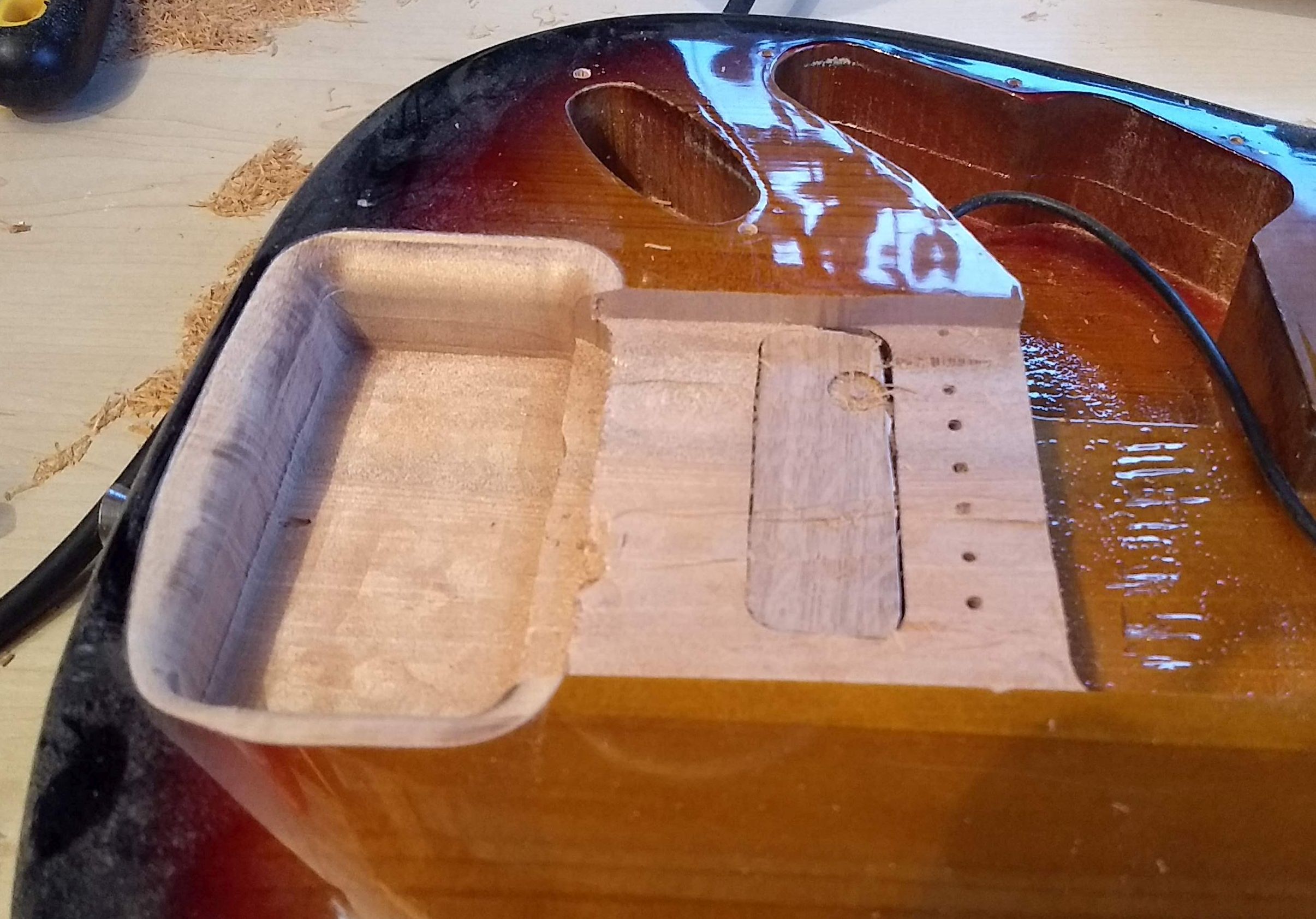
Strat pickups are suspended from the scratchplate, but P-bass pups are mounted into the body – as too much of the body had been routed away, I had to add a block of plywood to take the mounting screws. The Strat bridge also passes through the body – at exactly the place where the new bridge mounting screws should be! A block of oak glued in here solved that problem, though I was rather nervous about it when I had to rout down to to get the bridge at the right level. I also needed to rout out an ‘ashtray’ to give access to the tuning pegs. So far it stays in tune very well.
What does it sound like? It sounds pretty ‘light’ – but so did my other short-scale basses. It has an alder body, which probably doesn’t help. Perhaps Leo got it right, but I’ve got other basses that have a warm, deep sound, so it’s a fun addition.

Well done!
Want YOUR bass to be featured for Bass of the Week?
Submit yours now using our easy web form


Interesting. Sounds like you had fun with this experiment.
I agree with no controls. I’ve had two P-Basses, both without control knobs. Tone and volume come from the fingers.
Ooo, very nice.
Thanks for sharing.
Do you have the length and weight on this bass ?
Thanks for your time.
Please I’m wondering also
It’s 88cm long overall, and weighs 3.5kg, so it should go in the overhead locker on a plane.
Fa veramente schifo. Frankestein al confronto era mister universo!!!
That looked like a fun “prototype.” Hats off to you for sharing. If you make a show piece be sure to share as well.
I’m interested also in the length & weight
Experimentation – check
Interesting features- check
Wacky concept – check
Good work on cracking on down a path of trying out new ideas. Some of the best ideas have come from bucking the conventional so hats off buddy!!
The strings look good, but I thought short scale basses had to have light strings, otherwise the tension wouldn’t be playable? One exception to this are the ‘rubber’ core strings used on the ukele type basses as these are so flexible. So what is the string tension like on this? Thanks.
The tension is exactly the same as a normal bass – it’s just like a 5-string bass with a capo on the 5th fret (and without the top string).
Ian, think of a typical bass. If you play an open G, it’s long and thin. Play that same G on the D string, it’s shorter and fatter. Play that note on the A string, and it’s even shorter and fatter still. Play it on the E string… you get the idea.
The shorter the scale, the thicker the strings need to be. And that’s why short scale basses sometimes don’t give you the tone you might be looking for.
Great proof-of-concept, Jake!