
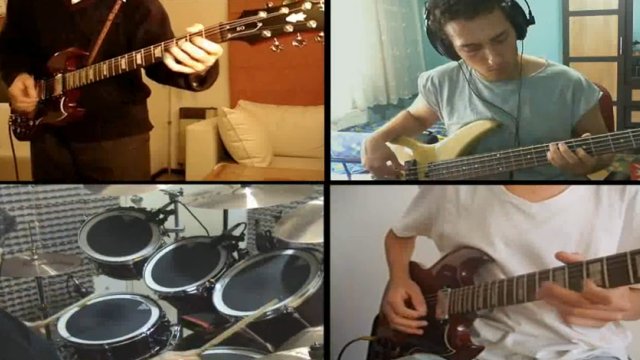
Something the internet brought about that didn’t exist before it is this thing called the virtual band. It’s when a group of people living in different parts of the world put together a song, mix it all down, and you get something like this:
The above is one of the better examples of a virtual band, because most people who try this, said very honestly, fall flat on their faces just for the fact it is so unbelievably difficult to put together.
When it comes to piecing together a song be it a cover or original, the audio really isn’t the hard part. For example, four guys could be using free multi-track audio software like Audacity (which runs on Windows, Mac or Linux) and trade audio sessions back and forth across email, Dropbox, Skydrive or what-have-you and be able to get the job done. With apps like Audacity that will basically run on any computer (even a PC that’s 10 years old!) regardless of operating system, everyone involved can get the stuff necessary to make a virtual band work.
However, where there’s video involved… yikes. Not easy to do. One guy may only have a smartphone to record video with, another may have a camcorder that can do 1080p and the others may have something totally different for audio formats. You have to sync all that with the music, and it’s not nearly as easy to do collaborative video editing as it is audio editing just for the fact the sheer size of the video edit session is so large, combined with the fact the many are under bandwidth caps by their ISP these days.
Virtual bands are something that never quite took off. There are exceptions to the rule, but generally speaking, virtual bands usually aren’t that popular. People did the virtual band thing “just because they could” because it was something new and interesting. However, given how much effort it takes to put together a “collab” song – especially when there’s video involved – you don’t see too many videos like the above these days.
If interested in doing a collab project song with friends, stick to just audio
Performing a collab song is fun, no question, but very time consuming as noted above. It’s also something that is decidedly nerdy, meaning that every single person who participates must have at least basic knowledge of how to create audio tracks that can be edited in and match up with the beats-per-minute the session is set to, and also know how to do basic digital audio mastering besides which.
Beginners to collab tracks almost always make the mistake of encoding audio files as MP3 and not an uncompressed format such as WAV. In an audio editor this can be hell because the compression of an MP3 file regardless of quality can put the timing of the track off by as much as a tenth of a second. It’s like I said, doing collab tracks is a nerdy thing. No, I’m not saying it’s a bad thing, but rather something where knowledge of how digital audio multi-tracking works is required in order to actually get it done. (And for those wondering if there’s a huge learning curve to that, the answer is no, there’s not, but the point is that it is something that must be learned.)
Also remember that collab tracks should be seen as a just-for-fun thing. If you approach it with the “I’m going to be in a serious band” attitude, your collab song will never get done. Have fun first and always.
Do you think virtual bands can still work today? Can you cite any examples of virtual bands that are successful? Let us know by posting a comment or two.


It will work one day, only when people can jam together in real time from different parts of the world. Solve the latency problem and then we’ll have real virtual bands.
Ninjam from Cockos (who make Reaper, which deserves to be mentioned whenever Audacity comes up) has another approach: “The NINJAM client records and streams synchronized intervals of music between participants. Just as the interval finishes recording, it begins playing on everyone else’s client. So when you play through an interval, you’re playing along with the previous interval of everybody else, and they’re playing along with your previous interval.”
With respect to fixing the latency problem — the largest issue you run into is the speed of light itself…you just really can’t get a signal from SF to Boston fast enough to not have a drummer notice the lag, unfortunately. Let’s not even think of the US to Japan for example.
That being said, this article doesn’t paint a pretty picture of the youtube music collaboration scene! As long as one person in the group knows the basic of audio mixing / editing, things can come out pretty well. But as the article puts it, no one in the group should take it too seriously.
I mix for such a virtual band (and also play bass in it occasionally — mostly covers from Japanese bands): https://www.youtube.com/user/CollaboDaisakusen
I’ve also played bass in other things like this: https://www.youtube.com/watch?v=Ginfs4TY0oo
more than 100 audio tracks played by 12 musicians from around the globe (France, US, Canada, Sweden, etc).
So I want to say such projects don’t need to just be “novel” for the sake of “novelty”, but this really opens up venues to play music at a larger scale than one would normally get a chance too (i.e. when’s the last time you got to play with a (virtual) symphony??) 😀
Just my thoughts!
Question: Are virtual bands a band idea?
Answer: No. Look at Gorillaz