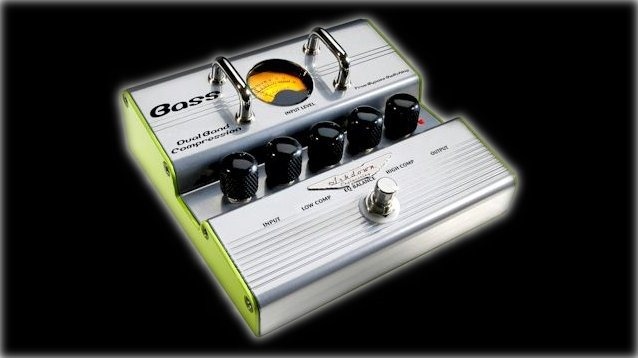
In BBG’s pedal lineup is the Ashdown Dual Band Compression pedal for bass. Looks cool and sounds great…
…but what exactly is dual-band compression and why would you want it?
Dual-band compression for bass splits the incoming signal is split into two bands, low frequency and high frequency, runs each through separate compressor circuits, combines them back into a mono signal, and then sends the output.
In a single-band compressor, there are times when a portion of the signal will get “squashed”. Either the low frequency will be cut out or the high frequency depending on how you play (which I’ll talk about more in a moment). And no matter how you tweak your signal, be it from the bass itself or the pedal, you hear certain parts of the signal getting the squash and there’s nothing you can do about it.
Note before continuing: Partial signal squash due to compression will be something very obvious to your ear, and it’s important to point out that not all players who use compression have this issue. If your signal sounds fine to your ear when compressed, then nothing is wrong. If on the other hand you definitely hear a signal problem when your signal is compressed, then it may be time to change over to a dual-band compressor.
What dual-band compression does is takes the peaks of the separated high and low, combines that, and then delivers back a more even sound. Better dual-band compressors like Ashdown’s offering let you manually adjust how much low and how much high actually comes through.
What type of player benefits most from dual-band compression?
Percussive and slap players. When you tap or slap, single-band compression will at times squash “the wrong part” of the signal as far as your ear is concerned. Either you’ll hear way too much of the tap/slap strike, or way too much of the boom. Dual-band compression allows you to easily tweak that so you and turn up or down the tap/slap or boom.
Unless you use a lot of ghost notes, those who aren’t percussive or slap players probably won’t find much use for dual-band compression and are better off with single-band to “smooth out” the signal so every note is heard better.
I’d like to see a demo of this in action, i’m not a slap player but do play percussively
man this is great how can i get one
This reminds me a bit of Chris Squire wiring his Rickenbacker in stereo, so he could run different effects on each pickup, and run his signal through a bass amp and a guitar amp, and blend the tone after, giving him a very crisp higher range. Hmmm Are there two outputs, or is it doing all the work inside, like a balanced cable?