See the business listing for this bass builder here
This week’s entry that arrived in the featureme@bestbassgear.com inbox shows that even a tree that was downed due to the forces of nature can still be used to make some amazing stuff. It also shows that for certain woods, you have to allow plenty of time to dry before using it.
John writes:
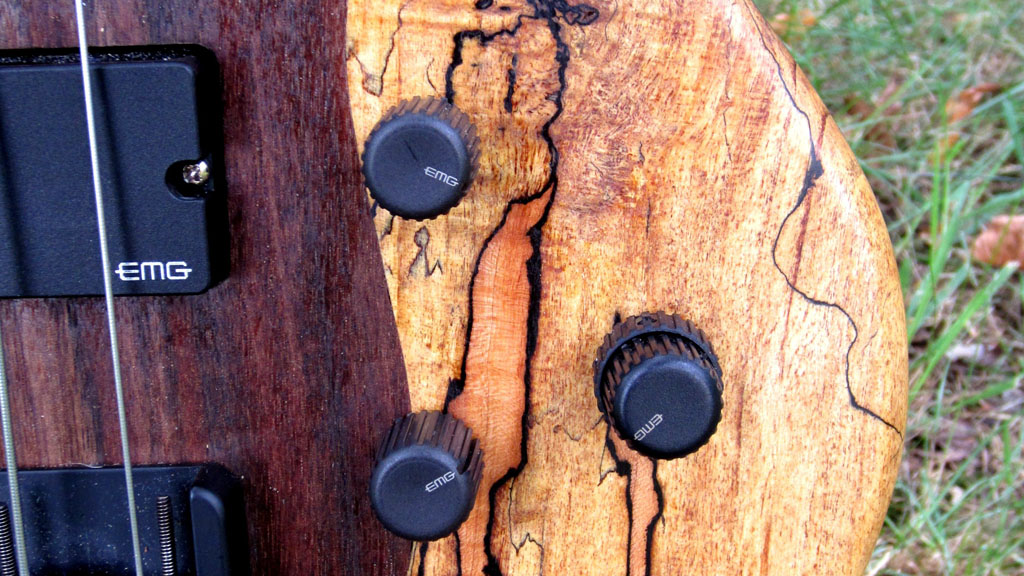
I am an avid mountain biker and while riding in a nature preserve named Case Mountain near my house I found a large maple tree that had been split in half during a hurricane. There were several pieces that had broken away from the main trunk and I was amazed to see that the hunks of maple laying on the ground were spalted. Over the next few weeks I came back and filled my backpack with as many pieces as I could carry.
I let the pieces dry for about a year then when I was ready to start this build I went through them and pulled out the best ones. None of them were big enough for a complete front, so I decided now was a good time to learn how to do inlays and I created a ying/yang kind of design using the splated maple and the black walnut body wood. Its a fretless with a cocobolo fingerboard with anigre filling in the slots. It has EMG pickups, EMG BQ preamp and a Hotshot through body bridge.
It sounds great, with a lot of depth and plenty of punch, which is surprising to most people who see it and expect that its going to have a mellow tone because its a fretless.


Well done, John!
Want to get featured for Bass of the Week? Send a few photos and a story of your build to featureme@bestbassgear.com.
awesome work!
NICE.
Case Mountain – like in Glastonbury?
yes, In Glastonbury/Manchester
Beautifully done! Love it! 🙂
That is gorgeous!
Now that’s art.
Nice work
Great Work! What strings brands and gauges do you use – and why?
I honestly don’t remember what kind they are – I do know there were not many choices, long scale, five strings, flat wound.
The look like the D’Addario XL chromes I have on 2 of my basses from the thread colour.
That’s beautifull nice1 John!
Very pretty bass. Great idea to combine different coloured woods even on the neck. How did you get the curves between the 2 pieces of wood? Chisel?
I used a router on the walnut first and fine tuned the maple with a drum sander. It took a long time to get those joints just right. I was really anal about not having gaps.
Beautiful woods.Nice work.I wish some of my builds could come out that good.You got lucky finding the maple!!