
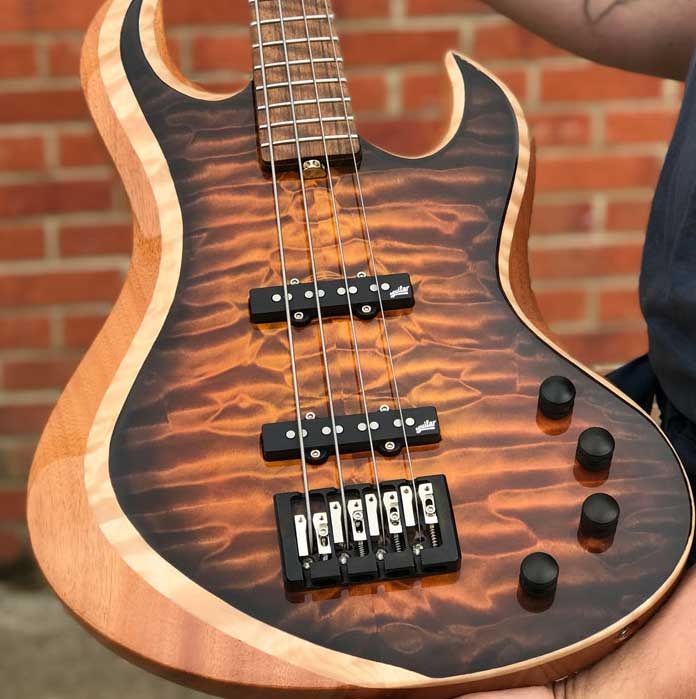
 Photo courtesy of Tim Patterson
Truss rods on many vintage basses use what is called a “cross screw” nut. This includes many early Fenders, as well as some reproduction vintage basses. The problem with the cross screw nut is that making even small adjustments to the truss rod require removing the bass’ neck.
Now most modern guitars and basses make use of hex drive nuts, which allows for easier adjustments without having to remove the neck.
The truss rod of your bass needs adjusted from time to time in order to maintain the correct bow in the neck.
Too much relief and your strings will sit too close to the fretboard, causing fret buzz. Too much of a back-bow will have your strings too far away from the frets, making playing more difficult.
The ideal bow will make every note on your bass clean and playable.
The exact bow you are looking for in your bass’ neck often comes down to personal preference, with many players choosing to go with an almost straight neck with just a little “relief” in the neck.
When you have the neck off it never hurts to remove the nut and put a touch of Vaseline on the threads for lubrication. Time can do a number on those threads, and an ounce of prevention is worth a pound of cure.
Also, the strings can become a bit of a mess, getting wrapped around the head when you are taking off the neck. Save yourself the hassle by loosen each string a bit and placing a capo on the first fret to maintain enough tension to keep everything in place.
When making any adjustments in your truss rod you want to work slowly, and carefully. Make your adjustments in small increments and then test the results. You shouldn’t be turning the screw more than 1/8 of a revolution at a time.
If you hear any cracking, or for any reason are feeling uncomfortable, stop and take your bass to a local tech. The last thing you want to do is damage your neck or truss rod.
Remember the trusty “righty-tighty, left-loosey.” If your bass is too far back-bowed you’ll need to tighten the trust rod by turning right. If your bass is front-bowed it is too tight and you’ll need to provide relief, making it looser by turning left.
You must also be careful when making adjustments not to damage the cross-screw. A stripped screw will make it impossible for you to make adjustments to your trust rod.
 CruzTOOLS makes a pair of rod drivers specifically for making these adjustments in vintage guitars and basses – Including a special “cheater” rod driver enabling you to make very small adjustments without having to remove your neck.
The cheater rod driver shouldn’t be your go-to tool for neck adjustments, but for a tiny correction in a pinch it should get the job done without having to go through the process of removing your vintage bass’ neck.
Both the CruzTOOLS Standard Rod Driver and Cheater Rod Driver are available for order from Best Bass Gear.


Good article. However, most of the vintage Fenders can be adjusted without having to remove the neck, especially any pre-CBS jazz or precision. They have a slight digout where the neck joins the body giving you enough room to adjust most minor problems without having to remove the neck. There is also usually a difference between the bow in a fretless neck and a fretted one. My 64 jazz had the frets removed in 1976 and replaced in the late 80s. There was virtually no bow when it was fretless.
I pay $ 40 to have a professional luhtier setup my guitars, I assume bass would be about the same. How long depends on their back log. It usually takes about 3 5 days before I get mine back but this guy is very good and stays very busy. The GC’s where I live don’t do any setup, I assumed none of them do but could be wrong.
Just wanted to point out that it is not the fact that modern basses use hex head screws, which makes it so you don’t have to remove the neck. It is the placement of the adjustment head of the truss rod itself — near the headstock or at the base of the neck. Most modern basses place it near the headstock and use hex screws, but the those two are not really dependent on one another.
Please forgive me for my ignorance,but why do they make it such pain to adjust your bass guitar? I am new to bass and I find this very annoying.
The Cross head adjustment is historically accurate for Fender basses and Fender style basses. Back in 1951, the Gibson patent on the original truss rod design was still in effect,so Fender had to make a different design for their truss rod. That is why the cross head adjustment at the body end was done.
Just a quickie…
If a neck is back-bowed, the truss rod is already too tight and needs to the tension lessened, not tightened. You folks wrote those directions reversed. Thought it might be important for those who might not understand tue internal mechanics of the system. Love the site, thank you for all the hard work!
i second this comment…. “If a neck is back-bowed, the truss rod is already too tight and needs to the tension lessened, not tightened. You folks wrote those directions reversed.”
I have a custom made bass and a Geddy Lee Signature both have this style of neck. Rather than having to remove the neck for every adjustment, a small route with a Router and some beveling with a Dremel gives you perfect access to the truss rod nut to make all your adjustments.
I’ve always been told not to use vaseline on the truss rod nut, it over time it can soften the wood around it. I’ve already had one Fender with this type of nut where the truss rod maxed out.
I wouldn’t use vaseline. a synthetic grease would be better, as it doesn’t dissipate or thin out due to heat, like a petroleum based product will.
Good point about the Vaseline!
The other bonus of using a proper grease like a Moly, Lithium, or one of the synthetics, is their high shear strength. These greases have a mollecule that will withstand very high pressures before shearing apart and allowing metal to metal contact. Petroleum jelly is not designed for this type of use.