
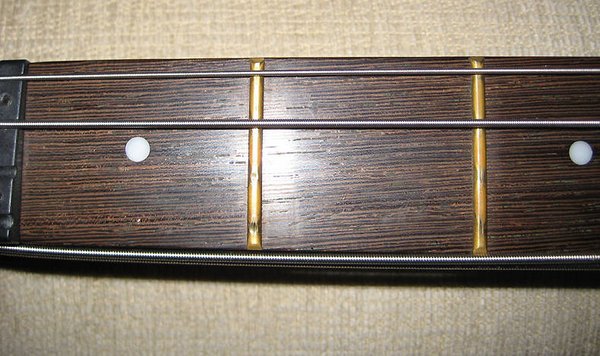
When frets wear down on a bass guitar neck and you’ve decided to keep the instrument fretted (as opposed to converting it to a fretless), you basically have two options. a) You can have your frets leveled and re-crowned or b) Have it refretted.
This is what’s involved with each:
Fret Leveling/Recrown
This is traditionally a three-part job.
A fret leveling simply means your frets are all made the same height. Since the frets which are worn down are physically lower than the others which aren’t worn down, the ones that aren’t worn down are filed to suit. That’s the first part of the job.
Second, after the fret leveling, there will be frets that end up having flat areas on top of them, so they are recrowned, which literally means to round off the tops.
Third, the frets are all polished to give them a uniform look.
Refret
The old frets are removed and new ones are installed.
Which one truly saves you money and hassle in the long run?
The refret is actually most cost effective, but only if you do it in a specific way. But before I explain why that is, the drawback of a fret leveling and recrown is that in the long run you’re actually spending more money.
Any bass guitar that has its frets worn down can only be leveled/recrowned probably about 3 times. Maybe 5 if you’re lucky. But after that, the entire neck needs to be refretted, and that’s major money. And if you’re wondering why you would keep going back to get the neck leveled/crowned again and again, it’s because each time you do it, you’re having the frets lowered, meaning they’ll wear out faster.
There’s this belief that when you go to refret, all the frets must be done. Not necessary. It’s probably true that the only frets that are worn down are the first 9, or possibly even just the first 5. That being the case, only replace those frets.
“But won’t that end up having my bass looking weird with shiny frets on one side and worn-looking frets on the other?”
No. Any luthier that does this job (good ones, anyway) will install the new frets where you specify, polish those and then polish every fret on the board so they all have a uniform look. In other words, every fret will look new even though only the first few of them were replaced.
If you examine this on a per-fret cost, you actually save money by having a partial refret done, and it will make your fretted neck last a whole lot longer.
Consider it this way: If a bass starts showing fret wear after 10 years of play, having a partial refret means it will be 10 more years before you have to have the job done again. But if you do the leveling/recrown job instead, that 10 years can be cut in half to 5 years before you need another leveling/recrowning.
The best advice you can take from this is that refretting has never meant “do the entire neck”. You can get a partial refret done; it doesn’t hit the wallet hard at all; you can afford it. In the long run, a partial refret makes your fretted neck last longer and also makes for a better-playing instrument.
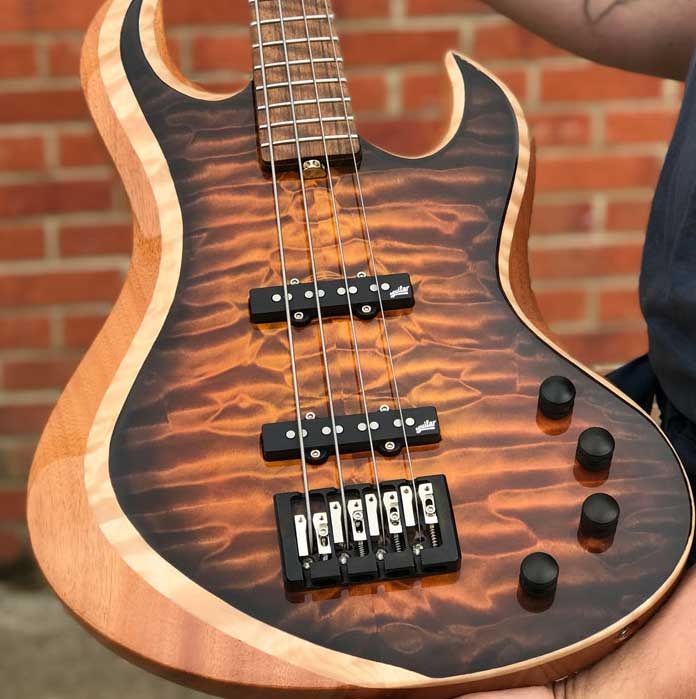


I have a Fender P-bass with some worn frets, and to be honest, I’ve decided that rather than having the frets done, or buying the tools to do them myself, I’m just going to replace the neck with one of the replacements they sell on Stewmac, and then just keep the original neck to have it around so I still have the original one. The main reason for this is because on my particular Japanese P-bass, the truss rod adjustment is on the bottom, and I can’t stand having to loosen the strings and pull off the neck every time it needs an adjustment. It’s also pretty cost effective, because for around the price of having it all done professionally, or buying all the tools to do it myself, I can just get a new neck and tuners and start fresh.
You will still have to set up the new neck.