
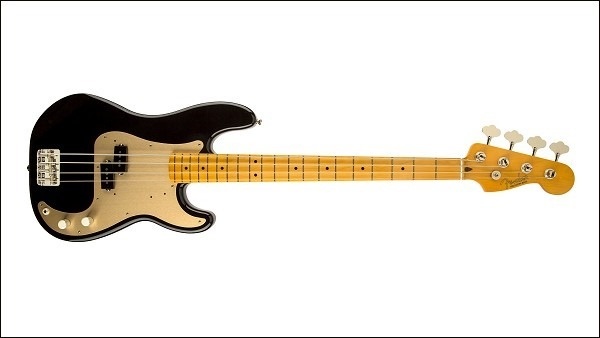
It is routine that some will argue the point that an electric bass only needs 4 strings and no more than that.
What does a 4-string player do to hit the lower notes of a 5-string? Tune from EADG to BEAD.
Are there are potential problems with BEAD tuning on a 4-string?
Not so much problems but rather minor inconveniences.
The “floppy 4”
The 3, 2 and 1 usually have no issues being tuned down, but that darned 4 can be a problem. The cure for this is switching to a D’Addario Balanced Tension set, or alternatively use flatwound strings as they have greater tension compared to roundwound and can handle BEAD tuning easily on a standard long scale bass.
Not sure which strings to get? We have a good selection.
Having to readjust the truss rod (maybe)
The loss of tension across the board by tuning down from EADG to BEAD may require a truss rod adjustment to compensate for it. How will you know if you need the adjustment? If you encounter fret buzz that wasn’t there before after having your bass in BEAD tuning for a few hours, the neck has bowed slightly from where it was in EADG. You can either tune back up to EADG and wait for the wood to adjust again, or perform a small truss rod adjustment.
Note: You may not have to do this at all. Some necks can go from EADG to BEAD and play just the same with no new fret buzz, while others bow slightly and do need an adjustment. The only way you will know if yours requires rod adjustment or not when detuning to BEAD is to just do it and see what happens.
Should you have a separate 4-string bass just for BEAD?
This is where the argument for a 5-string bass comes in.
A 5-string player never has to switch basses to go from EADG to BEAD since everything is already present on the instrument.
A 4-string player however will either have to detune or pick up a separate 4-string that’s already tuned to BEAD.
If you are a dedicated 4-string player that just can’t get comfortable with the 5 no matter what, but at the same time really like the BEAD tuning on occasion, then yes it might be a good idea to have a dedicated BEAD-tuned 4-string.
The main advantage of having a 4-string with dedicated BEAD tuning is that it will sound and feel right whenever you pick it up. The saddles, truss rod and string tension will be correct because all the setup has already been done, by you, to be BEAD-specific.
BEAD tuning sounds good, and you should try it
There’s obviously nothing wrong with EADG tuning, but playing in BEAD does sound really good from time to time.
Have you tried BEAD tuning on your 4-string?
How was your experience? Good? Great? Bad? Awful? Make sure to state the make/model of your bass in your comment so others know what works on which bass.


I find that a slim 4 string neck is VERY comfortable so I use the D-tuner and when that isn’t low enough depending on how quick the passage is I use a 5th interval on the E & A strings. For example: when playing a C#, I just combine that note played on the A string with its 5th on the E string, G#. Variables such as string type and amplifier come into play obviously but it can easily be done to get your point across musically.
Sounds like Gollum just died inside my bass! Think I’ll stick with EADG.
Awe dude! Think of what Peter Steele would say! And Good ol’ Gezzer!
Bead is a Righteous and heavy way to play! It’s what BASS is all about!
I tend to play really hard- meaning; I didn’t have an amp coming up- so I had to hammer the strings to hear it. Playing the strings softly- with the volume cranked- sounds really warm. To each his own n all. Maybe give it another spin? Best of luck either way!
Maybe I didn’t read the article correctly, but easiest would be to buy a 5 string set and save the high g string for when you break it on another bass.
That’s what I do and I *LOVE* the deeper notes!
Did you buy a new nut that fits BEAD and cut off the G?
Or did you make the slots wider to fit the lower strings?
I’m surprised you are recommending tuning down. Much better to get a 120 gauge string, put it where the E goes, and move everything over. You’ll have to widen the nut slots, but the strings and the neck will be at the right tension, and the strings will behave and sound much better.
I first started to play bass on a four string but could not get used to the narrower string spacing of the 5 string. After playing guitar for a couple of weeks (super narrow string spacing) it was no trouble to get used to a 5 string. Now when I play a four string I loose a lot of speed because of the distance my fingers have to travel to get from one string to the next on a four string. So for me it’s all about your ability to get comfortable with reduced string spacing. If I would still be playing a 4 string, I’d most likely have all strings tuned down a step. Not just the E to D. try it out, you might like it and have the best of both worlds
Been using BEAD for years. Along with balanced tension, a great setup and tapered strings on rge B and E help too.
I also like DGCF. A drop tuner can turn the D into a C
A very interesting idea! However, instead of tuning down to BEAD, wouldn’t it be better to use dedicated B, E, A and D strings? OK, this would need a new nut cutting but it would eliminate string tension problems.
Exactly.
I have a Kubicki that I’ve struck with flat wound four of a 5 string set tuned BEAD- with the d extender I have down to low “A”. I use it all the time in gospel and hip hop settings, it’s fantastic.
Yeah, tried it. lack of string tension was a deal breaker for me. And i missed that G string more than i thought i would
I use a Peavey Grind 35″ scale as BEAD , no sloppiness, cheap and comfortable bass.
I’ve been using DGCF with flatwounds for over 5 years. I love it, and get comments about my bass’s unique sound. I ordered a d-tuner to get a low C. Excited to see how it works out.
I did this last year, but I bought a 5 string set and saved the G. I installed the BEAD on my 2012 American Precision, and the tension was so high it was unbearable… I had a friend tell me that if I ever wanted to get rid of the bass he’d like to tow cars with it. Sounded great though.
Then you didn’t tune it right!
BEAD is L O W E R tension!
Yes but he used much thicker strings, so higher tension was the result.
I converted a standard 4 string to BEAD tuning back in ’94 to use in a NU-metal band I was in. Rather than tuning down a standard 4 string set, I installed the heaviest 4 strings from a 5 string set, 130-105-85-65. Doing it this way retains most of the string tension, eliminating much truss rod adjustment, BUT does require a good bit of intonation and filing out the nut slots, especially the E, now B string slot. In the end it worked out great though!
I use a set built for BEAD. I find that buying a 5-astring set and getting one string i don’t need is cheaper than buying the 4 i do need separately. The only supposed minus is the loss of the top notes but you shouldn’t be playing those anyway; you’re BAS PLAYER!
BEAD only for me on 4 basses. Will never go back.
Me either. I needed the low B for blues, and I got stubby fingers, so a 4 string neck works just fine. Have been doing it for years and have had zero issues.
My friend tried to put low “B” – 135 on his Yamaha 4 string bass and his nut just cracked.
125 B is better.
I played 5 string for a decade and realized that I was severely limited myself with the basses I could play, mainly I wanted to play some vintage fender p basses. I decided I could go without the g but I use the b string heavily, so I tried BEAD with a set of flats on an American standard p bass…..3 years later I’ve never even thought about doing anything other than bead. I own 3 p basses all strung bead and I’m so happy I went down this road. I’ve been through every flatwound string out there and pretty much settled on smaller diameter, medium to high tension strings. The only issues I’ve ever had are usually around fret 12 and up on the b string with certain strings otherwise it works beautifully.
I’ve been using BEAD on all my basses for years and get many compliments on how good my bass sounds. I’ve always bought the five string set and throw the G string away. Who, besides women, needs G-strings?
I had a StingRay set up for BEAD, I had to get a larger saddle to handle the fatter B string, but Ernie Ball sent me one gratis, thanks EBMM!! I used it a little but gave it up once I started playing 5ers regularly.
if you really want some fun- try tuning B-A-D-G. you get the low B and still have the range of a 4 string. you have to work up the neck more than usual. but your range is awesome!
Great post, I would like to try BEAD on a short scale for string I have. I prefer flat-wounds. Does anybody know a brand and model number for me to try? Thanks much.
That is because you need to file down the nut slot a little to accommodate the larger string diameter before tensioning it.
I’ve tried BEAD on a few basses in the past. Results were great sonically but my pour old Ibanez Soundgear bass couldn’t handle the tension (130 on the B) and I ended up with a bent neck. Ended up just buying a 6 string bass to pull out when I need it.
I tuned by bass this way for a long stretch when I was working in clubs in Miami. It was great because the neck was my 74 Jazz neck, not some tight spaced Korea neck. The bass suffered no damage and it sounded fkn great and came in very handy for Reggae and synth range stuff. It threw off my friends who sat in but they landed on their feet just fine. I would do it again in a heartbeat. Easy to readjust your playing for higher stuff. Go for it…
Forgot to add that my bass has a hipshot so the BEAD w/that was awesome. Sometimes I would from it to Low A…Nothing like it…
Another option is to tune to 5ths, Instead of 4ths (cello tune 1 octave lower) Replace E string with Bstring (file nut accordingly).
Tuning is C-G-D-A. Now you have 5 string range on 4 strings. Bit more work for the left hand – great for bass, unless you are fixated on fast arpeggios.
Or getting rid of the high strings entirely … like an earlier poster said, we are BASS players! Had a 3-string built to B-E-A specifications. It has good intonation above the 12th fret on all three strings if I do want high notes.
Weird, I came up with this idea about six months ago. I bought a 5 set and threw away the G. The bass I put them on needed the nut compensated but it’s great. I have a D tuner on my main bass but still like the BE combo for some songs.
I have a 5-string and I rarely use the lowest B and C notes. So, the reason for the 5-string is because I play a lot of box patterns and the B string gives me more choices for positions.
I use it for a long time now and have no problems with the bass 🙂 Feels very cool and sound awesome 🙂
I restrung one of mine with a 5 string set and left off the G string, saved it for the girl friend!
I got an actual five string later and went back,
My ’66 Jazz couldn’t handle the low tension and that resulted in too much work in setting up the neck properly. A Hipshot D-tuner does it ok down to D. Lower would be damaging to the neck
I just bought a few bone nuts………Might switch the nut for bigger gauges! The 5 string set was the same price as the 4 string set! Never had a 5 string but would like to try BEAD!
Every now and then, I’d tune my P Bass to BEAD and I play certain songs with it. When I play with a pick, I get a rubbery/flubbery/gritty sound. I like this sound for certain rock stuff.
I am considering on ordering a custom 5 string bass in the future. I would really want to keep the 34″ length. I could probably do a reversed angled Telecaster headstock design to add more tension to the strings.
I will stick with standard tuning 4 string Bass only because ALL of the songs that I have learned to play have been played on standard tuning 4 string Bass which are old school R&B, Funk, and Smooth Jazz songs. Smooth Jazz Bass players of today use at least 5 string Bass except for a few who stuck with 4 strings only like Marcus Miller, Victor Wooten, Stanley Clarke.
I went BEAD and settled on the Dunlop stainless steel Flatwounds. Good clarity on the B string. But now looking for the best amp cabnet to continue this ongoing project. I was thinking acme, with their excellent low B sound, but they are power hungry, and the speakers can get blown if your not pushing that power thru them all the time. I prefer something that is a bit more versatile, but still emphasizes that low end. I’m looking for 400w or so.
Any thoughts?
Tom
I sold my Fender 5 string and got a PRS Kingfisher that I tune BEAD with the 4 low strings from a 5 string set (GHS Precision Flats). Works great and should on any bass with a proper set up (nut filing, truss rod, string height, intonation and pickup height). I purposefully didn’t use a 35″ scale bass as I had a Ibanez BTB and didn’t care for it.
I started with BEAD tuning, but nowadays prefer C#F#BE. I find that the sound produced lower than C# is too vague to be useable.
I use lighter strings than what BEAD requires, which serves to provide the right tension and more clarity on the lower notes (for example, instead of a 130 low-B string I use a (Fender) 115 … the other strings are 100, 80, 60.)
Low E on a 115, for instance, sounds much more defined than low E on a 130 string.
Finally, I use a system of coloured dots to indicate which notes are which – works well; I never get lost on the fretborard.
I set up an old Dean Edge (Korea with EMGs) for BEAD tuning. The neck was dead on when I started and it I’d still perfect now. I filed the nut and adjusted the string height and intonation. Wanted to try it before converting my Fender Aerodyne. I’ve played the Dean exclusively for the last few months and I’m totally sold. Getting ready to convert my Aerodyne now. You just can’t beat the bottom end and you’ve got the whole neck to play with if you want higher registers. After all, as the other poster commented. We are BASS players. No more sore shoulders or hands from my five string!
I found this forum for the exact reason that I’m considering converting my Fender Aerodyne to B-E-A-D tuning! How did it go with yours? Would you recommend it..? Cheers 🙂
Wow !!!
I toyed with the BEAD set up for years, but never had it done. I’m gonna by a set of Di Addario’s nylon tapewound flats, and go for it. I got picked up on waivers so to speak in an ” old country ” group ” and I know that BEAD set up would be just the thing.
The best decision I ever made on the bass was converting my 4 string to BEAD tuning. It gave me a voice I was seeking forever, but found 🙂 I have an ESP Viper 104 bass with active eq. Though it’s a 34″ long scale, the strings are strung thru the body, requiring super long 35″ strings. I use half rounds D’Addario 5 string set (130,100,080,065 respectively), omitting the G string, of course. I had carefully filed the graphite nut ever so carefully to accommodate the thicker strings, and adjusted the saddles. However, I had to get a B string saddle, and move down the EAD saddles accordingly. The bass has a solid maple set neck, giving it great sustain and intonation; no problems with tension at all!
On a different note, I followed this attempt on a Fender Areodyne Bass to no avail. Though I loved this bass, the increased tension caused the neck to bow often, constantly adjusting the truss rod. I attributed this issue to the bolt on neck design not conducive to the added tension, thus, converting the Areodyne back to it’s natural EADG tuning….and replacing the nut that was filed 🙁
If you want to be on an even deep end, and want to keep playing 4 string….do it!
Rock on
I have had this idea for a year or so, 2 basses simultaneously played. The low end, a 4 string, with proper length scale & sting diameter, tuned B, E, A, D. The 2nd bass, could be short scale, possibly a semi hollow body & or a fretless, tuned A, D, G, C, or D, G, C, F, depending. This could be duplicated with by 1 player using a Looper pedal & octave pedal & fretless synth pedal, but not as cool live as 2 playing the separate parts simultaneously.
My band has two bassists; usually I play low end and the other plays more midrange, I’ve gradually drifted (using 5 string set) down to an ADAD tuning, and it works fine, I’ve been considering dropping even further to tuning in fifths, ie GDAE. Although mostly I want to go at least part~time to electric upright so that I can bow. Has anyone tried bowing an EUB tuned down to low A?
What a great thread, still going on…for years. I tune BEAD for a modern country band I’m in. Those Nashville guys love the B string. I enjoy it, and find BEAD range to be quite adequate. There are plenty of frets when you need higher notes. As a long time bassist, four strings necks just feel more comfortable to me. Absolutely no mechanical issues on my 2011 Fender Jazz with whatever net difference in overall string tension. Had to widen nut slots and do initial setup. I still play EADG on a spare Fender P bass for classic rock work I do, with a hipshot to have low D when needed.
Mark,
This is what I am planning to attempt. I have a Precision Bass that I play all the time and the Jazz Bass just sits in its case. I’m hoping converting the Jazz Bass to BEAD will work.
I’ve just left my bass with a local luthier for setup with BEAD (doing the thing where you buy a 5 string set and save the G string for… ???). I’ve been sitting on the fence about doing this for years. Fingers crossed now I’ll never look back. My hands just aren’t big enough for 5 string, and they’re heavier guitars too.
I bought 2 Fender MIM P-Basses about 3 years ago. I didn’t like the neck on either of them. One had a few dead spots. The other was just dead. So I bought 2 new necks from Warmoth to upgrade them. The improvement was fantastic and I’ve been super happy with both.
Then I changed the tuning on one of them to BEAD because I really wanted that low B string on a 4 string neck. I have to say, it’s freakin awesome!!! I love it!!! I have however struggled with the tone a bit. That B string sort of went back to being dead.
I’ve spent a bunch of time working on it to improve the tone and just couldn’t manage to get the B string to sound as live as the others. Being on the autism spectrum, this kind of took over as an obsession for me. I had an absolute need to understand what was going on. Eventually I learned about scale length and the effect that has on…, well just about everything. If you want a bass tuned in BEAD, and believe me, if you play heavier rock music you do want a BEAD tuned bass, start with a bass that has fanned frets.
Fanned frets take into consideration the different tension requirements for the B string to sound piano like, while allowing the G on your 4 or C string on your 5, to sound as good.
I’m in love with my Dingwall D-Roc!!!
All you need to do is buy the 5 string set and find another use for that un-needed high string.
The tension will be reasonable with only minimal truss rod adjustment. To fully setup the action permanently for BEAD you might need to “widen” the nut saddles and I often have to drill out or ream the tailpiece an ever so slight amount, just to get the B string to go through without wedging. A good rule of thumb for swapping to BEAD on a bass you already like the action on: if the truss rod adjustment is minimal after switching strings you have the string weight right.
I’m considering doing the bead thing . Might take me a few setups and diff gauge strings to get the tension just right . I never really ever use the g string because it doesn’t do much for grooving , maybe ok for some leads , but I leave that to the electric guitars haha .