
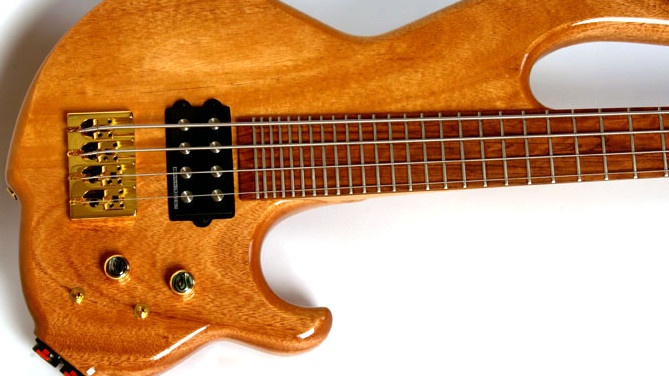
For those who follow Fender as the standard for what a bass guitar should be, the number of frets they use is 20. The number of frets is easy to spot on necks that have fret markers. After the 12th fret, there are 3 single-dot markers that mark where the 15th, 17th and 19th frets are. If there were a fourth dot, that would be fret 21. After that would be another double-dot marker indicating where fret 24 is.
For example, a really easy way to spot a 24-fret bass is just to look at the heel side of the neck. If it’s an adult-size bass with a double-dot inlay at the heel, that’s almost always a 24-fret bass guitar. I say “almost always” because some builders do wacky things with fret inlays. But the general rule of thumb is that if you see the double-dot at the heel, that bass has 24 frets on it.
Do builders of basses that use more than 24 frets mark them on the fretboard? Not usually, and there are two main reasons for this. First, most builders who go beyond 24 frets usually build a 26-fret. Being that is only 2 semitones higher than 24, there is no need to mark those frets as they wouldn’t have to be marked anyway. Second is the issue of space. The more frets there are, the less room there is between frets to put inlays into the fretboard. Some builders get around this by using block-style inlays since they can be “thinned out” easily as you go up the fretboard.
If one wanted to mark frets on many-fret boards, you would treat the 24th fret position as if it were the start of a new neck, meaning single dots would go at the 27th, 29th, 31st positions and so on.
But is it usable?
That is The Big Question concerning many-fret instruments classified as bass guitars.
Bass purists state loudly that no electric bass guitar needs more than 20 frets on it – especially since if you play up high on the fretboard, you’re not playing bass notes anymore.
Bass modernists will take as many frets as you can throw at them. And yes, they will use them. If a high fret cannot be reached when the fret hand is behind the neck, the hand goes over the neck and they will play using tapping. One way or another, that modernist will find a way to use all those high frets, if for no other reason than “just because they’re there.”
So the real Big Question is this:
How many frets do you think are usable?
Do you follow the “Fender 20” rule? Or would you rather have a 26-fret? Or would you just want a long, fretless board so worrying about frets is a non-issue?
Let everyone know what you think by posting a comment below.
Image credit: Conklin Custom Shop 4 String Bass (36 frets!)


Anywhere from 21-24 is good enough for me.
Is a 21 fret bass considered a. Long scale bass?
The scale of a bass is not determined by the numer of frets. Scale is the distance between the bridge and the nut and you could have a short scale bass with 20 frets or a long scale 26 fret bass.
I think it’s unnecessary. Maybe just for bragging rights. Get a guitar instead
It is a guitar.
Their should be no “should”. Whatever works. Some older people can play bass and not standard guitar, and extra frets provide versatility and range. Extra frets are particularly useful if someone is playing solo or jazz bass and is not interested in being part of the rhythm section.
Precisely . Not really sure why anyone would need to play that high on a BASS . . Because it’s A BASS . . Not a guitar
Having more frets on a 4 string bass is like teets on a boar hog. Why would you even do it? Just get a five and restring it, or buy a 6 string and play those notes higher there.
I really do not see the need and for me it would be need. I do not currently need to play those higher notes and therefor do not own a 6 string, though I am sure if I got one, I might start using it.
I play bass to play notes below guitar frequencies, if I wanted to noodle on the high frets I’d take up guitar.
I build with 30 frets in mind. Somewhere around 30 the spacing is the same as the 24th on a guitar. So from a space in between its just as feasible as going to 24 on a guitar. Sound wise its fine. So if it pleases the player then why not. However, if you like room under your plucking hand then having fretboard intrude into that space is a problem. It comes down to bass players are the coolest so give them what they want. We are enjoying the golden age of custom builders and you can easily get 20 frets or 36…. its all good.
I play a conklin 7 string .i would love to have the extra frets for chording….alternate fingerings available since the frets are closer down the neck…i use lighter strings to facilitate the tons staying even….30 it is…with todays pickup options u only need 1 humbucker and some interesting coil switching to vary the tonal spectrum
Optimally 26..I dont feel comfortable on 20 fret basses
I want so many frets on my bass that there’s hardly room for a pickup. I play more notes than anybody else, and therefore I need extra frets. *sigh*
Clearly you are playing too many notes. you aren’t playing the instrument as it should be played
“As it should be played?” I think that’s a personal decision and has to do with style. I’d prefer no one sit in judgment on how many notes I play, which notes I play, or any other darn thing. So long as my playing serves the song, little else matters, and someone else’s opinion matters not at all.
Anthony Jackson has a lot of extra frets on his 6 string contrabass guitar- I’m thinking 28 or perhaps 30 something– no shame in it whatsoever, same as no shame in a 2 string bass. There’s enough room for everyone 😀
Lol. Dolt! What an adenine thing to say. You’re clearly an idiot.
Hey Dolt, you can’t even spell asinine
I like it actually. I see myself as someone who makes music and happens to hold a bass guitar rather than identify myself with what others see as the ‘natural role’ of ‘the bass’. fact is, with a bass you can go low AND high, and very few instruments can make that claim. I also play 4 string exclusively and love to have the extra notes up there.
I dig 24 frets, but I do explore that high up the neck often. I wouldn’t have a beef with more than 24 frets, though.
anything past 18 sounds really crapy to me but then I only have 4 string not an 37 string bass
21 is plenty. Anything above that is jsut for showing off! ;0(
This old chestnut,…. if you want lots of frets, get lots of frets, if you don’t then don’t. Other people’s opinions are irrelevant unless you are very insecure… which in that case, get what everyone else wants you to get.
40 frets is good in 24EDO, which puts quarter tones in between every note. I’ve heard rocking metal in 13, 15 and 17 note octaves – there are worlds of music in between the notes!
Don’t know if anybody remembers, but Fender’s first five string (I think) was tuned up to a C and only had 15 frets. Very limited production as I recall. My main bass now has 24 frets, but I don’t use them that much.
My bass has 10 strings and 28 frets, because I’m not afraid of change.
Seems to me I’d rather add a string, than frets. If at all. As others have said, what’s the function of a bass, typically. That thing just looks goofy, and while looks (for an instrument) isn’t everything, it is part of the feel and inspiration to play many classic basses/guitars. Eliminating space for a ‘neck’ pickup vs having extended range with 4 stg playability as well seems a bad trade off. But, if it’s your ‘thing’ who’s to say it concerns anyone else. Acquired taste I guess, but definitely a fringe market. I just don’t think you’ll see say a Fender jazz 36 fret model anytime soon, lol. .
A standard Fender Jazz Bass has enough room between the end of the fretboard and the top of the front pickup to accommodate an extra 6 or 7 frets. Look at all that empty real estate between the fretboard and pickup. The fingerboard on a double bass goes up well beyond those notes.
No bass player stays up that high for long or they’d pick up a cello (or a piccolo bass) but if an inspired solo takes you up there and you don’t get nose bleeds it’s all good. Sure, in most bands the steady, meat and potatoes money might start fading away the higher you climb above the 7th fret, but there’s more to cuisine than meat and potatoes.
“Anything nature lets you get away with is natural.” – Bucky Fuller
For BEAD stringers having the upper frets can be helpful. A 4 string that is strung BEAD can be used like a short scale (treat the 5th fret as “home” and only move up and down from there as needed).
I cannot say how many frets are perfect, but I never understood why there even are basses with less than 21 frets? (on a 4-string) -Why not complete that third octave? Still… I have a P-bass, a Jazz and a Ric, all one fret short… 🙂
This^
Frets do not limit a bassist, lack of imagination limits a bass-player. Listen to Jaco’s artificial harmonics on the intro to Weather Report’s Birdland.
Do. Or do not. There is no try.
Stevie Wonder’s bass player would have probably loved one more fret on his bass when he recorded “Sir Duke” – I remember him saying that he had to bend the highest note up a semitone to get the highest note of that famous riff…
I prefer exactly 21 frets. (High E on the G string.) E flat isn’t quite high enough to play certain jazz melodies, and 24 fret necks don’t seem to set up as low as I like.
I like 24, but am making more and more 26-fret basses lately.
24 tops, or buy a mandolin.
Im stuck on btb 6 strings…..24 is it for me
I’ll opt for a long, fretless board so worrying about frets is a non-issue…
I personally doubt particularly care for only having 20 frets.I prefer to have at least 24. I’ve used basses with up to 29 frets before. But I’m also the type of bassist that likes to do some subtle ambient stuff higher up on the neck that the 20 fret basses just can’t quite get
I think 22 frets is ideal. That high E at 21 is nice to have because so many popular songs have been played in E or E minor, since guitarists (esp. blues) love E so much. Same for the high F, F is a widely used key. But much beyond that and either the end of the neck is too close to the pickup for best slap&popping, or the neck pickup to moved too far towards the bridge for deep tone. (Or, in the case of my 26-fret Thumb5, a little bit of both.)
I don’t need that high A, and if the high G is needed, can just play it as a harmonic. So 22 frets seems like the best compromise.
I think 22 frets is ideal. That high E at 20 is nice to have because so many popular songs have been played in E or E minor, since guitarists (esp. blues) love E so much. Same for the high F at 21, F is a widely used key. But much beyond that and either the end of the neck is too close to the pickup for best slap&popping, or the neck pickup to moved too far towards the bridge for deep tone. (Or, in the case of my 26-fret Thumb5, a little bit of both.)
I don’t need that high A, and if the high G is needed, can just play it as a harmonic. So 22 frets seems like the best compromise.
(Corrected number from prior post)
There’s really no right answer. Personally, I’m always tempted to use them all, no matter what the number. I will say, however, that I’d prefer treble strings to tiny inter-fret distances for the notes. After all, if it’s okay for the guitarist to play a 7-string in drop G# or whatever crap they want, why shouldn’t a bassist step on their toes for a change? 😛
I think 24 frets is a great compromise, great for playing melody lines.
My 77 P-Bass delivers what I need in 4 string format. When I need Higher/Lower notes I use my Dimension 5 string. But I guess it depends if you’re a guitarist masquerading as a bass player or you are truly like me first and foremost A BASS PLAYER! Fret numbers don’t matter, its your playing that counts ffs!
24’s the sweet number for me! The Dan Armstrong, with a 24 fret short scale is my hot rod. But 22’s cool; the extra frets on the 24 make the distance a little shorter, but I don’t use that high a register often in what I’m playing now (Classic Rock styles).
I love 24 frets. I feel the most comfortable playing on a thin, fast, two octave neck.
I think one string and 12 frets are plenty sufficient. Maybe 11 frets…
4 strings,21 frets E to E. Just seems to make sense
In my opinion, I think all bass players (and musicians in general!) should be open minded to any number of frets and/or strings. Some of these extremist comments saying that people “aren’t real bass players” if you have anything but a Fender P Bass with 4 strings and 20 frets and a stick up your ass sort of make me sad, knowing that there are people out there who actually think that they have the authority to decide if one is a musician or not. So to all the purists out there who refuse to respect someone else’s musicianship just because they’re more open minded of you, try thinking a bit more outside of the box. Who knows, you might have some fun 😉
I have several 4 strings a 5 a 6 a couple of 7s and a 10 string stick strung up standard ascending..low f# on up….24 frets this thing kicks butt it has a dual stacked humbucker(4coils) fully tapped series parallel phasing w/3band eq…
Once you past the 22fret, an extra string is probably easier to play on. Hence 6 and 7 string basses… not that it sounds very “bass-ish” up there. ;o)
Personally I like to have 24. Notes beyond that can be reached by pinch harmonics. However, I dislike basses that have the extra frets, but don’t have a sufficient cutaway to actually reach them.
To each his own but I doubt you are holding the pocket at that point.
Wanna Bet???? Respek my Bass Gangstah….lol
I have a BASSLINE Buster-4 headless Bass with 24 frets. It´s nice to have, but not realy useable. I think that 22 frets are enough
Depends what you feel like doing with it. There are many jam bands out there with bassists that do some shred soloing as well as classic low end bassline things and slaps. There’s nothing wrong with variety and expanding on bass creativity. I’ve got a 7 string 24 fret and i give every string and fret the same amount of love
Eight.
Ask Les Claypool when he’s playing “Jerry was a racecar driver”
I always felt the 20 was sufficient and played happily with that even when playing the 21 or 22 – never really ventured in the further direction unless a little excessive Coda doodle at the end of passionate piece – until I came across a Tobias 4 String 24 Fred neck with Body designed perfectly for ease of access – And I am old school but love it, I find the start frets to be somewhat levelled and a lovely positioning in 4 bar stretch even all a lovely sound and ease and it give that little adventure as and only if you so desire – so really as music is meant to be – Very enjoyable and Fun to have the option in any style and variant you want to venture into – Music is for discovery and pleasure
I have a few 24 fret basses and find the high G useful.
20 is OK but 21 with the high E is better.
Only because I boringly play in Em….
I play Fretless so don’t have any views on frets