
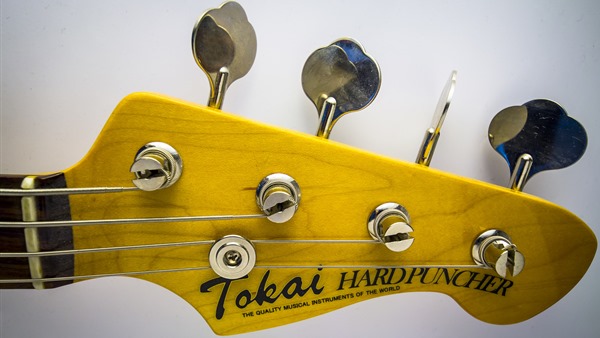
(Tokai Hard Puncher bass shown because we hardly see these things anymore. Got one? Submit it for bass of the week if it’s in good shape. Trust us, they sound pretty darned good.)
Installing a new set of bass strings is not an exact science, however it is amazing how many players do not know what you’re about to read below. So before you say, “How to string up a bass was the first thing I learned!”, others don’t have the benefit of that knowledge and have been guessing the whole time how much string to clip on a string change.
The majority of bass tuning posts have open slots on the top, and at first glance, this can be confusing with new strings, because how much should you clip – especially if there are silk-wrapped ends?
It’s actually easy if you know the “two-peg” measuring method. When using strings with silk-wrapped ends, the goal here is to try and make them line up as close as you can like this:
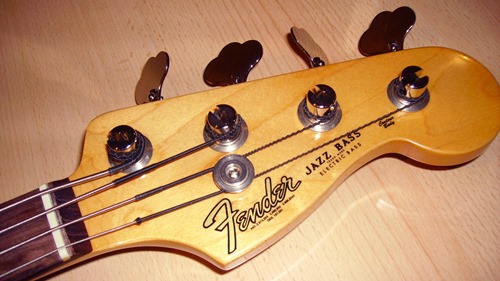
Note before continuing: These instructions assume you have a standard 34-inch scale length Fender-style (whether made by Fender or not) bass guitar, it’s a 4-string bass, and the strings used are roundwound or flatwound.
For the 4 string (low E)
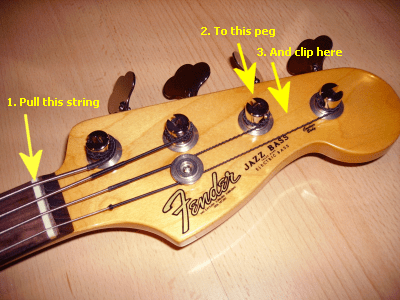
Put string through bridge as you normally would
Pull up to 2-string peg (2 pegs after 4-string peg)
Clip string after peg
Wind up normally in the 4-string tuner
For the 3 string (A)
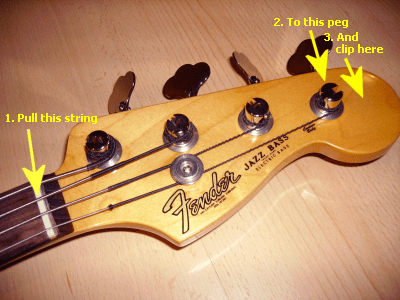
Put string through bridge as you normally would
Pull up to 1-string peg (2 pegs after 3-string peg)
Clip string after peg
Wind up normally in the 3-string tuner
For the 2 string (D)

Put string through bridge as you normally would
Pull up to 2-string peg, wrap around back to 4-string peg
Clip string after peg
Wind up normally in the 2-string tuner
Why wrap around? Because there is only 1 peg after the 2-string peg position. To compensate for that, you pull up to the 2-string peg, “wrap back” 2 pegs to the 4-string peg to get your 2-peg measurement, then clip the string there.
For the 1 string (G)

Put string through bridge as you normally would
Pull up to 1-string peg, wrap around back to 3-string peg
Clip string after peg
Wind up normally in the 1-string tuner
The same applies here just like the 2 string. There are no pegs to count forward, so you wrap 2 pegs back to the 3-string peg and clip there.
Is there any chance of overwrap or underwrap?
If it’s a standard 34-inch scale Fender style headstock, no.
You will typically get 2 to 3 wraps around the tuning post. If using strings with silk-wrapped ends, those ends should line up nicely on the headstock when tuned to pitch.


what about ibanez atk300?
It’s best to give a 90 degree bend about 5/16 from the cut before doing so. This helps to keeps the core and windings intact.
Oh shit that’s good advice thank you
I didn’t do it this time but I think I got lucky but I’ll be sure to do that from now on
I just use a ruler, I know I need about 3 inches (7 centimeters) of excess string. Ibanez taught me that in their manuals.
Thanks. Been doing on the fly for 20 years. Now I know.
2×2, 4in a row, 5 string + or any scale; pull string straight to peg, grab at first fret and slide up two frets. where the silk wind is at the peg now … cut there. stuff end in the hole, bend out the slot side to the nut, wrap around the back side and start turning the key. the string should wrap around the peg spiraling downward pushing the string down on the nut. tune.
Do you know to wind the string down on the tuning peg to get optimum sustain?
Wind down the peg, looks like the A string in the pic is wound up. This string is very important to get it right, it needs to be wound down as the windings hold it down so there is a break at the nut to get better intonation.
Nice article. One minor thing, though. No matter how you clip the strings, the silk wrappings will line up because the distance from the ball-end to the silk doesn’t change.
Some non-Fender basses with Fender-shaped headstocks use the smaller diameter tuning posts. Basses with the smaller diameter posts (3/8″ vs 1/2″) this may be too much string. If you aren’t sure, take one of the old strings (the one on the peg farthest from the nut), snip the curly part off and do a test winding to see how much will fit. Then, uncoil the end and see how much you need to keep.
I use the 3 inch for smaller pegs and 4 inches for the bigger fender style pegs. From the middle of the peg I measure 3 or 4 inches of excess, cut and wind.
This is the same method I have always used just out of trial and error. When I get to the D and G strings I just eyeball 2 inches. That is about the distance between 2 tuners. Never used the wraparound method.
I don’t change my strings
I just use my index finger if it is a small post( like a all in line 5 string jazz) or tip of the index finger to thumb for a standard tuning machine.