

I came across the thread If someone handed you $3000 for a new bass, which poses the question that if someone handed you a pile of money that was specifically to be put towards a bass guitar and nothing else, what would you get?
The answers seen in the linked thread above are interesting because what players would do with an opportunity like that go all over the place. Some would go for a Dingwall, some would go straight to Fender Custom Shop, some would go for G&L, and there are a few who would go with no pre-built bass at all and buy the woods and parts they always wanted to make “the ultimate build,” so to speak.
In the thread is also mention that $3,000 is not enough to get “that bass” they want…
…and it’s here where I make mention of the real difference between a mass-produced bass and one custom built by a luthier.
To note: When I say “mass-produced,” I’m specifically talking about the stuff you see all the time in guitar stores. Fender, Squier, Jackson, Gibson, Epiphone, Schecter, ESP, LTD and so on.
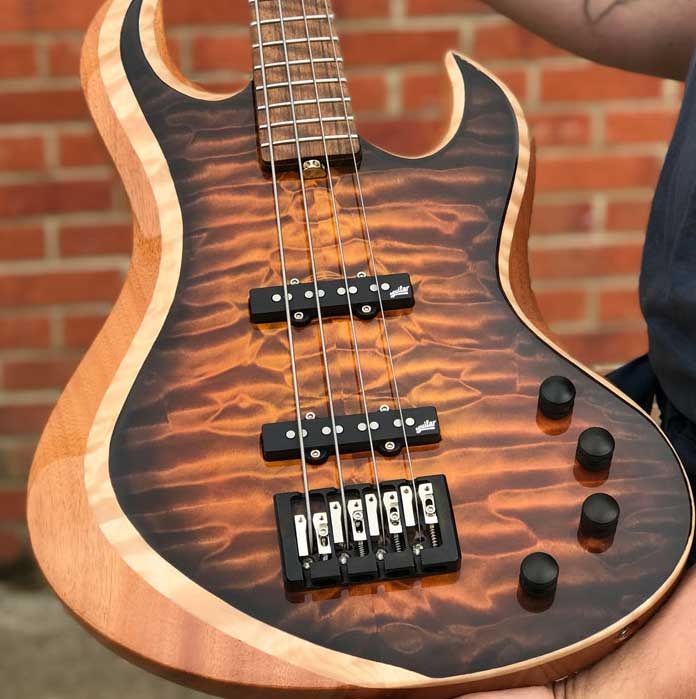
When you have a bass custom built by a luthier, $3,000 is usually the starting price. It’s not out of the question that all parts included for the bass will total $1,000 and the luthier’s cost for labor will be $2,000.
Some upon read of the above think that’s a total rip-off. Well, it isn’t, because what you’re paying for with a custom build isn’t the bass but rather the luthier’s time and craftsmanship.
I’ll put it this way:
If you were to build an entire bass yourself, which includes cutting and shaping the wood from scratch, doing all the routing and so on, then adding in some high-quality electronics like Delano pickups and/or a Mike Pope preamp, you’ll quickly realize that it’s real easy to spend a lot in a short period of time. You’ll also quickly realize it takes a good amount of time to construct the bass and make it all work. And on top of that, you learn fast that those who do know how to construct basses properly are totally worth spending money on.
That’s when you realize paying a luthier $2,000 for a custom build with a $1,000 cost on top of that for parts and electronics is a bargain. The luthier has the proper tools, workshop and expertise while you don’t, and that’s what you’re paying for. And that’s why $3,000 is for all intents and purposes a starting price for a from-scratch custom build.
Sure, there are ways to get a custom build cost down. You could, for example, hand a luthier a brand new Made-in-Mexico Fender Standard Jazz Bass (which has a current street price new of $600 by the way) along with $300 worth of upgrade parts, instruct the luthier to a fret leveling, then installation of parts and setup, and he won’t charge you nearly as much as a from-scratch custom build would…
…but is that a custom build at that point? Not really, because the bass is already made. What the luthier is doing for you is fixing from-factory flaws, installing parts and not much else.
Real-deal custom luthier builds, simply put, are not cheap. And there’s really no way to make them cheap.
In other words, what I’m saying is to not confuse a mass-produced guitar’s price point with a luthier build price point, because both are two totally different types of purchases.
With an expensive mass-produced guitar, all you’re buying is a product. You have no idea who built it, nor do you really care. For 3k you can currently buy two Fender American Standard Jazz Bass guitars plus hardshell cases for each.
With a luthier build, you know exactly who is building the guitar. And at the end of it all, what you receive is the instrument. Just the instrument. But what you bought wasn’t the instrument exclusively, but also the time and effort it took to put that bass together. You’re buying something that was crafted just for you.
And if you can’t see the difference between mass-produced and luthier-built, well, my suggestion is to get to know a luthier, because he can build it better than anything you can buy in the guitar store.
Image Credit: StGeorgeUtah.com


I was recently handed my tax return — $3,350.
I bought a 1976 Fretless Fender Precision with a maple neck.
what you buy is the error learning curve of the luthier, and his magic. Pierre Laporte’s neck intonation is the best I’ve seen ever. You can strike an 14th fret A and the harmonic on the A string, and there is not a wave. This guy is a genius, and that is what you buy… plus his access to amazing wood (not necessarily the good looking, but the great sounding one 😉
watch this guy: http://www.clementbass.com/web/Home/tabid/36/Default.aspx and learn about his reputation on TalkBass.
I wouldn’t know where to start. There are so many that I would love to have, it would be a really really tough decission
A lightweight Nordy PJ5. Why sweat exotic details that I might screw up?
Would be a hard choice between Fodera,Pedulla or Roscoe,three of my absolute favorites.
Great article. One question I have is how does $1000 worth of parts turn into a major manufacturer’s $3500-5000 custom shop bass? Smaller luthiers are the way to go. I particularly like the latest G. Gould 5 strings, which are less than 3,000…not sure how Geoff is doing it but hey…
apparently you’re not aware of how the supply chain works… or the efficiencies of scale…
Thanks for the polite response.
My point was that major manufacturers also use their pricing power to charge more for their “custom shop” basses. Meaning that small luthiers are a bargain because they don’t charge up as much for the logo.
Custom Carvin SB5000 with all the bells and whistles and still have enough left for a………Frettless Carvin SB5000
I with you, 2 SB’s:-)
Easy. A Rickenbacker
Exept Carvin does not offer much as far as pre amp and pickups… Take a look at their bass tone chart, their pickups all seem to lack bass and treble, too much emphasis on mid range. Carvin should start offering major pickup builder’s products on top of their own pickups. I would be the first to purchase one of their Icon basses…
A custom built Short Scale from Birdsong, of which I already own two. Hand built shorts that sound like the big boys and play like a guitar.
Tough call, but my first instinct would be a Sadowsky Jazz-type bass.
I would use the cash to build a custom , neck through semi-hollow Claro Walnut fretless
I would commission a a Linc Luthier
I am happy with my selection of bass instruments, but I don’t own an upright bass… That would be my next serious purchase…
Sadowsky USA.. That would be my choice….
Carvin icon six. Sweeeet……..
A modular synthesizer, they make excellent basses. Smartassery aside, I’d get the Warmoth parts I select and have a luthier set it up. I don’t care about prestige. 3rd choice, a ‘Wick thumb of choice. 4th would be a Big Al .. those things rip. Whatever munny was left over would go into piles of strings of many different types.
I build for fun and relaxation.$1000 for parts is not unrealistic. Hec i’ll pay more for a pickup than what most entry level guitars cost. The amount of hours i put in …that $2000 for labor i’ll difinatly will go broke. Like your articles
A Wal…or maybe a Carl Thompson. Of course, for either, $3000 is pretty much just the down payment… lol
I’m actually in this situation. Was given some money, and after long consideration, am waiting for a Dingwall ABZ5. Their prices went up this year, but I’ll get out for a little under $3K.
I would have Carvin build me the bass of my dreams. I already own 5 of them and each one is different. I would take the things I like about each one and incorporate them into one fantastic bass.
The dingwall abz, it’s absolutely perfect, and I’m sure I could get a case for it as well
Go to Chicago and get that 5 string Lakland I need.
a carl thompson