
See Chris Stambaugh’s business listing here
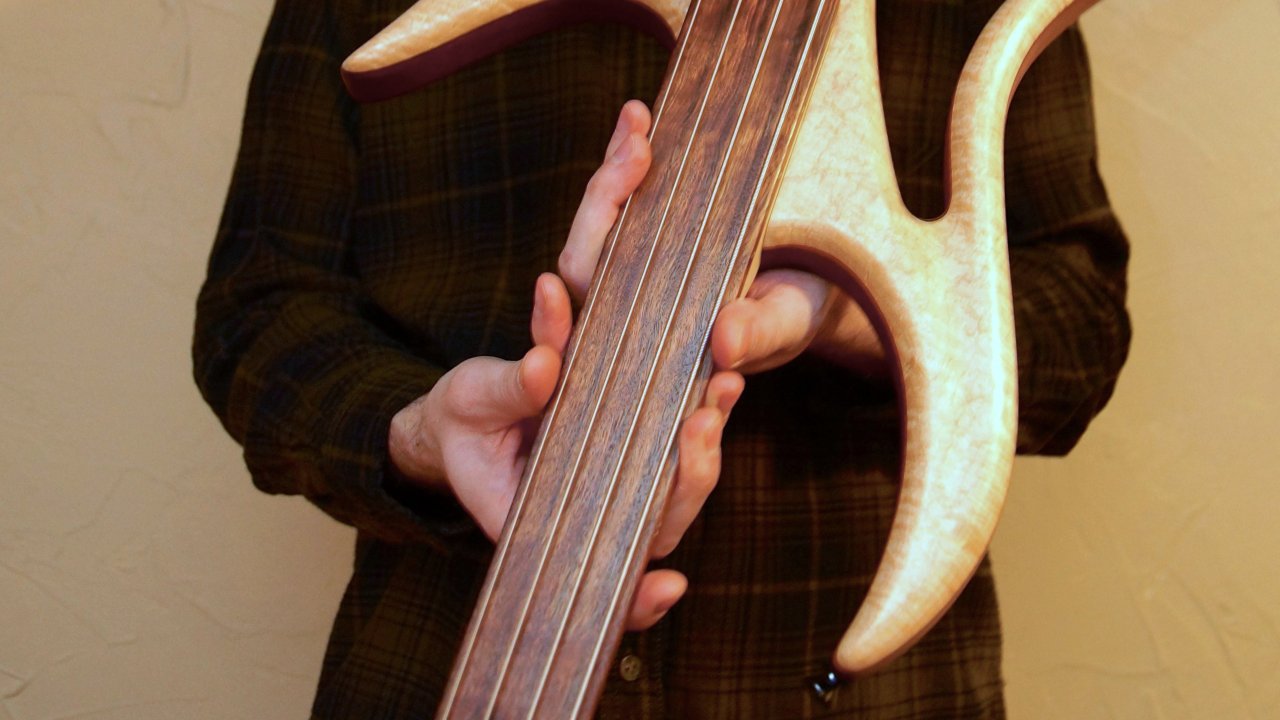
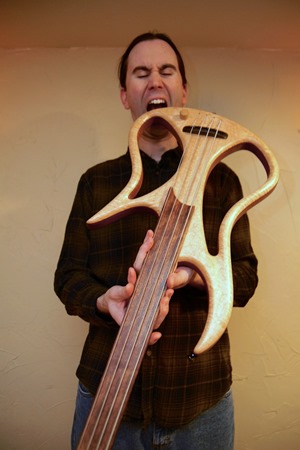 Builder Chris Stambaugh puts together some pretty amazing stuff. Originally trained in industrial design, he took his skills to guitar building and has basically been there ever since.
We interviewed Chris to get insight on how he got started, what he draws inspiration from, and learn from him what he considers the ups and downs of the business.
~~~
So… what’s your favorite grit of sandpaper?
Well, 150 is the money-maker, but 400 is probably my favorite because it’s the last one [for finishing].
How old were you when you first built or repaired your first guitar?
I was about 16 when I started getting parts of guitars from local stores, where I would assemble and/or modify them. The first time I tried to actually build one, I was 17.
Was the build successful?
As far as it could be. Myself and a friend built [guitars] from scratch in his father’s workshop. We even made our own truss rods, and made the fingerboards fretless to keep them simple. What we built back then still exists today and still plays.
 What was your inspiration for wanting to build bass guitars?
I was raised as a hobbyist, so once I started playing bass, it was a natural progression for me to want to tinker them. I never thought I was going to do this as a profession but it just kind of happened that way. I went to school for industrial design, and that allowed me to continue making instruments and pick up more mature design skills.
Did it seem obvious to build bass guitars since you were a bass player?
Yes, absolutely.
Do you have any formal training in your craft, or did you learn strictly by experience?
I never had any formal luthiery training. My schooling is in industrial design, and that included woodworking, metalworking, plastics technology as well as product design, and that all lends itself greatly to what I do. But in terms of actually making instruments, that was learned “the hard way”.
 Nobody showed you how to do a fret job, cut a guitar nut, etc. and you figured all those things out on your own?
Yes, and learned it before the days of internet access.
Are there any woods you feel work particularly better for the instruments you build or work on?
Some of my personal favorites are maple, mahogany and walnut; these are woods that are predictable in their tone and also in working characteristics and stability.
Are there any woods you feel look better but not necessarily sound better?
Buckeye would be the most obvious example.
What specific brands of hardware do you prefer to work with?
I’ve always leaned towards working with hardware made by US manufacturers – especially manufacturers where I can get someone on the phone when I need to. In that respect, Hipshot is definitely my preferred option for both bridges and tuners, and it’s nice you can get custom hardware built by them as needed. For pickups, I prefer Aero more than anything, mainly for the same reason I like Hipshot as they are willing to construct anything custom on an as-needed basis. They are also very clear in tone, which allows me, as a luthier, to shape the tone with the woods I use.
What’s the biggest job you ever had to do for a single build or repair job?
If measured in hours, it would have to be the 8-string acoustic guitar. The learning process with that build is what made it take so much time to complete, basically inventing how to build it as it was being constructed.
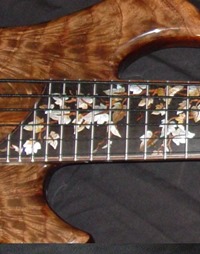 Which of your custom bass guitars required the most work?
It was a build that happened in 2012, a giant 6-string bass with a long leaf inlay. It was a combination of things that made it time-intensive, one of which in particular was fiber optic side markers; it was the first of my builds that featured them.
Do you still offer the fiber optic marker option for anyone who wants to order it?
Yes, the option is still there but nobody has requested it yet. But I have done the glow-in-the-dark markers a few times.
Have there ever been any builds you had to turn down for one reason or another?
There was someone who wanted a shorter scale bass than what they already had. But when it was pointed out to me the scale was already a 29-inch, I had to say that there wasn’t much I can do for something even shorter than that, as a scale that short would not have worked well for tuning stability.
There are only two types of builds I will refuse. First, if the build breaks laws of physics, I can’t do anything about that because it just won’t work. And second, I will not make exact replicas of existing instruments and/or their logos.
What would you say is the most important thing you’ve learned about building guitars?
To never start a project unless I know beforehand truly what I’m getting myself into, and having large amounts of patience as you must have that with this sort of work.
What do you think has been the best advancement in guitar building/repairing technology in the last 10 years?
Modern CNC machining has made guitar building much easier compared to 10 years ago.
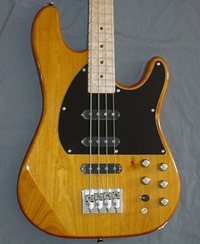 What is the #1 tool that you use the most?
My belt sander, and the second would be the band saw.
What is your favorite specifications for a bass guitar?
Bolt-on 5-string, mahogany body, fancy top, birdseye maple fretboard, Aero pickups, Pope preamp, oil finish.
What advice would you give to other builders/techs looking to break into the business?
To understand that doing something as a business is very different than doing something that you love. In other words, you need to identify a market where you can actually offer something, as opposed to just doing something because you want to do it. Just because you know what your dream bass is doesn’t mean that’s someone else’s idea of a dream bass. You have to build what the customer wants and not what you want. And when that means building things that are difficult to do sometimes, you do it.
What can we expect to find in the future of Stambaugh Designs?
I will be releasing a few more stock models that are aimed to be a larger part of my business, and I plan on starting a YouTube channel to help demonstrate those instruments as they become completed and generally available.
To see more of what Chris has made,
check out www.stambaughdesigns.com
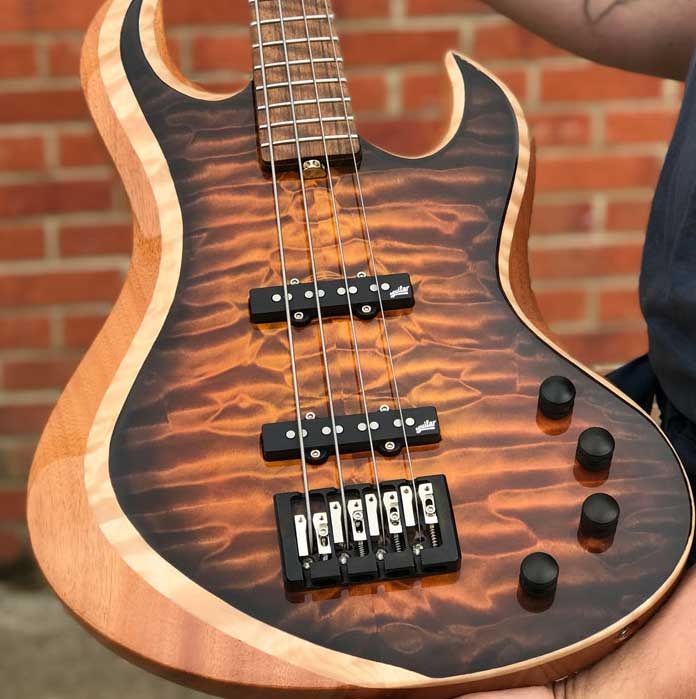


Great interview from of the East Coast greats!
Chris’s instruments are always class acts Ihave a Stambaugh fretless 4 and liked it so much I ordered up similar freted version.. I’ve owned at least 4 of his basses over the years and will probably add at least one more(5 string)
Love this guy’s work, and have had a chance to handle several of his instruments.
If you’re planning on buying one, the best thing I can tell you is that he’s a very good builder, but an *EXCEPTIONAL* inlay guy. If you’re doing business with him at all- go for custom inlay. It’s what he does best, and you’ll be very glad you did.
I really like what I’ve seen in the photos on the Stambaugh website. I’m surprised to read that Chris learned most of his skills by himself! His woodcrafting is absolutely spectacular. I’m a proud owner of a custom built bass handcrafted by Chris’ onetime apprentice, Brian Ristola, and my next custom built bass will be a Stambaugh. The state of New Hampshire is the home of two very talented luthiers!