
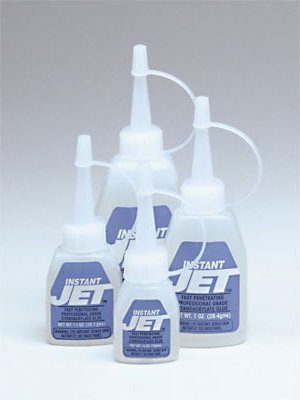
 Cyanoacrylate, which you commonly know as superglue, is something that probably isn’t in your tool kit. Or if it is, you probably would never bring that stuff anywhere near a bass guitar when repairing it.
Well, it just so happens that with the correct type of superglue, it can be one of the best things to have around when performing bass guitar repairs.
“There are different kinds of superglue?”
Yes. Generally speaking there are three kinds, that being thin, medium and gel which is the thickest.
The most often-used type to use for bass guitar repairwork is medium, although sometimes thin can be used depending on what type of work you’re doing.
A quick list of things that can be done with superglue
- Finishing (such as for control knobs and necks)
- Fret installation
- Nut installation
- Inlay installation
- Finish (ex: body) and structural (ex: headstock) crack repair
- Binding installation
“You can repair finish cracks with superglue?”
Yes. Superglue can be buffed and polished, and makes for an excellent filler material to fill in minor finish cracks.
Note: Superglue is not advised for use on nitrocellulose finishes because superglue and nitro generally do not mix. In other words, the blend will not result in the desired effect. For polyurethane finishes however you should have no issues.
“A neck can be finished with superglue?”
Absolutely. Thin superglue can be literally painted on a neck and when done finishing, you’ll have a mirror-like shine that will feel good on the fret hand when the instrument is being played…
BUT…
Superglue is best used for those that want to finish a neck quickly, and there are a few tradeoffs to this convenience.
Superglue starts to cure almost the moment you start applying it; it is not something you can take your time with; this means you have to work quickly.
Another thing is that you probably have no idea the scent superglue gives off when you use a good amount of it in a single sitting. The best way I can explain the scent is that if you’re not in a well-ventilated room, your eyes will tear right up like as if you were chopping an onion and there is even the possibility you’ll pass out. Yes, seriously.
It is totally possible for one to have a neck finished in superglue, and I mean done, in a single day. But it requires working fast, getting used to how fast superglue cures, operating in a room with good ventilation and of course getting experienced with it through good old trial-and-error. If you’ve never finished a neck with superglue before, it’s strongly suggested to test it on a scrap piece of wood first before moving on to the real thing.
“Why is superglue good for binding installation?”
For new binding installation, medium works best. For binding repair, thin works better for partial repairs where the binding is already in place.
Why use superglue for binding installation and repair? Because it will not erode any masking material as it can be simply be wiped off without any resulting damage; this is especially good for when working on vintage and high-cost instruments.
Does superglue bond to wood well?
It bonds amazingly well. In fact, the bond time is much less, and once the bond is established it will have incredible durability.
One of the best uses of superglue is when gluing together mixed materials. For example, if installing a brass nut, metal is obviously a different material from wood, however the bond you get from supergluing the metal nut to the wood will hold properly and have excellent durability.
“Do luthiers really use this stuff?”
Some use it every day, and have been for years. Superglue is one of the best kept secrets of luthiery.
Should you use an accelerator?
Sometimes you may be in the situation where you need the glue to dry as quickly as possible, and in that instance you would use an accelerator. Accelerators can be applied via a pump spray or aerosol. When working with superglue, aerosol is usually the easier of the two accelerator application types to work with for the reason the finer mist of an aerosol atomizes better when applied.
As to whether you should use accelerator or not, this is dependent on two factors. First, if you’re pressed for time, accelerator can speed up the job. Second, depending on what you’re gluing, you may be required to manually hold the glued piece(s) in place, and if you don’t want to spend as much time standing there holding glued pieces waiting for them to cure properly, accelerator can help in that respect.
A recommended aerosol accelerator, should you want to use it, is NCF Quick Accelerator.
“Okay! I’m convinced! Where do I get some of the better superglue appropriate for my bass guitar repairwork and installations?”
Jet Glues. It is suggested you get both the “Instant Jet” (blue label, thinner density) and “Super Jet” (red label, medium density) because chances are you’ll need both. There are thicker densities available, but the medium and thin are what you’ll be using the most.
Disclaimer
Use the information in this article at your own risk. Best Bass Gear is not responsible nor liable for any damages or injuries you may incur from the use of the information presented here.


I cut the top of my finger tip I used some super glue to glue the wound back together and played the gig !! Beats the hell out of a bandage !!
Another common use that I use it for, is to fill back of neck dents and dings.
Actually they’re not really the same much at all. Both are srginted instruments and the typical tuning on a 4 string bass is E A D G, which is the same as the 4 lowest strings on the guitar in standard tuning (E A D G B E). That’s pretty much where the similarity ends. is typically played using a pick or finger picking where the thumb hits the bass notes and the fingers alternately pick the treble notes. Bass is generally plucked using the index and middle fingers to pluck upward on the strings. Guitar music is generally written in treble clef (if you take lessons you’ll learn to read treble clef), while bass music is written in bass clef. Bass is primarily a rhythm instrument while guitar can provide both rhythm and lead/melody. You’ll spend a lot of time learning chords on the guitar and that is not really that applicable to the bass, where you’d typically pluck individual notes.As a and bass teacher, I really wouldn’t advise trying to teach/learn them both together. They’re really not that similar.
My other vice being RC planes and stuff, I am well versed in the use of CA glue. You want to buy it at a hobby shop, not a Home Depot type store as you will get much more per volume at a hobby shop than at a big box retailer who sells small bottles of “super glue” at a high price. Having used Jet, ZAP, and many other brands of CA over the last 20+ years in the RC planes world, I would recommend the ZAP brand, which is available at your better hobby shops and online. Why ZAP? The bottle and applicator tip is far superior — less likely to clog and less likely to leak air and dry your glue out before the bottle is empty. All the other bottles tend to either clog over time or they leak air and your glue will thicken up and eventually become less than useful. A 2oz bottle of CA can last a long time and you don’t want to throw it away when only half empty. I have a bunch of such empty bottles at home as evidence. With regards the fumes when using a lot, especially thin, at once. Yes, these fumes can be dangerous and over time can cause you to become allergic to CA or cause other sorts of reactions. If you will be using a lot of it at once, get a fume/paint ventilator and use it when working with CA at the quantity you get lots of fumes at.