
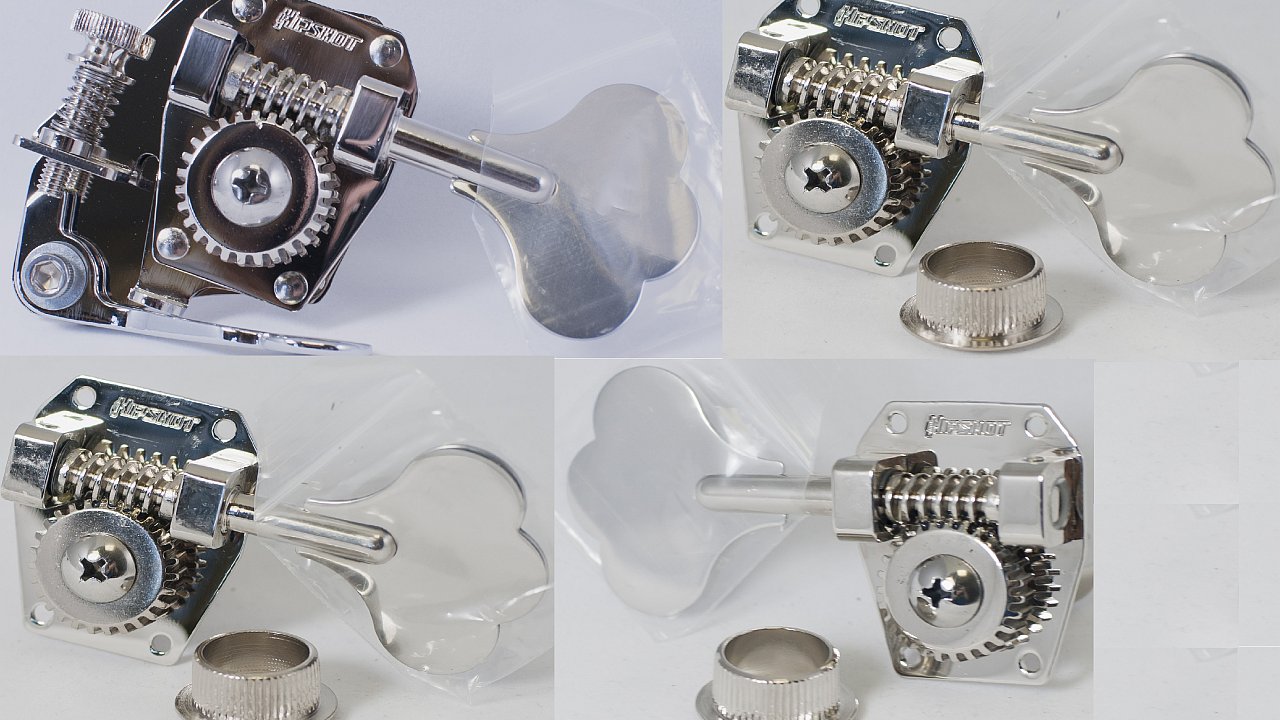
One of our more popular items we sell are bass tuning machines.
Oftentimes, owners of older basses will replace the machines on their vintage instruments. While the originals still work, the gears are long past their prime simply due to wear, so replacements are necessary. Once the replacements are installed, it’s common the owner will keep the original machines just in case the decision is made to sell the instrument later.
Machine replacements for older instruments are totally understandable…
…but what about newer basses?
For mid-tier and lower priced new electric basses, it’s usually true you’ll see the most cost cutting with the electronics and the tuning machines. Sure, you get a bass that’s priced lower, but you end up fighting with tuners that don’t perform very well.
Things premium tuning machines have that are worth the money
Precision machining
When examining a cheap machine, it’s usually at the gear where you will notice how cheap it actually is. The machined cuts to make the gear’s teeth will be inconsistent. The end result of this is that when tuning a string, you may feel a “hump” happen while tuning for any gear tooth that wasn’t cut correctly. And there’s really nothing you can do about it.
Better tuners have proper machining to ensure all gear teeth are a uniform shape with proper edging. You will not encounter any “humps” or skips.
Greater ratio
A higher gear ratio allows the post to rotate in smaller increments. This gives the player, you, more tuning control.
With cheap machines, getting exact tuning is, said politely, difficult. But with machines of a higher ratio, you get fine tuning control, allowing you to get the exact pitch you want, every time.
Some Hipshot machines for example use a 27:1 gear ratio (others use 20:1, which is still great), giving the player amazingly good fine tuning control.
Better materials
There’s cheap steel and good steel. On lower and many mid-tier basses, the cheap stuff is used for machine manufacturing.
Cheap steel machines don’t initially have any problems when the bass is new, but with regular use will start wearing out early. Gears may warp, gear teeth will start to “hump” or skip, posts may slightly bend, and so on. You might even see early corrosion on the smaller screws holding the tuner to the back of the headstock.
Premium tuners that use the good steel don’t develop these issues early in their life span. It should take a long, long time before any tuning machine starts to exhibit any real problems.
Said another way, when you install a premium replacement set of tuning machines, it should literally be the last set you ever install on the instrument.
Consistency from machine to machine
With cheap tuning machines, it is often true that there is little consistency from one to the next. This means that if you have a lower end bass with just one bad machine and replace it with another equally cheap machine, there is no guarantee the replacement will be any good at all. In fact, it’s likely you will introduce new tuning problems.
Premium manufactured tuning machines absolutely do not have this problem. Every machine is built to be as consistent as possible.
Better tuning machines is one of the best upgrades you can do
Tuning strings is not something you should have to think about. On the electric bass, tuning should be a simple, easy process where you just get the strings up or down to the pitch desired, play and not give it a second thought.
With premium tuners, you get that fine tuning control with no “hump”, skip or any other annoyances cheap machines have. Not only do premium machines get you in tune faster, but they keep tune longer, and just outright feel better to use. A good set of machines really does make the bass feel better to play. You wouldn’t think something as simple as tuning machines would be so important, but they really are. It’s definitely one of the best upgrades you can do for your bass.


Agreed! Planning to order new tuners today-as a matter of coincidence.
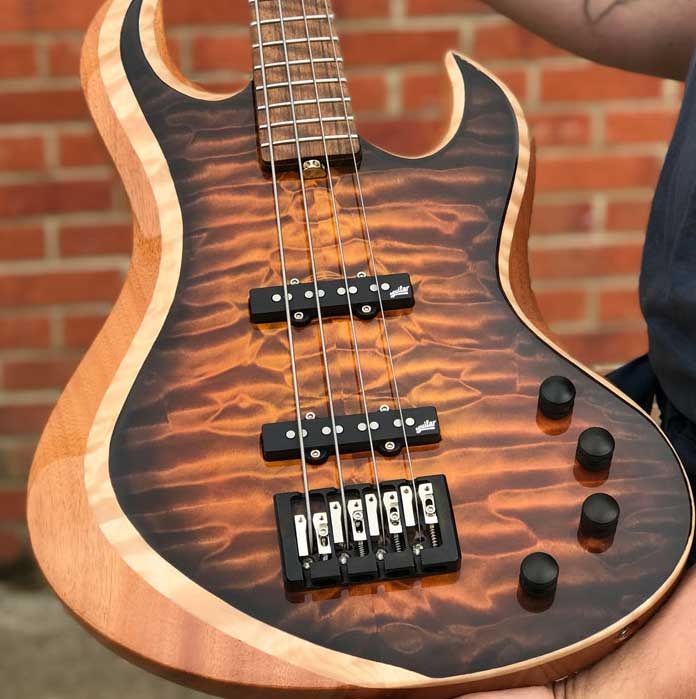
Over the past 54 (55 in August) years, I’ve upgraded a lot of tuners on my guitars (main instrument) and one MusicMaster Bass that I modded with Grovers, BadAss, a tapped +series/parallel DiMarzio Jazz set, a new nut and custom designed hand made pickguard. So this is “normal” operations for me. How would you rate the machines Fender is using on my MIM Blacktop Jazz?
Something not mentioned is weight. My personal favorites for my custom builds are Sperzel locking tuners which are very light, have a small footprint and are precision made. Hipshot also makes small footprint lightweight tuners with various paddle styles. Along with Schiller and Grover, Gotoh also makes some very nice quality tuners. When replacing stock tuners you’ll need to make sure the hs face (tuner pole) holes are compatible (there are 2 different sizes) and also make sure that the paddles will clear each other width-wise flat side-by-side. And finally, Hipshot makes their Drop-D machine incorporating many existing styles of tuners and also will use your existing E tuner (if it’s not one they offer) to combine with their machine.
…Schaller, not Schiller (spellcheck) 🙂
I am looking for replacements on a five string Sandberg – it’s a used bass and the tuners are shot.
The price range is expensive so any advice?
I like the fender style paddles in black. It would be 4L 1R Sandberg California five
I got some bad experience with the so called upgrade boutique shop brand Hipshot where the chrome plating is starting to wear off (rust!) after about 4years of normal use and basses always kept indoors (livingroom / bedroom). Hipshot replied to me that my tuners (including a bass extender) are to old to get a replacement/refund?? ignoring the fact that they(or somewhere in china) did a bad chrome-plating job..