
Brian sent us a very long email (which is cool) with a lot of photos about his rig. To say it’s “involved” is a big understatement.
There’s a lot to read and see here, but that’s great because it’s a very interesting setup. Thanks for sending it in, Brian!
~~~
Hi, a friend encouraged me to submit my rather unsual bass rig.
I’ve been playing bass since 1990. I’ve owned dozens of bass amp rigs, and about 30 basses since then. Every rig I have ever owned has always left me wanting or was unable to handle changes in my tastes or changes in my needs depending on what recording projects or bands I was involved with. I’ve owned Ampeg SVTs, SWR, GK, Hartke, Line 6 …. tube, solid state, digital .. many others … the works.
After having spent too many munnies on too many rigs that never seemed to be the ~right thing~, I decided to design my own system. I’ve been playing analog synthesizers since 1978. I have always loved how flexible the modular systems are, and own a modular synthesizer of my own. I decided to apply the modular ethos to my bass system in an attempt to design and build “the last bass amp system I will ever own”. So I set about designing a fully modular bass rig, one that had completely separate modules for each section of the system. This approach set the tone for the entire design. The modules include:
** Power Amp: Solid State, rack mount. Replaceable, or changeable should the situation demand it. I can even go without it if needed.
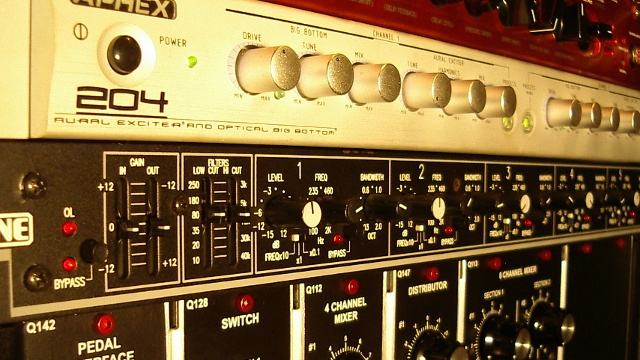
** Preamp: Consisting of completely separate modules for each stage (bass controls, midrange controls, treble controls, and so on). Imagine a bass amp where each single control knob consisted of a separate module that you could replace with any number of available control modules. Well, that is precisely what I have done. I use a combination of modular synth filters, rack mounted fully parametric EQs, aural exciters, and digital modeling processors. I’m currently using a Rane PE-17 seven band parametric EQ, and an APHEX 204 2-channel aural exciter with Big Bottom, as well as a Line 6 POD Pro rack mounted modeling system. I also use a modular synth State Variable voltage controlled filter that has Low Pass, High Pass, Band Pass, and Notch filter states as well as being fully resonant and highly controllable.
** Parallel processing stage: This stage is for adding other EQs, processors, and overdrive/distortion devices. It is a four-channel parallel processing rig that has four separate active “sends” and eight separate “returns”. The send unit is a modular synth module that is a four channel active distributor that sends four separate active parallel feeds to whatever I please. The “remixer” is another modular synth module in the form of an eight channel modular mixer. This parallel processor allows me to process any type of device while still retaining the original integrity of the genuine original bass signal. I can mix any type of processor at any level of “mix” with the unprocessed “dry” signal. Among the processors I use is a Line 6 M13, a Line 6 M9, two Boss DD-20 Gigadelays, and a Boss RE-20 Space Echo. I also use a few Farndurk BGC Bass Compressors and several Farndurk BGX Bass Overdrives. I also employ my modular synthesizer as well, using the Ring Modulator, VCA, and modulators to produce any number of tones.
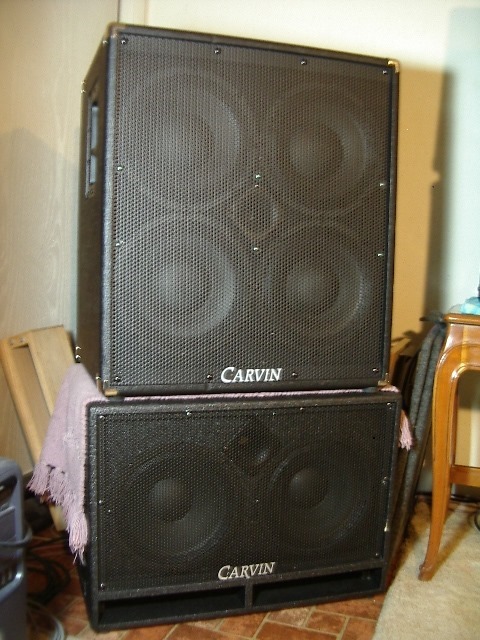
** Multi-amp distributor: Another modular synthesizer four channel distributor allows me to send a final processed mix to up to four separate amplifiers with four separate cabinets. I currently use a Mackie FR 1400i 1400 watt 2 channel power amp that powers a Carvin ported 2×10 BRX cab, and a Carvin sealed 4×10 BR cab, as well as a Marshall JTM45 tube guitar head that drives either a 2×12 closed back cab with Greenback Celestions in it, or a 2×12 open back cab with Celestion Vintage 30 speakers in it. I also have one more feed that may be used as a send to a FOH connection, or PA, or DAW recording system. With this distribution system I have much flexibility and a wonderful monitor setup.
** The bass that I use for the most part is a modded Squier Vintage Modified Jazz Bass 70s. Each pickup has it’s own output jack and it’s own discrete volume control. Each pickup is connected to a mixer after they have been run into separate input buffers and EQs. They are sent to a modular synth mixer that mixes the pickups down to a single signal feed which is then split into four parallel feeds (as described above in the “Parallel Processing Stage”).
Here’s some pics.
So ….. This is my Bass Rig. 🙂
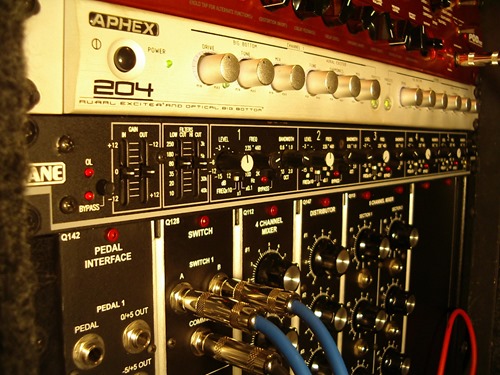
This is what I guess you’d call my PREAMP. It is a 12U rack that houses everything I need except for the Mackie power amp. The rack and the Mackie comprise my Bass Amplifier. The rack houses the parallel processing setup, as well as the modular State Variable Filter, the Rane Parametric EQ, the APHEX 204, and the POD Pro. Everything is connected to the patchbay below. The synth modules are normalized to the patchbay as well, which allows me to produce most of my sounds without using a single patchcord because the most used connections are pre-connected in back.
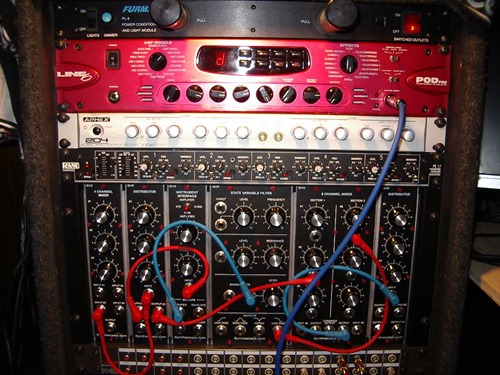
One of the parallel processing channels is also used to feed a computer where I apply a few stand alone VSTs as filter and EQ stages. Primarily I use a program known as FILTER by Antares.
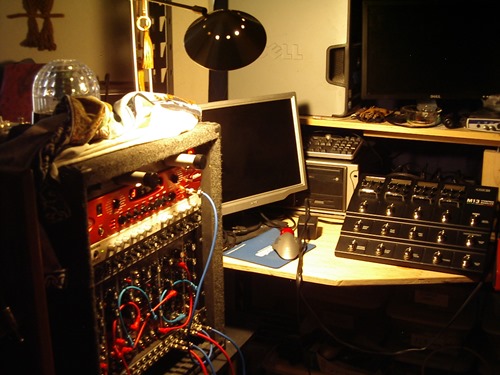
Panning further to the right is my modular synth and the second computer system that is typically used as a sequencer. The modular synth has two more voltage controlled filters, five oscillators, a three channel ring modulator, a panner/fader, and another four channel mixer as well as a few other tricks and bits. It weighs only 35 pounds and is easily transported if needed. I frequently patch the various modules into the rack unit to further process my bass.
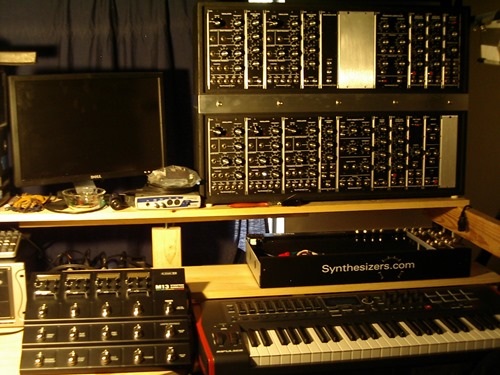
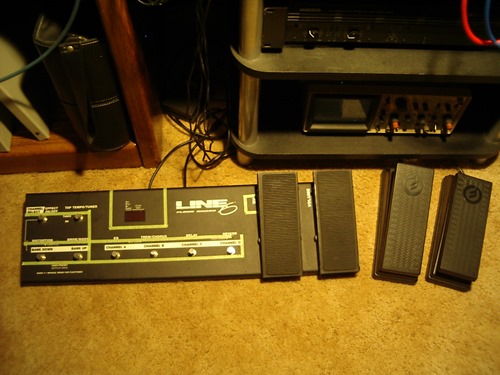
These are the foot controllers for the bass rig. I am presently modifying a set of vintage organ bass pedals to be used as momentary footswitches in concert with bypass relays that will serve to bypass and engage various EQs and processors in the rack. The Line 6 Flooboard is also being modified to add more footswitches for controlling bypass relays. The two solo expression pedals are used to sweep the State Variable filter as well as change my bass pickup mix.
This setup allows me to switch between two pickup presets with a momentary footswitch on the fly. The first mixer can be set up as two separate pickup mixes, then those two mixes may be A/Bd between via the footswitch in mid-flight.
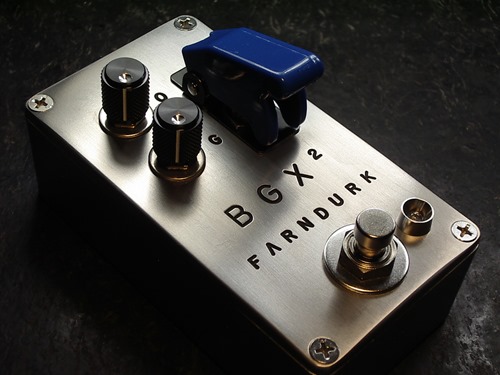
This is one of the bass overdrives I use ….
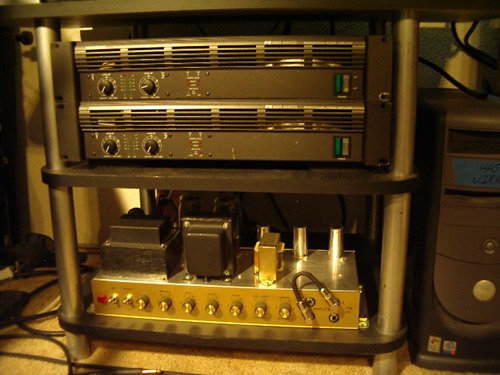
The two Mackies and the Marshall JTM45, they reside below the 12U rack array.
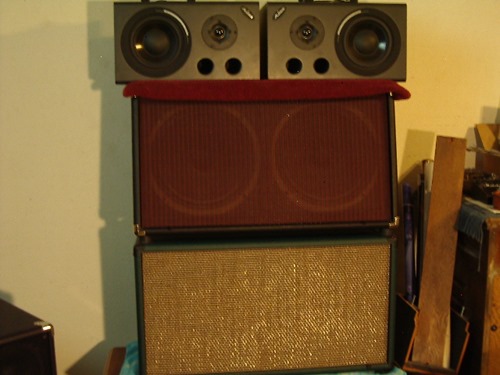
Here’s the 2×12 guitar cabs that are driven by the JTM45.
The two bass cabs.
Other than some silly pictures of the other FX pedals I use, that about covers it. I have played live with this rig and it works great. I typically use 70’s Rock Bass tones (Geddy-esque bass tone).
This is most certainly the last bass amp rig I will ever own. It is highly flexible, and can change with whatever situation I find myself in with very little effort. It is highly mobile and easily set up. I can actually just use the 12U rack array if the venue has a good enough house system. The ported 2×10 is plenty enough stage monitor for those FOH/PA situations. It is one of the last Neodymium equipped cabs Carvin had in the BRX210 series. So it is very light and portable. I can use the Mackie, the 12U and both bass cabs for most live venues. Since it is in “chunks” it is relatively easy to transport and set up.
With this system I will never again be enslaved to an amplifier that I cannot get what I want out of, or isn’t correct for a changing situation. It is super-easy to repair since each stage is removable leaving the entire rig in service while I either replace the module in question, modify it, or repair it. Should my tastes change this system is easily adaptable by simply replacing any given module(s) to suit my needs. It is highly configurable, and easily set up to any number of routings and purposes. It is easily the best bass amplification rig I have ever owned or used. I can produce any type of tones, from modern to classic. And it works with any type of bass or bass cabs as well. It can be as sophisticated as imaginable, or as simple as a 12U rack. Studio or stage.
So that is the short story of my fully modular bass rig. It may not be “what you’re looking for” to be eligible for consideration. If not, I totally understand. I figure you’re probably looking for something more “slick” and presentable. In any case I thought I’d let you see what it is I put together. Sorry my studio is not the neatest thing, it is in daily use and in a neverending state of flux.
~~~
Well, if you made it this far, thanks for sticking around. 🙂 Please be sure to post a comment or two.
And remember, if you want your bass or your amp/rig setup featured, send an email with photos and a story to featureme@bestbassgear.com.
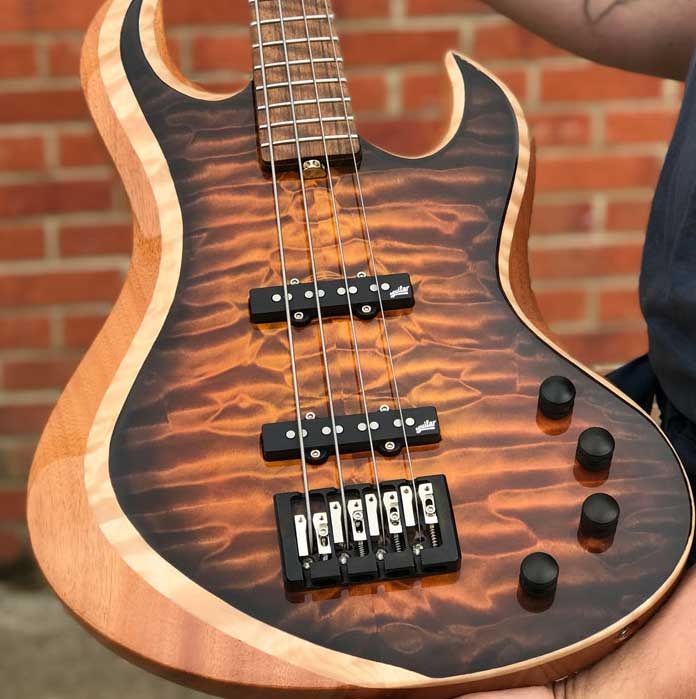

And I thought putting in custom sweepable low-, mid-, and high-boosts into my bass was intense…
So, I give up. I bet that punter in row 7 really appreciates that extra EQ digery do, and spots the odd mistimed foot pedal gaff, still, McCartney managed quite well with an AC30 and Hofner violin bass for a few decades (well ok not the original AC30) Just sayin…
And then again, Entwistle had five times more than this, and “managed quite well” also. Just sayin’ 🙂
It’s actually quite compact. It boils down to just the 12u rack, a power amp, two cabs, and a foot controller. Pretty modest by some standards. Yet, very flexible. (Brian).
HOW MUCH DID THIS BEAST COST ?
Cost? Roughly about the same as a brand new SVT head (just the head!). The POD was only $125, the racked synth modules were about $1k total, the Rane EQ was $150, the APHEX was $300, the power amp was about $250, and the two bass cabs were $600 .. comes to $2425 (if I added that right). Keep in mind that the additional gear is also used with the modular synth, my guitars, my slide guitar, and my Hammond. So a lot of it serves multi-functional duties. And ~yes~ I have played live with the bass rig and the synth rig. Takes me less time to set them up than the drummer does, and there is no single piece that weighs over 50 pounds (the 4×10 cab). I most definitely do NOT miss hauling around my old SVT CL and the 610HLF! The lightest piece in that rig was the 80 pound head. Set up is very simple, plug bass into rack, plug rack into power amp, plug power amp into cabs. Connect foot controller to rack. Tune. Done. I played synths and vintage Hammonds from 1978 to 1995 so this is actually a small rig to me. (Brian).
I read about your rig on talkbass as well and enjoyed it. I congratulate you on it. All it needs is soundclips so we can hear this monster of a rig.
There’s fifteen soundclips on Talk Bass of many parts of this setup. More coming later.
your over compensating for something or too much meth
Wow, I see no need to go there.
Really great that you put this whole thing together, but I just don’t get it. Do you actually wheel all of this out to gigs? Do you manage to get any playing done, or is there constant knob and pathway tomfoolery?
As I’ve said it’s very easy to use. Just because it has a lot of knobs doesn’t mean you’re always using them all. The setup is all taken care of during rehersals and practice. There’s only five chunks to the bass rig (bass, rack, power amp, cabs, foot controller). It has fewer knobs and gadgets than many MANY pedalboards.
Is there any place to hear your tone in action?
Pretty insane. Though I think that my rig from hell offered more real flexibility, in a far more portable format. The writer calling this “portable” is kind of a joke. My rig had all MIDI Controlled patch loops and effects, a bass-to-MIDI synth system, subharmonic synthesizer, analog filter, distortion/overdrive, chorus, solid-state and tube preamp sections, automated EQ, and storage for 200+ patches. It all fit in 8 spaces (6 + 2 for the power amp). It was controlled by a Ground Control MIDI pedal and a single CV pedal, and pushed a 2×10, or biamped a 2×10 and a 1×18 if needed.
Well, it’s no joke. As I’ve said a few times the actual bass rig is only five components when you include the bass itself (bass, rack, power amp, foot controller, cabs) and there is no single piece that weighs over 50 pounds (which is the 4×10, which I don’t always need). The largest piece is a 35 pound 12U rack. The synth modules that are used for parallel processing are very lightweight, so while they take up 5U they weigh very little.
It amazes me how people that haven’t played keyboards before are so put off by the “size and complexity” of this setup, it’s actually quite modest, especially when compared to some bass players’ pedalboards. Entwistle’s rig was mountainous, as is Geddy Lee’s. Thing is, that no-one but me has to like it, y’know? The crowds always love the gear, they like seeing me switch patchcords on the racked synth modules between songs. It’s a matter of clever setup and being familiar with your gear. Am I compensating for something? YES! The fact that I have hauled around 200 pounds of bass amp for far too many years, and still didn’t have everything I needed tone-wise. This rig is the last rig I’ll ever need. It is super easy to reconfigure, and it fits MY needs excellently. I understand why some people don’t understand it though, they’ve lived different lives than I have. It’s that simple. (Brian).
If it works for you……But quite honestly, I stopped reading early in the pre-amp paragraph. For me give me my chorus & compressor peddles. 1×15 & 4×12 cabs with a 500 watt head, plug in, tune up, play. And hopefully the PA is half decent. The way I see it is, the more you have the more there is to go wrong.
Can’t argue with that! 🙂 To each his druthers, is what it all boils down to.
One thing to keep in mind here is that if you invest all of your system into one single device (like some master midi controller or something like that) if that one device has one single little part go bad, your entire rig goes down. In a truly modular rig if one little thing has a problem, simply bypass it, or remove it and use some other part in it’s place. Using one master thingy as your entire processor is great, but if it goes down, the whole rig is down. I can blow an entire amp channel and keep playing. I can lose two EQs and still use a backup preset in the POD to struggle through the set. I can lose the entire POD and still continue with some quick repatching. I designed the entire system so I know it literally inside and out. This is the basic ethos and mentality of a proper modular rig. There is built-in redundancy while at the same time full functionality. I set out to accomplish this set of ideas from the beginning.
I’d like to thank everyone for their comments and replies. The differing opinions are always something that may be used in a positive way. Diversity is the basis of this rig in the first place!.
Talk about “overkill” … you must have a really bad sounding Bass!
Bad sounding bass? That all depends on who you ask. I’d have to say YES, it sounds bad ass! But why would you say it’s overkill? I don’t see how one digital gadget (POD) two EQs, and a parallel router are “overkill”. It’s just the elements that every good bass amp has all broken up into individual modules. It is very simple to understand, very simple to use, and very simple to transport and set up. Aa well as highly reliable, and less expensive than many off the shelf bass amps.
I’m a huge fan of technical gadgetry, overkill and the like. Mine tends to be more onboard than outboard, but I LOVE this setup. Nice job!!!
It’s going to be tough for anyone to top this in future weeks! 🙂
I think this is a really smart idea, having extra bits and pieces in case something breaks, which does happen. Also very smart having AB Class power amp in the Mackie 1400, even though its heavy, website says 22kg (is that about 48lbs?) each, its much safer than a switch mode amp that I feel are not as reliable.
WOW kudos for the originality! And if you say it’s paying off I believe you! Someone who would go to this much effort because they are happy with their SVT wouldn’t be talking rubbish about this! I’d LOVE to hear it!
Really cool rig. It seems we have two camps – the gear hounds and the “just give me an amp and a head” folks. I tend toward the former – my pedal board probably weighs 40 pounds alone. I think your point on being modular is great advice. I have a fairly complex rig, but I have two “in” connections and one or two “outs”, depending on the cabs. Then I help the drummer set up while the guitarist lug around their stuff.
Thanks for the positive remarks, I was beginning to wonder if I was among a very small group that feels many small parts are better than one large part. I often think of how a Navy submarine is designed, the entire thing is modular. If one compartment has a problem it may be sealed off to save the ship. While the rest of it remains fully functional. One of the things I love about this type of rig is that if I decide that I want to use a different component to only revoice just the bass controls, or maybe just the midrange controls, I have that option. And the more I use the parallel processing section (the modular synth mixers and distributors) the more I find I can emulate many off the shelf Fx devices and distortion units. Using a fuzz face and a parked Zakk Wylde Cry Baby as a band pass filter in parallel with clean signal I can produce a very modern rock tone with boatloads of bottom end, nearly indistinguishable from an active bass played through modern distortion and EQ FX. I can also dead-match stuff like the Tech 21 BDDI and VT Bass with ease. Simply because devices like those have blend circuits that run two channels in parallel. The parallel processing section in my rig is proving to be the most valuable stage.
Thanks again for the encouragement. You can hear some demos I’ve done with this rig on SoundCloud, my account name there is LunarDune. 🙂