See Don Campbell’s business listing here
BBG: There is debate over whether one type of capacitor is better than another. Is there any difference in bass tone concerning the capacitor for anything having to do with the capacitor other than its capacitive value?
DC: In a very general sense, the answer is no when you exclude poorly made capacitors (such as those that allow in air and moisture). If you start at the level of a new orange drop, and then look at new-old-stock, vintage, oil-and-paper or whatever it may be after that, people have written whitepapers on this subject and performed many tests with frequency scopes to better analyze what’s going on. However, in a guitar or bass, there is not any appreciable difference by instruments or by human ears in the performance or the tone of high-end capacitors.
BBG: Is it necessary to have a large capacitor in an electric guitar?
DC: No. An electric guitar is a millivolt application. Back in the 1950’s when guitar makers bought capacitors, the large type capable of handling 400 to 600 volts that were used in televisions and radios are what manufacturers used simply because there was nothing else available. Millivolt capacitors were not available back before the invention of the transistor radio when parts started getting a lot smaller.
The type of small capacitor we use in the ToneStyler is made for aerospace satellite use, which can easily handle things like shock, microphonics, temperature changes, vibrations and so on.
BBG: Concerning potentiometers, it’s been said you should always use audio taper for your volume controls, and linear taper for tone controls. You say the reverse is true.
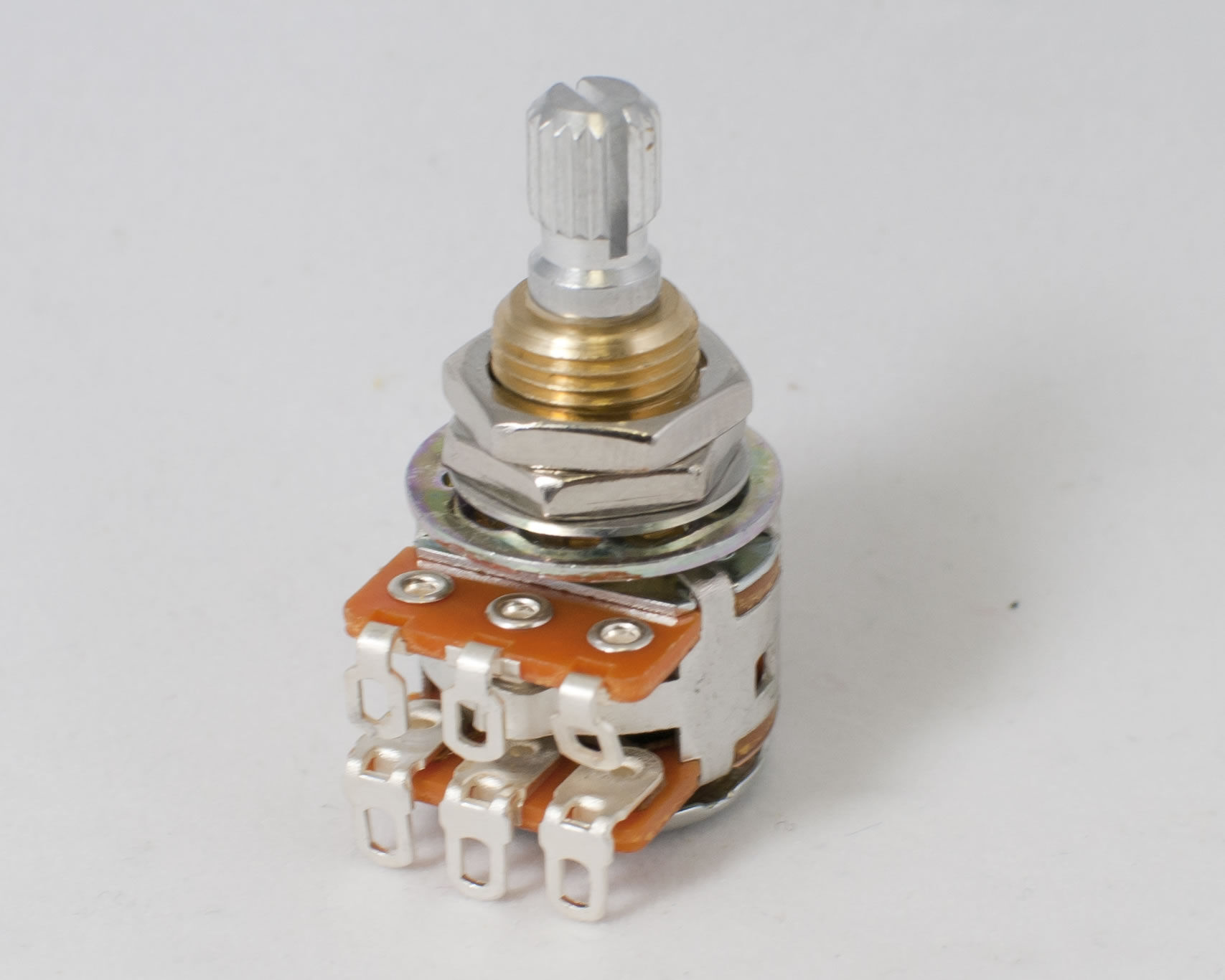
DC: I would encourage anyone to experiment to see which works best for them. If your pickup sounds too dark with a 250k with audio taper, try a 500k with linear taper. Use what works best for you. Since potentiometers are so inexpensive and not complicated to install, anyone can experiment with different kinds until they find the right one for their sound.
However, one will usually discover quickly just by ear that a linear taper is a bad choice for tone pots and that audio works much better.
Some prefer an audio taper for the volume pot because of how fast the loudness changes when rotated. Those that like to do volume swells greatly prefer the audio taper for that purpose.
Conversely, those who prefer a volume knob that allows for very subtle changes will prefer a linear taper volume, as it will give more precise volume adjustments as far as the ear is concerned.