

It is typical that many 5-string basses have a flappy low B string. Why is this? That’s what we’ll attempt to answer here.
Before we get into that, here’s a quick tip. On a 4-string bass, you can get away with tuning to B-E-A-D, but the strings may be too loose for your liking. In that instance, put on a set of Deep Talkin’ flatwounds which by nature are much tighter compared to roundwounds. If you like it, you will have to adjust your string saddles and truss rod to compensate for the different tension, but it’s nothing a 4-string electric bass can’t handle as long as you don’t bounce between E-A-D-G to B-E-A-D too often. Ordinarily, the best solution here is to have a separate “dedicated 4-string B-E-A-D bass”.
The reason the above is mentioned is to give you a basic idea of what causes the flappy B on a 5-string in the first place. String tension issues.
There are several ways to attack this problem, but we’ll concentrate on two.
Solution 1: Use a balanced tension string set – even if you have to customize it yourself
D’Addario does make 5-string mostly-balanced sets like the EXL170-5. It’s labeled “mostly” because the D has greater pull compared to the rest, but that’s the easy way to get a mostly-balanced set for a 5-string bass.
The other way is to buy single bass strings and customize your own preferred set to achieve the desired progressive tension.
“Progressive tension?”
With a progressive tension string set, the thickest string gets the most tension, next thickest gets less tension, next thickest gets less than the the one preceding it, and so on on down to the thinnest string that gets the least tension. Many bass players consider this to promote optimal comfort when playing.
To craft your own custom string set based on pounds-of-pull-per-string, use the D’Addario string tension chart (that’s a PDF document, by the way.) The electric bass guitar section starts on page 10. This is D’Addario’s guide on how to use the chart.
Or… try this handy dandy guitar string size calculator, as that may work better for you compared to going through a tension chart.
Solution 2: Use a bass guitar with a longer scale length
While a more expensive solution, this is an option.
Longer scale instruments will put greater tension on the strings when tuned to the pitch you are used to.
The bass guitar above, a Schecter Stiletto Studio-5 bass, has a 35-inch scale length instead of 34-inch, and that 1-inch difference in scale length may be just the thing you’re looking for to cure that flappy B issue – especially if you don’t feel like messing around with crafting a custom tension string set.
Is the reason so many 5-string basses have flappy B strings because of 34-inch scale length?
Yes and no.
A properly crafted bass with a progressive tension string set on it will play and sound like a dream, even with a 34-inch scale length. When care is put into the crafting of the instrument and proper strings are selected for it, you will feel and hear the difference.
A cheap 5-string bargain bass without a progressive tension string set will have its B string flap all over the place.
If your 5-string suffers from low B flap, try a flatwound set first as the tension is greater.
If flats do not suit you, try a progressive tension set of roundwounds next. It will take experimentation and you probably will have to buy a few single strings before you find the right combination that works for you, but it’s worth it.
If trying different strings doesn’t cure the low B flap issue, consider trying a bass with a longer scale length to it like the Schecter mentioned above – but only as a last option. It’s probably true you really like the 5-string you have and don’t want to give it up. That’s OK. Getting the right strings with the correct progressive tension ordinarily will cure low B flap issues. And as a bonus, it usually makes your bass more comfortable to play.
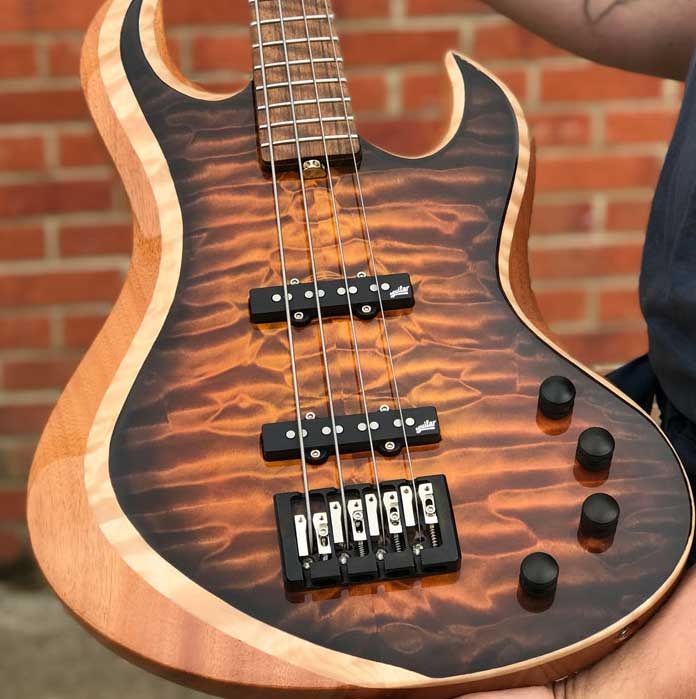


What role does construction play? I fail to understand how the same string will have a firm tension on one 34″ scale bass and a floppy tension on another 34″ scale bass. Why would there be a difference?
There are two main things that affect string tension when it comes to bass construction. First is whether there are string angles introduced or not. String angles can be introduced with things like a tilt-back headstock, thru-body string mounting or even string retainer bars on the headstock. Second is the neck material as certain woods are harder than others. For example, a quartersawn maple neck is stiffer than flatsawn/plainsawn, and will affect string tension. Generally speaking, the harder the wood, the greater the string tension. The tension won’t be super-firm or anything like that, but will be firmer compared to neck woods that flex more.
Interesting, this is the first I had heard of how neck woods can impact string tension. I always thought tension was tension, impacted by the gauge of the string and the distance traveled.
While I could see where a more stiff wood would make things feel more solid and would contribute the sustain, I am not sure how wood would impact the tension of the string.
This is incorrect information. Qsawn/flat sawn/ Riftsawn/ Slab Sawn makes NO difference in string tension. The only thing that effects string tension is the construction of the string. Core size, core type (round , hex, spiral) number of wraps and type of wraps. String alloys can also play a part. Strings come to tune at 1 specific tension between speaking points, (face of nut and apex of saddle). A simple switch from a .125 to a .130 can cure a floppy B, or switching to something like an S.I.T. Powerwound, which has one of the best .125 B’s I have used in 32 years of building and repair. The DR hi and lo beams are also quite firm for a 125. Kalium and D’Addario will do balanced tension, Kalium will do custom sets if you contact Chris or Skip, who are great to work with to get the tension you desire from rctra firm to soft and silky.
String tension should be exactly the same, but with stiffer or softer woods the response of the string vibration is affected; when not stiff enough, most of the vibration is absorbed, like hitting the string of a bow.
I have a couple of 34 inch 5 string basses and a couple of 34 inch. After playing the 35 inch models I find it extremely difficult to go back to the 34 inch, even with progressive strings on it.
I have found it helpful to use fret wraps as well. They keep the “B” string from flapping around and you can adjust them as tight as you like. I play in drop “A” and the fret wraps provide a tighter sound when placed on the nut by the headstock. They’re only about $40 to purchase online. I bought mine from GruvGear. Try them…..
Easiest fix is to use stiffer strings — hex core over round core — and tapered strings.
I love my Dingwall bass with fanned frets for this very reason!
The neck is important, although it does not affect tension in any way, because, as it has been said, strings aren’t in tune at a given tension.
The neck is important because, as interferometry pictures show, it is practically the only thing that vibrates in a solid body instrument. The body is too stiff to vibrate.
Therefore, vibrations of the neck subtract energy from the string and make it vibrate in a less stable way, since one of the fixed points of the string, the nut, is all but fixed.
This is why a rigid and solid neck is important.
hi fellow bass players, I have been having trouble getting strings in Australia for my bass, my bass is a 5 string, it has a 35″ scale and is a body through only design, I like to have a 135 on the B string, then 105, 85, 65, 45 that has worked for me in the past, Cort used to make a 3535 bass set, but they no longer supply strings for this bass, where can I get strings for my bass?
Well my bass IS a Schecter Stiletto Studio-5 bass and the B is floppy. So the long scale doesn’t seem to help. I guess I need to look at progressive tension.
Strings make the difference for sure. Perhaps the neck stiffness comes into play, also. I have a cheap Sterling S.U.B. Ray 5, 34-inch scale, with maple neck. After playing around with different strings and action setup, I have a beautiful tone and playability with Cleartone medium strings, 130-45. I rigged an extender to keep the full string wrap on the bridge saddle for the B-string only, the extra long distance between ball end and full wrap on B-string only is a quirk of Cleartones(?). It looks a little odd but does a beautiful job. If anyone is curious, I used a 10mm socket and SS washer between the bridge string hole and the ball end.
I just bought a 35-inch scale Schecter Model-T, string-thru setup with Diaddario extra longs. Somewhat floppy B, and I’m fighting the neck all the way with the string spacing and extra scale length. It’s going back…
I have a Spector NS2000/5 and it has one of the best Bs Ive ever played. Not floppy at all and it sounds like a dinosaur on a rampage. For this reason I will always prefer a 35″ scale on any 5 string bass. You can work out the floppy B on most 34″ scale 5s but the longer scale is going to save you a lot of trouble. The Spector at least I have never had to even think about . I have a Yamaha RB765A and while it isnt as crisp as the Spector it definitely has one of the better Bs of 34″ scale fivers that I’ve played and I havent ever attempted to improve it via string gauges or anything. The best thing I can recommend is playing a bass before you buy it and if you dont like the B on a fiver dont buy the thing. I bought the Spector through the mail but they are known for having exceptional Bs,even on their budget models. 35″ scale should be something you look for in a 5er. This doesnt mean they are all perfect but it’s an instant deal breaker for me if its not 35″ and I have passed on some great basses for this reason alone.