
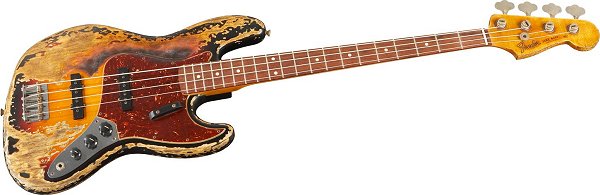
To “relic” an instrument basically means to make it purposely look old and very-well-used. There are varying degrees of “relic’ing” (pronounced “rell-ih-king”), and the Fender Jazz Bass above is one of the more extreme examples as the body was burned on purpose to give it its final look.
Builders have come up with some fairly inventive ways to relic a guitar. One example for a light-to-medium relic job is to have the body held over a campfire (using equipment and not with your hands, obviously) until the finish starts to crackle off. Others will purposely use ways of simulating finger or arm wear by over-buffing. Then there are those who purposely use steel wool or other abrasive to make the bridge and string saddles rust. There are any number of way to do a relic job…
…but should you?
Chances are pretty good you’re not an artist
There’s the assumption out there that relic’ing an instrument is easy. It’s not, nor has it ever been. You can’t just take a body, beat it up, ding it, dent it, heat/burn it and expect to have this awesome work of art at the end of it all because that’s simply not going to happen.
In fact, it’s actually much easier to apply a finish for a new look than try to achieve an old look.
With a new look, the goal is simple in that you’re trying to make everything look neat, uniform and shiny. If applying a solid color with no metal flake, the goal is to achieve a coat that uniformly looks proper over the entire body of the instrument (and possibly the back of the neck as well).
With an old look, the uniformity is thrown completely out the window, and chances are pretty good you have no template to work with.
Template?
The only real way to relic an instrument properly is to model it after the real thing. In the Fender Custom Shop for example, their luthiers use real-deal vintage instruments that have been truly beat up by age, stage use and so on, so that’s the template they use and that’s why they get it done so well. The vintage gear is used as a guide to construct the new relic instruments, where they can physically see and touch every cut, scrape, chip, dent, burn mark, etc. and replicate it.
If you do in fact own a vintage bass guitar with real proper wear (with “proper” meaning “actually used on stage”), then you have a template. If you don’t, then sure you could go by pictures found on the internet. But without the real instrument in front of you as a guide, well.. chances are pretty good you’re going to miss a few things in the relic’ing process, such as having absolutely no tactile feel to go by.
Is there documentation on this stuff?
Indeed there is if you’d like to give it a try. If you do a Google search for how to relic a guitar, you’ll find tons of guides and videos out there.
You’ll quickly discover however that no two ways of relic’ing are exactly the same. Some guides are from players who experimented with relic’ing techniques in their backyard, while others are from pro luthiers with pro shops who take a completely different approach. Trust me, you’ll have plenty of guide material to go through.
Right and wrong reasons to relic a bass guitar
WRONG: To look cool
The only people who sincerely believe beat-up instruments look cool are other musicians and luthiers. You will not score any “cool points” with anyone else. In a stage situation, the people watching you play will see your beat-up bass and think you should be playing something nicer-looking.
RIGHT: To create functional art
A relic job is a piece of art and doesn’t really do much (if anything) to improve the sound of the instrument. When done right however, it can look good depending on how light or heavy your relic job is.
WRONG: To add value to an instrument
Given that most relic jobs are done totally wrong, your relic job if anything will devalue the instrument rather than add value.
How do you know if a relic job was done wrong? Easy. If from inspection of the instrument you can still see anything that looks new on it (right down to the screws that hold in the pickups), it’s wrong.
RIGHT: To hone your skills as a woodworking and metalworking artist
Doing a proper relic job isn’t easy, but that’s part of the fun of it. You’ll learn a lot by experimenting with how to give things a used vintage look.
Should you do it?
My answer to that is: Only if you desire a bass guitar as functional art, as said above.
Yes, I know that sounds like a copout answer, but it’s the truth. It is far easier to put together a bass with the goal of having everything looking new rather than relic’d. Why? Because on a relic job you’re taking all new parts and materials, then adding in extra time to age them all, taking the bass guitar apart, putting it back together (which will probably need to be done several times), and so on, and so on.
In other words, a proper relic job is a long process that can be very trying on the nerves. And given there are so many unknowns with a build like that (it’s never a simple 1-2-3 process), there’s a lot that can go wrong. A whole lot.
If the prospect of a relic job interests you, my final advice is this: Read as much documentation as you can and watch many instructional videos on it. You’ll see a lot of conflicting instructions, but you should be able to hatch a plan for your own relic project that will work for how you do things.
Should you BUY a relic’d bass guitar?
As long as you know what you’re buying, then yes, go ahead and get one. And what exactly are you getting with a relic’d bass guitar?
First, I’ll tell you what you don’t get.
You don’t get an instrument that plays perfect out-of-the-box. Even though it looks old, it’s still new, so it has to be set up. It’s really easy to think the instrument is ready-to-go just from its appearance, but like any new bass, it isn’t. You’ll have to set your string height, maybe adjust the truss rod slightly and so on just like you would any other new bass guitar.
Depending on what you bought, it may not have the “warm” sound you were expecting and the pickups might need to be replaced with an appropriate “old-sounding” set, such as the Seymour Duncan Antiquity series. Pickups of that type are purposely engineered with softer magnets (meaning less magnetic pull) to simulate what a vintage instrument would sound like today. For example, a real 1962 Fender Bass has a sound that’s softer because of its age, and the Antiquity series simulates what a 50-year-old pickup would sound like now.
And what do you get with a relic’d bass?
In general terms, you get a bass you bought for 50% looks and 50% feel.
The look of a relic’d bass is obvious as it’s meant to look old. However the other thing you’re buying is feel. The bass feels old, worn-in and comfortable (after setting it up of course). This is a bass guitar you can bang around with, not worry about dinging or denting it while at the same time having a very classic looking instrument.
Many owners of relic’d instruments specifically buy them so they can gig with a carefree attitude and openly admit what they have isn’t the genuine article. In fact, it’s usually true that an owner of a relic’d bass probably does have the genuine article at home but won’t dare take it out gigging with because it’s just too valuable. When gigging with the relic’d bass, one of the big comfort factors is the lack of metal stress from playing with a “fake”.
In the end, yes, pre-relic’d bass guitars have their purpose. They may be expensive, but like I said above, 50% of what you buy is for feel; this is something many consider a small price tag to pay to play happy.


I recently saw an ad on Craigslist for a used “road worn” bass that was “mint.” I wasn’t sure what that meant exactly.
Quite frankly, It’s a waste of money.
Those battle scars should be earned, not imitated.
Dumb as hell. Real battle scars are cool, fake ones are lame.
Don’t do it!! It’s a waste!!
Want a $19,000 original and can’t afford a road worn? You love the look and the nostalgia? Then fuck these jokers and make what you want?!! Fender does it for 3-7k a pop
Take a brand new bass, take it all apart, tie a rope to your back bumper and drive on a gravel road!!!!!! This will beat it up !!!!!
The best way to relic a guitar is to play it at gigs for a couple of thousand hours.
It’s pathetic – you either earn those scars through time and use or they should have no place on your bass.
I relic’d my p-bass by putting it in the back of a tour van and playing it night after night.
I’m still waiting for the first reliced guitar with worn frets. Because for me, it’s part of the deal. Afterwards you should go to your local luthier, to get a refret, because that’s, most of the time, part of buying a real vintage guitar ! 🙂
Sorry. I for one have worked very hard to keep my basses as undamaged as possible for nearly 50 years. I have a 66 Gibson EB2 that is a 9.5. Honest wear and tear is just what happens through use, and I believe that basses should be played. I say let the patina come naturally. But it’s just the way I feel because I worked so hard to buy my own gear.
Buy if you want. But I sat buy a new and play until it becomes part of you. You’re doing the relicing (is that even a word) by playing it. Wish I could post a pic of my two 78 p-basses. They are fine examples of real wear and tear.
My 68 and 69 Fenders have lots of wear and it’s because those instruments have been played significantly……relicing is like giving a medal to a conscientious objector.
Vince Cunetto did the first Relic Basses for Fender. I have a 1996 Relic Jazz & it looks just like it did when I first got it when new. It’s like the first good bass I got in 1964 & I can’t afford a 1964 Jazz Bass. Memories.
It just looks beautiful to me. Silly? Maybe. Charming? Definitely.
So if I do this will the gig pay more??? Lol. I think it’s dumb because like many others have said I’ve paid to much money to damage the tools that bring in money.
I have a very beat up bass- a 71 Jazz neck on a 72 P body. SOmebody before me painted the body army green. I wanted a more traditional Fender color, so I refin’d it, but the shiny new body looked silly with the very road-worn neck, so, yep, I relic’d it and it looks much more like it should.
I embarked on a 1960 JBass relic remake project that really worked out well. I was looking for three things: aged sound, slim taper neck, and something I didn’t have to worry about scratching up, etc. I achieved this the sound element with Antiquity pickups and a true stack knob setup featuring oil in paper capacitors. I also had a thin nitro finish put on top quality wood (slim taper) to get full tone from the wood. The fun part was putting in the research to get the exact nuances of the 1960 axe down. From a “functional art” perspective, features from the exposed ground wire to the finish relicing was a lot of fun. Other details included a darker rosewood, reverse tuners, thinner fret wire, and more. With research and part acquisition the entire project took almost 18 months.
Before this project, my go to bass was a Keith Roscoe 5 string (which I still love). This 1960 remake Jazz Bass, has really slid to the top spot because of the sound, feel, and it is so much fun to play.
If you take on a relic project, do your homework and do it justice. Don’t let anyone tell you it is a waste of money or stupid. Have fun and follow your passion.
Relicing is totally lame! One fellow here said “it’s like giving a medal to a conciencious objector”. Diottos to that! If you had a beautiful car or truckn would you take a hammer to the hood? Perhaps an ice pick to the windshield? I think not! Currently, my main axe is a MIM strat in metallic midnight blue. In certain light and angles it looks almost translucent purple-ish. Looks so tasty I want to take a bite out of it! WTF would I want to put a scratch on it? Just play the damn thing!!
Why be fake when the in a decade or two you could be real?
I have a1980 Fender Precision 70’s style reissue…..somebody dinged it, in a weak attempt to relic it…The neck is perfect…has some wear….I want to relic the body along the upper and lower edges…as well a the lower edge of the neck….to create an authentic relic level of wear. The bas is fitted with PreCbs style hardware and Seymour Duncan vintage pbass pups…and vintage pots and jack…..
Another reason for relicing this pbass……to add additional edge wear and neck edge wear to cover most of the previous owners lame attempt at relicing…..This bass has a good amount of wear…but the edge dings look fake and intentional….need to cover those over…
Buy what you want but I’ve never understood the concept of paying more for a new bass that has been relic’d. Relicing any instrument is a time consuming and expensive proposition. Why not do the legwork and find what you want used? Pups and electronics are easy to find and change that can reproduce a more vintage sound if that’s what you’re after. Used instruments can be much less expensive. My 10 year old Warwick Streamer $$ still functions perfectly while exhibiting lots and lots of wear from actual use and what some may consider a very attractive patina. I’m doubting I could charge a premium if I were to try to sell it!
I don’t intend to own one, but I can’t help but call out the people in this commment section literally calling people who like relic work “dumb” for like it. There is nothing, nothing worse than a music gear snob when it comes to taste. Those are the people who might be a good player but is everyone’s least favorite band-mate.
I rebuild guitars and basses from old parts and broken guitars. I use relic method as a tool to make an old neck or body work with the replacement pieces and parts. The instrument is mostly built from pieces that no-one wants, so I make a fully functional and playable instrument that has a unique sound and look. I also put my own brand logo on them. So as far as the personal comfort and attachment in the instrument I feel I have that covered. I also don’t sell any of them and the actual cost of the instrument is 50% less than a name brand. However the brand that I have is my name.
I also build new guitars and look forward when the wear and tear of playing them happens. I have a 10 year old tele custom that is slowly looking old as dirt because its my favorite to play for hours on end. It killed me when it slipped off of my work bench and took a chunk out of the paint near the input jack. But that is where the character of the instrument comes from.
It’s not about look.. It’s about feel.. I am pretty sure years of skin oil has changed the wood on my 93 MIM J-Bass. I just bought a 96 P-bass, and clearly this guy didnt gig like I did, it looks new, doesnt have nearly the same feel..
I intend to relic the old-fashioned classic 50’s way – by playin’ it.
not sure why everyone is hating on this idea so much. if it’s a very expensive and shinny new bass its kinda dumb, but if its an old cheap bass you found for like a hundred bucks (like me) i see no problem in doing it. i see no reason to get mad at people for trying to make THERE bass look cooler. i’m also spray painting, drawing on and adding stickers to this very cheap bass for fun, and if people are gonna hate on that to so be it.