
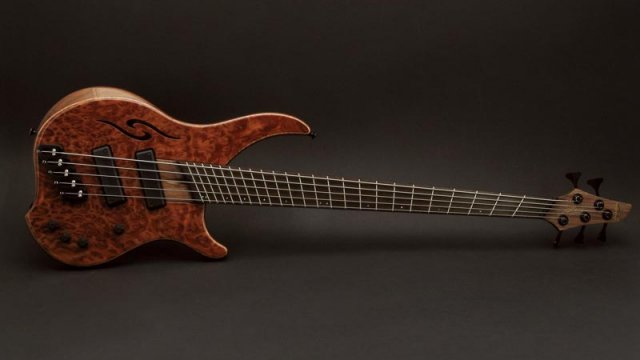
Above is a Dingwall “Afterburner 2” bass guitar. Very pretty, very expensive and very awesome all the way around; you’re definitely getting something special when you buy a Dingwall. And as you can see from the photo, it has fanned frets on it, and that’s what this article is about.
On a fanned fret layout, there is one fret which is perpendicular to the neck’s center line, and the rest are slanted. From the photo above it would appear (although not confirmed) that the 7th fret is “the straight one”.
What’s the purpose of fanned frets?
The lower-pitched strings gain more length and the higher-pitched strings get shorter, similar to the string lengths on a grand piano. What this does (supposedly) is that it makes for better tuning, and on the bass guitar in particular, “deeper” bass tone due to the fact the lower-pitched strings are longer and therefore should (operative word there) be more resonant.
Are fanned frets a new idea?
No. Fanned frets first appeared on a 16th century Renaissance-era stringed instrument called the orpharion, so the idea of slanting the frets is a very old one.
Does playing a fanned-fret instrument take a long time to learn?
No. The most difficult to learn is the fretless because that requires having a trained ear to get the most accurate notes since you have no frets to “fall back on”, so to speak.
While you see fanned frets, your brain says, “Whoa. Different.. I bet this will take a while to learn..” But when you play it, that’s when you realize it’s really not difficult to play an instrument with fanned frets at all.
Does fanned fret allow for different tunings that straight-fret can’t do?
Whether you’re playing straight-fret or fanned, both have the same capabilities as far as tunings are concerned.
Where the fanned fret has the advantage is concerning the reach of your fingers. On the higher frets in particular, you may find that playing intricate solos is far easier on fanned compared to straight simply for the fact your fret hand is more comfortable when playing on fanned.
Fanned-fret bass guitars are best described as “being more inviting” to tunings you otherwise wouldn’t bother with on straight-fret because the reach of your fingers feels so much more comfortable when the frets are slanted.
Is fanned fret a replacement for straight-fret?
Absolutely not. Fanned fret, while more inviting to alternative tunings and more comfortable to the fret hand for many players, is not a replacement for the straight-fret bass guitar.
Just because frets are slanted on a particular instrument does not make that “better” compared to straight-fret; it’s just different.
What’s the only real learning curve with fanned-fret?
Where your eye travels when playing.
Notice on the image above that the fret markers on the fingerboard are on the bottom and not the top. There’s a reason for that, and it’s not just for show. You will naturally look towards the bottom of the board when playing on the higher-pitched strings, and use the side markers on top when playing the lower-pitched strings. Why? Because of the slant. With the exception of one fret, the held note on any fret will always have its position slanted from string to string. That slight difference in finger position for many requires extra attention to the markers, and the solution presented for that was to simply move the on-board markers towards the bottom.
You’ll notice that most fanned-fret bass guitars do specifically put the on-board fret markers on the bottom simply because it is easier for the player to keep track of where he is when playing. Side markers for lower-pitched strings; on-board markers for higher-pitched strings. It works.
I know, I make that sound difficult, but believe me, it’s not. When you get the opportunity to play a fanned-fret bass guitar, you’ll understand why it’s important to have those on-board fret markers near the bottom.
Have you (or are you considering) playing a fanned-fret bass?
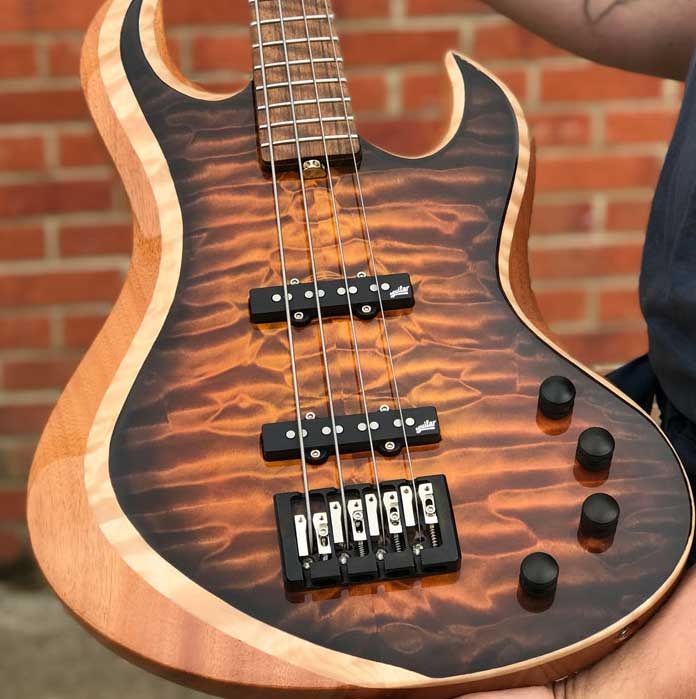


I am lucky enough to reside in the same province as Sheldon Dingwall, and as a result, there happen to be a couple of places in the province that I can play on Dingwall basses. I can attest to the awesomeness of his basses, and how amazing the B-string sounds. As far as the fanned frets go, it will take about 2 minutes of playing before you forget entirely that you’re even playing on fanned frets. It might take a bit longer to adjust if you’re heavy into tapping or chordal playing (though Felipe Gomez has a Dingwall and seems to do quite well with tapping). About the only thing you couldn’t do with this system is fretless. http://youtu.be/-EbTV_WuDbQ
I’ve been playing a Dingwall Prima V string fanned fret bass since 2000. I absolutely love it! The sound is spectacular and the intonation is the best I’ve ever played…I’m not a player that plays high up on the neck (past 12th or 14th fret) so the optical illusion for those frets doesn’t bother me much, but it is there. Otherwise, the craftsmanship in this bass is amazing! I would love to be able to afford the Dingwall SuperJ5 but it’s not in the budget at this time…maybe someday….
I’ve been playing a five string afterburner for about 6 years, as my only electric bass. The advantage of fanned frets has nothing at all to do with tuning: it’s all about strong feel. The longer scale length means the low strings are at nearly the same tension as the high strings. You don’t have to “baby” the low strings, especially the low B. it’s a big improvement in playability and as a result in tone. With conventional basses I learned to compensate and change touch depending on the string, to keep timbre and dynamics consistent. With the dingwall that’s much less of an issue. That’s the main advantage of fanned frets. The afterburner has a bunch of other virtues independent of fanned frets
And, you have to admit, a bass that looks that good, has to be a killer thing to own and play!
I have been playing an After burner II for about 1.5 years now and love it. It’s the same model as the one above. A friend lent me his Dingwall and I used it in a gig the same night so no it doesn’t take any time to get the swing of it. The quality of Dingwall basses are second to none. A super P is next on my list !!
I build my own basses, and my favorite right now is one made from a solid plank of quilted maple, and is muti-scale, with fanned frets. The B string has a growl like a grand piano! Thats the reason for doing it. And, playing it is not much different than straight frets.
I also build my own fanned frets 5 strings. This is a real pleasure to play, fast, smooth and growly. I never thought that fan frets had so much influence on all the laying and sound parameters. It took me a minute to adapt my hands and I’m able to change from standard to fan frets without any difficulty. Sure I’ll build another one, maybe 6 strings. The difficulty is to find the right pickups to adpat the geometry.
I now think that fan frets will be the future of bass crafting. Don’t know if this is the same for guitars. Any experience?
Fiquei chocado! PURA COINCIDÊNCIA , nunca tinha visto contrabaixo assim . Me apaixonei pelo contrabaixo elétrico a uns 10 anos , e acabei tendo problemas de tendinite devido a posição dos teste (a mão fica muito inclinada em relação ao cotovelo) e por ter conhecimento de cálculo de harmônicos ( em eletricidade ) apliquei na escala e pude inclinar os traste para que ficasse mais anatômico, com isso diminui a inclinação da mão em relação ao cotovelo ficando mais confortável para tocar e batizei como vida FIXED ELBOW , vida que segui, continuarei a fazer meus próprios instrumentos.
Simply put, the NG-2 I tried out was simply the best playing bass I ever played. Simply amazing with the best B-string ever.