
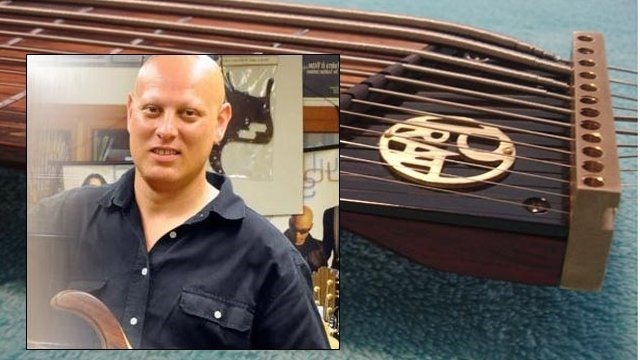
See Oscar Prat’s business listing here
Oscar is a fourth-generation antique dealer who studied under Stephen Higgins to become the builder he is today; he has always been involved with woodworking in one way or another, and turned his passions towards bass building. Because of that, he now builds bass instruments that are some of the best of the world.
We interviewed Oscar to get some better insight on his bass building techniques and the man himself.
 Could you describe to us what your business is?
My business is creating instruments for bass players, and I say “create” because I construct some very unique basses sometimes. Some say that certain instruments are “not basses” because of the number of strings or “strange” scales, but regardless of that, I create instruments for bass players.
At what age did you build or repair your first instrument?
It was after I married and after college. I was about 26 or 27 years old.
Was your first project successful?
It was for me and was able to sell that bass. But I was able to construct basses all along because even then I had a lot of woodworking experience. I was an antique dealer and was restoring antiques myself. I decided to start building basses because after I sold my first one, I didn’t have any until I made more.
Are there any particular woods you feel work better than others for the instruments you build?
 I prefer maple and wenge first because they are easy to work with. I mostly use American woods. Maple, swamp ash, sometimes alder, sometimes walnut. And then from exotic woods I use basically anything from around the world. After that, concerning exotic woods, I have a love/hate relationship with cocobolo and paduak.
Are there specific brands of hardware that you feel work better for you than others?
Yes. I do favor Villex pickups. And lately I have been working a lot with Carey Nordstrand as well. For preamps, I’ve been heavily using Noll from Germany. They are musical, clear, noiseless and flexible.
What was the biggest, as in the most work, you ever put into a bass build?
One was for Chris Cardone, one of the guys for Circle K strings and it was for this year’s NAMM show. It’s a 24-string bass. As in an 8-triple bass, like a 12-string guitar, except 8 triples instead of 6 doubles. It might be a record for one single neck. It was a huge challenge because every part of the bass was custom. And to make all the strings work and sound correct when the instrument is being played was a huge challenge.
Have there ever been any build projects you had to turn down for one reason or another?
No, especially considering the project I just mentioned was one of the most complicated bass builds there ever has been. No matter what someone wants, I can build it.
 Other than your own work, what are some of your favorite basses?
I have high respect for anyone that can build a good instrument. I particularly appreciate the work of Michael Tobias, and he’s also a very good man in general. I consider him one of my personal heroes. Another I have high respect for is Jerzy Drozd as he is a pioneer in the way of building bass guitars with CNC machines. But again, I do have high respect for anyone that can build a good instrument because it’s not an easy thing to do.
What would you consider the most important thing you’ve learned from building guitars?
To be patient. It is something that is very difficult to learn. You have to have time in your mind to be calm. While I was learning woodworking techniques under a master luthier, having patience was the most important thing. However, being patient is sometimes very difficult because of the intense competition in the industry.
What would you consider the best advancement that’s come around in bass building technology?
 Electronics. When I was first starting building, there were maybe 2 to 4 brands to choose from. But then more brands with newer technologies appeared later like Noll or Glockenklang. Other than that, most luthiers are following the traditional methods of bass building because it just works.
Which tool in your shop gets the most use?
The three that get most used are the sander, the planer and the CNC machines.
What’s your favorite grit of sandpaper?
220.
What advice would you give to other builders/techs that want to get into the custom bass building industry?
To have passion for what you do. If you lose the passion, you will not survive long in the business. You should also be humble and not rant. And remember, I’m still learning new things every day.
What do you have on the horizon for future projects?
I expect to have regularity, which I consider very important. This is to say I mean to have a more regular line of products. Once this is established, that will allow me more time to experiment with newer ideas.
You can learn more about Oscar Prat instruments at www.pratbasses.com
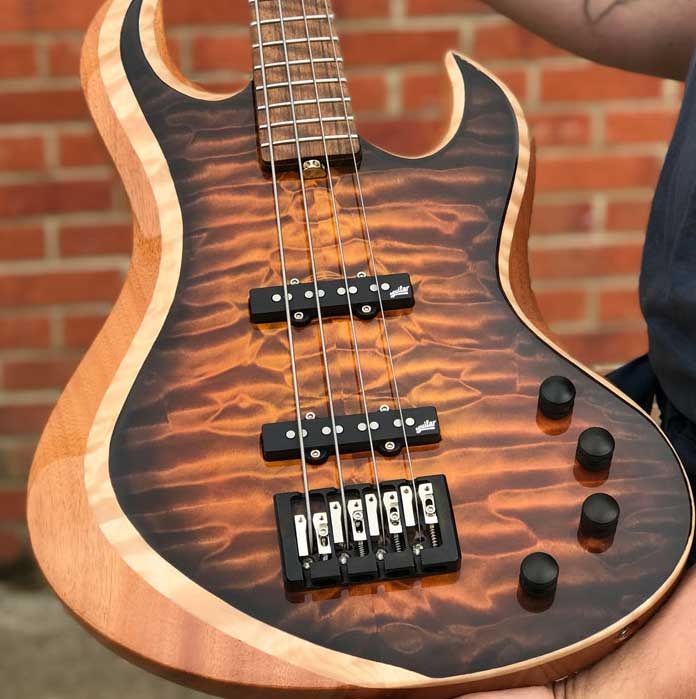


Amazing instruments. Where you get the pickup?Regards from Bali