
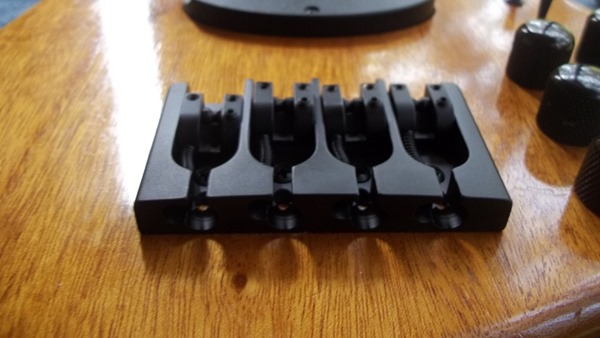
Whether you are installing a bass bridge on a new build or on an existing bass that already has a bridge installed, the method to handle the install is relatively the same.
Step 1: Select the New Bridge
Before selecting your new bridge you will need to determine a few details about your existing bridge. The existing bridge’s string spacing is the most important detail. You can determine your existing basses bridge string spacing using the following article:
https://www.bestbassgear.com/articles/bridge-string-spacing.pdf
Once you have the string spacing you can determine which bridge is going to work with your existing spacing. Hipshot bridges offer the widest variety on string spacing options with both A and B style’s to choose from for 4, 5, and 6-String basses.
Some bridges, particularly for Fender basses, may offer a retrofit option that will use the existing screw holes for mounting the bridge. Hipshot and Babicz both offer bridges to suit Fender bass retrofits. These can be found here:
https://www.bestbassgear.com/hipshot-fender-a-style-bass-bridges.htm
https://www.bestbassgear.com/hipshot-b-style-fender-bass-bridges.htm
https://www.bestbassgear.com/babicz-full-contact-hardware-bass-bridges.htm
Most installations (even some Fender basses) will require mounting screw holes to be drilled.
Step 2: Determine the Install the Location
To install a new bridge onto the bass, a centerline from the body must have been previously established, the neck installed, and the scale length already known.
Using the scale length, measure from the nut to the lower bout of the instrument until you reach your particular scale length and place a mark at that location on the right side of the existing centerline. If a bridge has been previously installed, lay a piece of paper alongside the treble side of the bridge secured with tape, and make the mark on the paper.
On your new bridge move the highest ringing string saddle (“G” on a 4-String) as close as possible to the front edge of the bridge. Using the closest point to the neck side as reference, determine based on your scale length mark and how much the saddle can comfortably move rearward, where the optimum location is. You should be planning for how much the string needs to be lengthened or shortened with saddle movement to intonate the instrument as this is an important detail.
Once the location of the bridge has been roughed out, use the centerline of the instrument and the centerline of the new bridge as reference for placement. If your bass already has a bridge installed then you can take the existing bridge length and divide by two to get a centerline. On new builds a centerline to the body should have already been established and retained to this point.
Take your new bridge’s length and divide it by two to get the centerline on the bridge. Using our scale length mark and the centerline we have already established, place the bridge in its respective location and mark the screw mounting holes with a pencil or a scribing tool to establish the screw mounting locations. Determine based on the mounting screw size, which drill bit, and how deep the hole needs to be before drilling for mounting screws. Using a center punch make a mark to register the tip of the brad point drill bit. With a drill press, or hand drill, center the bit on the hole and begin drilling each mounting screw hole.
Step 3: Drill for bridge ground wiring channel
If your bass already had a bridge previously installed then there is most likely a bridge ground wire channel. If your bass has passive pickups from Aguilar, Bartolini, Delano, Nordstrand, or other manufacturers then you will need to retain the existing bridge ground wire. Take the ground wire and sandwich it between the body and your new bridge. Once the bridge is installed the wire will remain clamped between the body and bridge.
If your bass requires a bridge ground wire channel then you will require a 3/16” bit that is 12” or longer, and a friend as a second set of eyes.
Step 4: Install the new bridge
Once each hole has been properly drilled out, use some wax or bar soap to lubricate the screw threads before install. This will help on installation, and removal should it ever have to occur. Install the bridge to the body and hand tighten with the correct sized screw driver.
After the bridge is installed it is time to enjoy a new set of strings and a fresh setup.
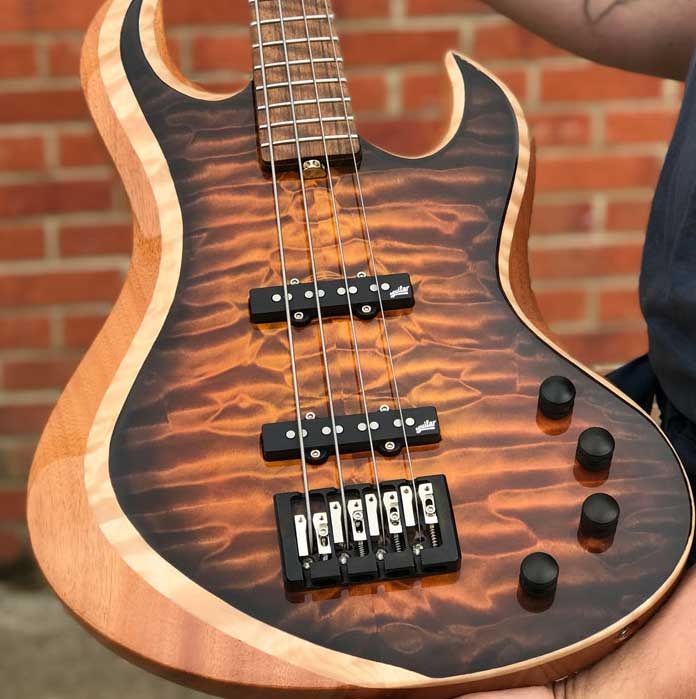


I’ve never attempted installing a bridge on a bass guitar so this advice should be helpful. I’ll need to select a bridge, find the install location, drill the wiring channel, and install the bridge per your instructions. Thanks for your guitar advice!
How do you set up for drilling a first time string Through Body Bridge onto a bass with a standard bridge?
what about single bridge? any tips?
Gotoh Vintage Style Bass Guitar Bridge (4-String) Will this Bridge work on my Ibanez SR 300 DX
String Through single bass bridge drilling set-ups?