
 First in a series of articles about tools in the small builder’s workshop, this is a brief overview of the larger power tools commonly used in a shop. Later articles will cover smaller power/hand and luthiery tools, as well as specialized jigs used in instrument building.
To a large degree, bass (and general instrument) building is woodworking, and as such, several power tools are used to accomplish much of the work. I recall my grandfather’s hobby workshop, and he had several of the same types of tools that I use to build basses.
So, where does one begin? I faced this question over a decade ago when I decided I was starting to build instruments. Having worked in another luthier’s workshop for a couple of years, I had worked with much of the equipment that I currently use in my shop before I had the necessity to make these larger purchases. While this experience was advantageous and helped guide my initial purchases, the larger tool purchases (and more expensive purchases ) are not specialized to instrument building and can be found in most woodworking stores (in most cases, consumer level equipment is adequate), online retailers, as well as the fairly active used tool market.
There are a lot of ways to build an instrument, and no two luthiers go about the process in the same way. Many builders show a lot of their processes and the tools they use on their websites, and much can be gleaned from perusing some of these sites. This article is just a perspective from my small shop and shops of other builders that I have visited.
In no particular order:
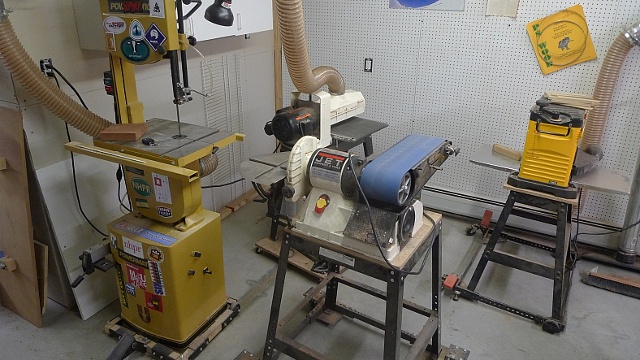
Band Saw – Used in every build and on nearly every piece of wood that goes into the instruments that I build. Nearly all builders would have a band saw in their tool arsenal. A large band saw is not needed, though the ability to cut up to 8” is useful. Most builders will have a blade for cutting tight curves as well as a blade for making straight cuts through very thick pieces of wood. Examples of use: cutting bodies to rough shape, slicing laminates for headstock veneers.
Jointer – Largely used to create straight/flat surfaces for glue-ups. One of the harder tools for some folks to get the hang of early on, it is pretty indispensible for a quality build. The jointer is actually one of my favorite tools. It is quite gratifying to create an extremely level surface in short order. It can be one of the more dangerous tools however; the postman in our town is a half a finger short of 10 on account of a jointer accident. Examples of use: surfacing neck laminates prior to glue-up, surfacing body edges prior to glue-ups.
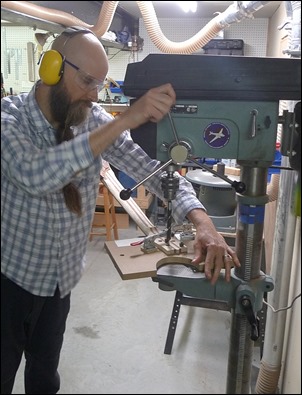
Drill Press – While it may be tempting to go without a drill press and instead use a hand drill for some heavier drilling tasks, I highly recommend against it. The drill press in my shop gets a lot of use and is used in many steps of my builds from early steps till final steps. Examples of use: pressing in frets, drilling holes for tuners, hogging out large cavities before routing, even rough surfacing with special attachments.
Planer and/or Thickness Sander – While I use both in my shop, I know several builders who use one or the other successfully. These tools both work well to help achieve final thicknesses of components as well as providing a glue-able surface similar to the jointer, and often in conjunction with the use of a jointer. Examples of use: final body thicknessing, fingerboard thicknessing.
Spindle Sander – Used for shaping/sanding non-flat surfaces. Examples of use: Final body or headstock edge shaping, nut shaping, cover plate shaping.
Belt Sander with Circular Sander – Used for quick surfacing/leveling of surfaces that do not need to be glued to another piece of wood. On occasion, I will use a belt sander to do a rough straightening of an edge prior to using the jointer. Using the circular sanders adjustable table, I can angle the back of a nut easily. While fairly benign at first glance, this tool has bloodied the tips of the fingers on my fretting hand on the afternoon before a gig – suffice to say, the bass grooves were pretty rudimentary that night, using mainly just my ring finger. Another luthier mentioned getting the tails of his shirt caught in his belt sander just last week. Examples of use: nut shaping, cleaning up neck carves.
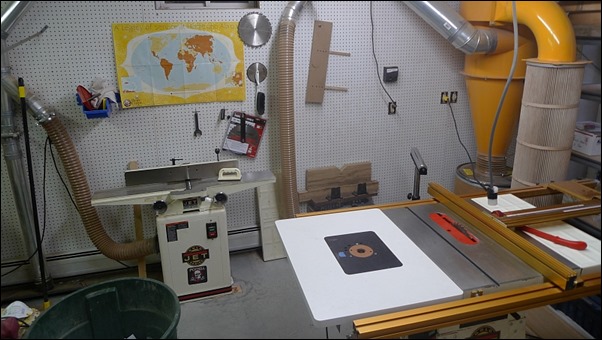
Table Saw – Not found in all shops, I find this tool quite helpful and a time-saver, though it is a space hog. Useful for quick straight cuts, as well as some precision work. Examples of use: fret-slotting and cutting body blanks to rough thickness.
Dust Collector – This tool hooks up to nearly all the tools above and keeps a shop somewhat clean. For health reasons, it is good to have a dust collector and is a universally embraced piece in woodworking shops.
Radial Arm Saw or Miter Saw – Great for quick cut-offs and some precision work. Personally, I only use a miter saw occasionally, and sold my radial arm saw a few years ago to free up space for a thickness sander. Examples of use: fret-slotting, cutting neck blanks to rough length.
Early on, I worked in a 14’x16′ shop. Looking back, that was quite small, but adequate. I had a small bench, and nearly all of the tools were on rollers. Not even a drum set could have been set up in the free space in the middle. When building instruments one-by-one, most of the tools need accessibility only for a few of the steps, and then can be rolled out of the way.
If you are interested in building some instruments for yourself, but lack the funds for the big tool purchases, you may be able to find some artist/woodworkers co-ops that share space and power tools. Woodworking hobbyists will likely have many of these tools already, so a relative that enjoys woodworking can give guidance and maybe offer some time in their shop as well.
 |
This article contributed by Brian Ristola. You can check out his web site at www.ristolainstruments.com. |


Good article. I use each of these tools in the instruments I build and I cannot think of any one of them I could do without. The spindle sander was one of the best purchases I ever made.
A tip to add, if you do not have a spindle sander, but you do have a drill press, you can get sanding tools that will fit into your drill press and effectively turn it into a spindle sander. My drill press allows for speed adjustments by changing pulleys the belt uses.
Like a lot of small builders, we just added a small CNC Router to our shop. We’re really looking forward to the challenge of making it work for us and the benefits of automation that will free us up to do other things.
A CNC small router is definitely next on my list.
going the DIY route. There are a lot of successful DIY designs out there now. For the sake of consistent duplication (especially for necks) I think it will really help. Will be nice not to have to use routing templates and the like on bodies anymore either.
This is a great article. I am actually in the process of making my bass and guitar company legit. I currently work out of my uncles’ private shop and will be making my first big purchase very soon, a Dewalt 735x planer. I cannot wait until I have my own shop and all the proper tools. My company is going to take off, Naked Bass and Guitar Company.
I use my father’s shop (he’s a woodworker by trade), so I kind of have to use what he has. Luckily he has everything on this list, with the exception of the jointer. He used to have one, but after he got his new, super fancy table saw he said it wasn’t necessary to put stuff through the jointer. I went with it and haven’t had any issues with gaps in joints or anything else. I’m always wondering if I’m missing anything by not using a jointer, but I don’t see it.
Probably the most important tool I have is the dust collection system that I installed last year. I have all the power tools and a wide selection of hand tools but the dust collector keeps every thing cleaner and healthier.
Really nice set-up you have there – very efficient. Everything you have is useful.
I find the jointer is no more ore less dangerous than any of the other peices of eqipment in a shop, just because the authors local postal worker had a mishap it’s all in the way you use it. I will say though that getting a jointer and planer with spiral cutting heads will be well worth the added expense for luthiers since we use many highly figured woods which are a challenge to work without chip-outs, the spiral cutting head wont eliminate this problem completely but will certainly help.
Also this article doesn’t mention it perhaps due to the fact it’s not a stationary tool but one of the most used and important pieces of equipment in my shop is by far my router. A good quality router or two (or three or four) and good template making skills can add a level of consistency for things like necks and bodies, I don’t care how skilled you are with a table saw, jointer, band saw or edge sander you can’t make exact duplicates for things like tapered necks unless you have a router and template.
thanks for the article but I’d love to see pics accompany such materials, and for two reasons:
1) English is not my native language, so I have to look up the definitions and then sample pictures to know what you’re talking about;
2) continental instruments, machinery, tools and skills used may differ alot from those used in the US, and it is interesting to see what is actually being used, for small luthiery operations is way more common in the US
thanks again