The feature bass this week comes from a builder rekindling his hobby for the craft.
Builder/owner Greg writes:
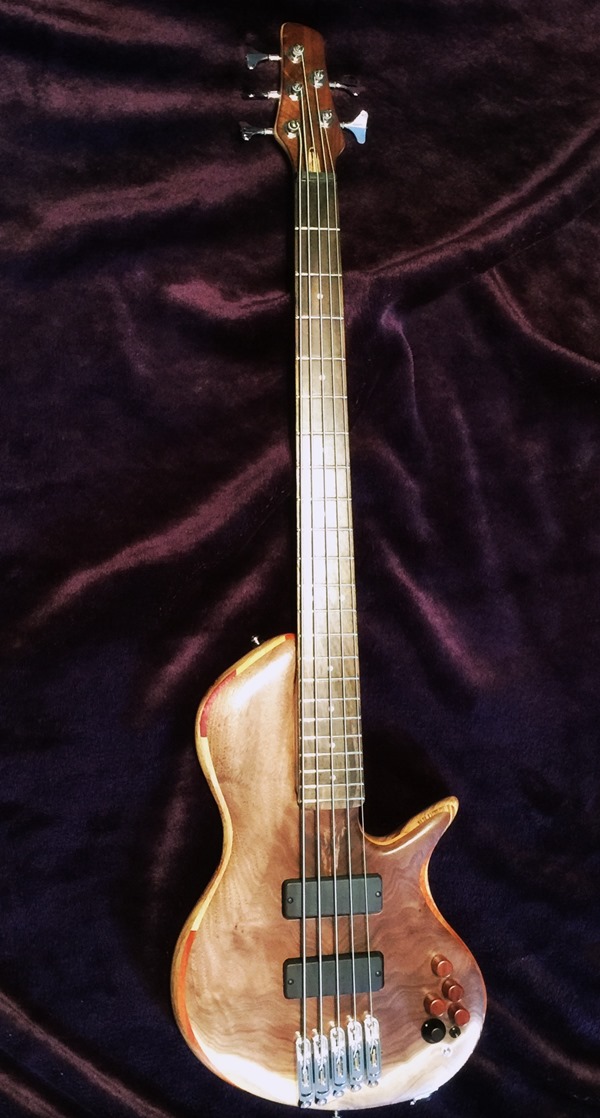
I haven’t built or modified much on an instrument in over 20 years and recently rekindled my hobby. This project is a re-body of a bolt on budget bass, replacing everything but the neck and machine heads (and those are next).
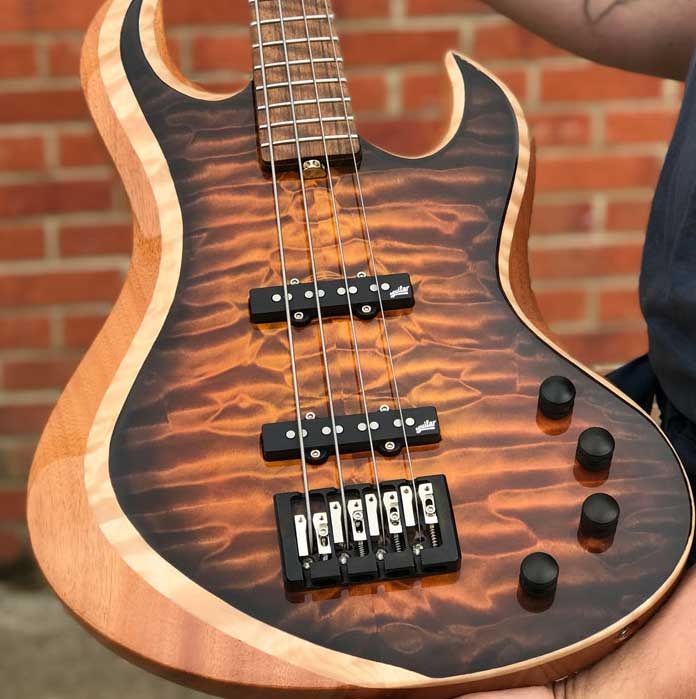
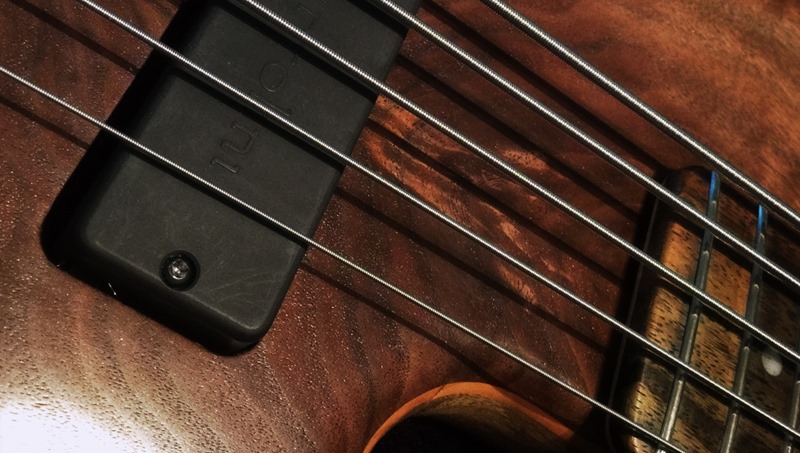
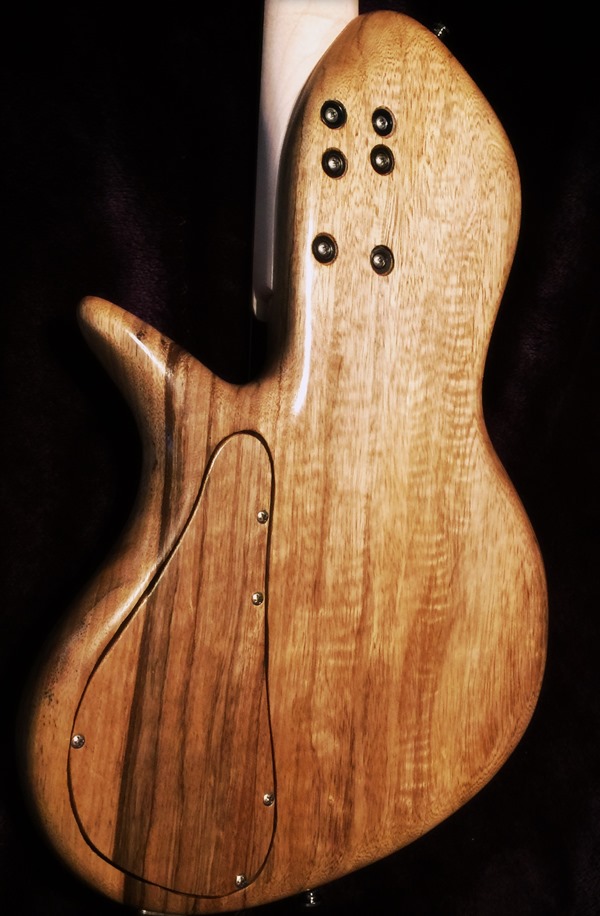
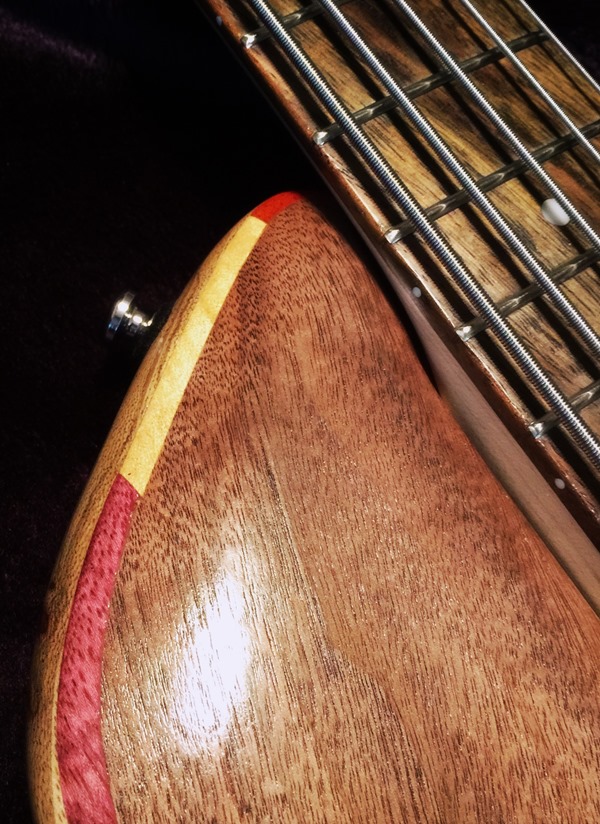
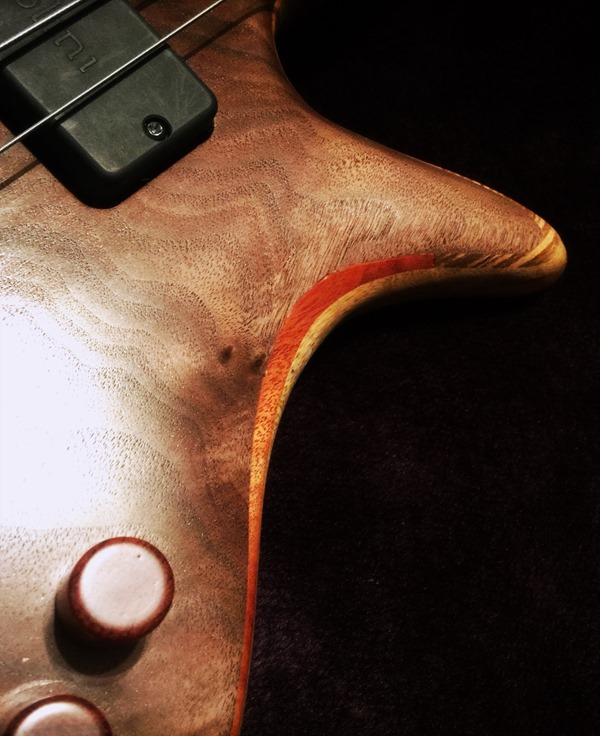
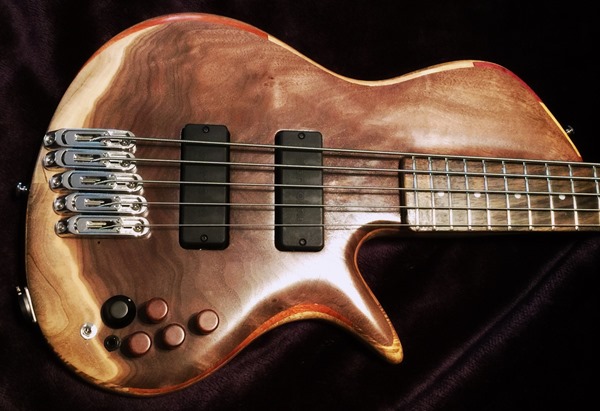
It’s loosely based on an Elrick silhouette, modified in Photoshop to fit the dimensions of a body blank I found. The back is Black Limba, chambered on the bass side and between the pickups, the top is Claro Walnut, and the laminated layer is a patchwork of zebrawood, purpleheart, bloodwood, yellowheart, and padauk. Pickups are Bartolini BD Classic Bass dual coils from Best Bass Gear (got for a great deal on a scratch and dent sale!). It has an Aguilar OBP-3 preamp with separate treble/mid/bass controls, pickup balance, volume control, a toggle for 400/800hz mod freq, and another toggle for pickups in series as humbuckers or outer coils only in humbucking mode.
It started with an Ibanez GIO GSR-105EXOL five string I picked up online as a project bass for under $200. It was playable, ok sound for an entry level, and basically costs less than a kit or neck would by itself.
The fretwork was barely completed from the factory, not leveled, unpolished, lots of buzzing even with high action which is about what you’d expect for a budget model. I installed a $20 set of good quality Chinese imitations of Ibanez Mono-Bridge II individual saddles on it, and those already had made great improvements in tone and sustain with the original body. I asked Best Bass Gear for suggestions on a pickup upgrade, and Max recommended the Bartolini BD after I described the sound I wanted.
I decided to go beyond a pickup upgrade and planned out a singlecut, chambered body with a laminated layer between the top and back. I found good eBay deals on decent woods without spending a ton on something I might screw up. About $85 for the Black Limba in one piece, and $75 for the bookmatched, jointed, unglued walnut. When looking for the binding layer I saw a mixed pack of 1/8″ exotics from 3″-4″X8″-10″, which gave me the idea of the multi-wood patchwork around the edges instead of a single veneer layer.
To do the body matched control cavity cover and reduce the overall thickness (almost 2.5″ after laminating the chambered back, 1/4″ walnut, and 1/8″ binding layer) I sawed 3/8″ off the back of the slab. Tedious work without a bandsaw; used a circular saw to get at least 3″ around the perimeter of the unshaped block after lamination, then finished the rest with a handsaw in two hours.
The extended neck pocket is hand shaped to fit the original heel contours of the neck, a couple of hours hand shaping with micro planes, rasps, violin planes, using carbon paper to check fit and interference after roughing out with a router. The control cavity cover was a similar process.
I used the original 4 bolt neck holes, added two more further up and they’re all attached with stainless machine threaded inserts and bolts.
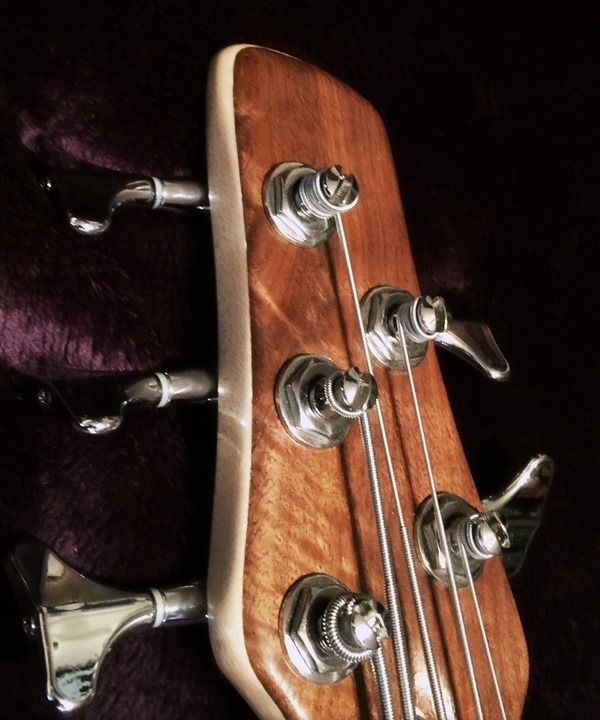
I did a new headstock veneer from walnut, and a little reshaping of the whole thing. New GraphTech nut as well.
Loads of mistakes and learning events, which was the whole point of this. The overall lessons were “don’t rush” and “plan better”.
First mistake was splitting the bookmatched top during sanding and I had to redo it without a jointer. I screwed it up even more trying to sand the old glue back, and the walnut was so brittle it chipped out when I tried a hand plane. I finally salvaged it enough to bookmatch again with an up-spiral, bottom bearing flush trim router bit following a piece of MDF to square the edges. Still have a bit of visible glue line between the bridge pickup and bridge hardware, but you have to look for it after filling with matching sawdust and DAP Wood Fuser glue.
On the patchwork lamination layer, I had great luck with most of the alignment, but got a couple of pieces with gaps in the butt joints that ended up showing in the edges as the contours reveal it. It was over a dozen individual pieces to align, then laminate to the walnut layer. The small gaps filled well since I had scraps of each piece to sand and use.
The walnut/patchwork sandwich cupped after taking out of the press, which made for a nerve wracking lamination to the Limba back. Thankfully that went well, and actually helped the center glue down well (was convex in the center and high on the outer edges of the glue up, so the middle pressed down harder than the outside).
I carved a small hole through to the bass side chamber when shaping the tummy cut (plan better next time!). I was able to cut a wedge from the same section of that body using the 3/8″ slab I removed earlier, and again filled the remainder with sawdust and DAP fuser. Love that stuff!
The bridge saddles are so tall and the neck pocket ended up lower than stock in relation to them, so I had to lower the area where the bridge sits to get a enough adjustment height travel.
I worked that into the contours so it’s about 1/16″ lower than the rest of the top, but not obvious unless you feel it.
My router pattern bit nicked the edge of an MDF router template I bought from Best Bass Gear for the pickups too, so that side had a notch on the first cavity. I ended up flipping the template around and using the unharmed long side to fix it, so it’s about 1/32″ bigger than it should be. I made the other pickup cavity match so it’s not as obvious. Then I routed into a chamber between the pickups…not a major effect, not visible, and fortunately it was a small chamber so it’s not affecting tone.
Controls are way too close together, not much I can do about that now. The control cavity is very tight, and I should have laid out the parts before ever routing that. No place for a separate battery box due to the layout and chambering decisions I made, so they’re inside the cavity.
Wiring the Aguilar OPB-3 and the extra switching options was a special challenge, over 40 soldering connections with very small wires. I did the majority outside of the body with the electronics in a piece of foam to get everything aligned properly.
Got everything installed, and…nothing. Had the battery connections reversed and they were discharging each other. Fixed that and still no sound. After checking every connection again and searching for advice, I found that Best Bass Gear has a great OPB-3 troubleshooting guide. That publication helped me more than the manufacturer’s forum, mentions grounding that Aguilar’s schematic doesn’t address, and showed me how to bypass the preamp to troubleshoot.
Finally got everything in the right place and all the controls worked, then I noticed I had the balance pot “backwards”. Reversed the pickup connections and now everything is perfect (and sounds glorious).
To close it all up, I wanted to use a cool trick I saw with neodymium magnets instead of screws to retain the cover, and a finger pull carved in. Got 6mm magnets, put six around the edges of the cavity and in matching locations on the cover, then found out they’re not strong enough to hold it. I ended up using screws (then drilled a 1/32″ pilot hole all the way from the back through the finished top. More DAP and sawdust). I also routed the ledge too narrow, so the screws are very close to the edges of the cover.
Things that did go well…finishing. Used Zinnser Bullseye shellac-sealer and it got exactly the effect I wanted without a lot of effort. Wiped it on, used a 220 grit 3M sanding sponge between coats, and got five coats on in an afternoon. It’s dry to touch in minutes and can recoat in an hour, cleans up with ammonia, and you can do touch ups by diluting the finish with denatured alcohol.
On the bad factory fretwork, I did a good leveling (still have an old MDF and glass leveler that take a cut belt sander belt or roll). I upgraded the fret crowning file I bought as a teenager for a nicer Stewmac version, and used their fret buffing discs on the Dremel. They’re abrasive rubber, two grades, and genuinely work well. They suggest using a round file to cut the profile in the disc, but they’re aggressive enough to destroy the file (fortunately it’s just one of the Harbor Freight cheapies I’ve used up anyway). I’d use a screw the same size as the fret wire instead. Those got a mirror polish on them once I got the hang of just how aggressive the coarse grit wheels were (and fixed the divot I put in the first fret). Finished with a felt wheel.
Anyway, lots of things to do differently, a few more tools I know I need now.
Overall it’s a huge improvement for a total of less than $600 on top of the original $200 bass. It plays nearly as well as my beloved (and ten years gone) 1994 Pedulla ET-5 Thunderbass, just short some sustain. The B-string actually feels better, and with the electronics package it nails the tone I had back then. Balance is tremendously improved over the stock Ibanez body, and its ergonomically comfortable. Very lively unplugged tone too, enough to play on the couch with kids watching TV and still hear it.
Next upgrade will be a multi piece neck to replace the original Ibanez one, which means I’ll need to improve my fretting skills substantially.
Well done!
Want YOUR bass to be featured for Bass of the Week?
Submit yours now using our easy web form