

Max sat down and talked with Tom Ambrose, who has had a rich career as a bassist. He has been classical trained as an upright bassist, played with B.B. King once, taught scores of young players, and is currently gigging with the Rick Miller Band and singer/songwriter Travis Humphrey.
Max Kay: How long have you been playing bass?
Tom Ambrose: 24 years. That’s a long time. It’s a lot of gigs.
MK: Did you study formally? Or what was your approach to learning the instrument?
TA: I studied the upright in undergraduate for four years. I started playing upright when I was 19. I wanted to be a music teacher in a public school but they wouldn’t let me study musical education on an electric bass.
And I had a really great upright bass teacher who eventually became one of the bassists in the Cleveland Orchestra. So I got lucky enough to study with him for two and a half years right before he went to the Cleveland Orchestra.
And then I also studied with Marty Ballou, the bassist for the Duke Robillard Band. He’s played with Peter Wolf and a variety of other famous people like James Cotton. And so I was lucky to get a really solid classical background.
MK: How old were you at this time?
TA: I was 19-21 when studied with those guys. And that really created the basis for everything that I do today.
I just got sucked into this hard core jazz group. There were these guys that were really deep into certain styles of jazz and I got really sucked into that in college. So it was more like I was part of this community of people that were into Keith Jarrett and that style of quasi-free and straight ahead jazz.
So I only listened to almost all jazz and classical music for almost two and a half years and actually never watched any TV. I had no clue what was going on in the world until I went home for Christmas months later. I was so focused on music because I was young and I could be. It was a good time to do that.
MK: What were some of your early gigs?
TA: I played a lot of straight ahead jazz gigs for the first two and half years. I took to the upright pretty naturally and I started picking up work with a lot of local people that were really good players. That nurtured that side of my playing.
And you have to remember, bass wasn’t that popular in the early ‘90s. Victor Wooten hadn’t really exploded yet. So the bass wasn’t what it is today. I was the first bass major at the University of Southern Maine in 20 years. But right after me there were like ten.
So I was just a really lucky. I had the opportunity to play the bass with really great musicians and that quickly nurtured my skills in a way that you can’t get right now. There were more opportunities because there were less people interested in that instrument.

MK: Were you pretty determined that you’d make music your life at that point?
TA: I was pretty determined that I wanted to be an established musician. But I was struggling with whether or not a career in the type of music that I enjoyed would be viable at that time. I was starting to become aware that I liked music that wasn’t necessarily popular and I wondered what would that mean and what would my life be like if I choose to do that. There was definitely a defining moment for me when I decided that music would be something that I would always do and I set my goals to be a really solid and sought after local bass player. Not a road dog.
I can remember hanging out with a really famous guitar player. He was at the top of the music that I wanted to play. And he was living in this tiny little apartment making almost nothing, even those he had a hit on the R&B radio stations. Not pop R&B, but the real legitimate guitar playing, soul music R&B. But I realized I wanted to work with people like him. If they came to town I wanted them to call me.
About seven years later when he came to town to open up for B.B. King I got the call. So I hit that goal at one point in my life to be that person. And then ever since then I’ve just been playing with really good local musicians, and making a substantial part of my income from music. But never having it be the only way I make my income. Except for a period of 9 years right after I got out of college when I taught and played professionally for 9 or 10 years. I put myself through grad school doing that.
MK: Do you still give bass lessons?
TA: I don’t. But I still will to one of the children at my wife’s school. This little girl is going to be a burning bass player. I used to do it full time. That and playing gigs for ten straight years. I’ve had 55 students a week for a while. It wasn’t even like I was living in New York.
My kids always held one or two of the top chairs in All-State Jazz. One of my students won a $70,000 plus scholarship. Another won some significant scholarships to Berklee, which is not easy to do these days. Even if you just get $5,000 or $6,000 a year at Berklee that’s a lot of money now. It used to be that Berklee was doling out the full boat to the heavy hitters, but they don’t anymore.
MK: Do you miss teaching bass?
TA: Yeah, I do, quite a bit. It’s not an issue of not wanting to teach bass it’s just not the time. I have the two little kids, the day gig, and honestly too many gigs. It’s a bizarre problem to have. I never thought in my mid to late 30s that I’d have a billion gigs. I thought the reverse would happen as I got older. You know?
MK: When did you start to get interested in playing the electric bass?
TA: Well it’s interesting because I had started on electric, but then I started to play so much jazz that I couldn’t play electric anymore. So there was a point that I was playing so much upright that I almost dropped out of college because I couldn’t keep pace with the gigs. I was playing four or five nights a week in all different kinds of bands. Then on top of that, there was the orchestra and jazz band rehearsals. There were times when between practicing, rehearsals, and gigs, I’d play for 13 hours a day. I’d get home at 2 A.M. and have to be right back up to rehearse in the morning.
I was focusing on playing the upright and then I figured that the chops would transfer over to electric. What happened for me is that at some point right after college I started taking guitar lessons. I started taking guitar lessons with this great guitar teacher in Portland named Bob Thompson. He was fantastic. I studied off and on with him for 3 or 4 years. That’s when I first realized that the electric bass was its own instrument. It required its own touch and finesse. It was difficult to cultivate if you come at it as an upright player.
It also was a practical matter. I was a grad student and I couldn’t play upright enough to keep my chops up to where I wanted them to be and also play electric. And I was getting a lot of gigs playing electric so I stopped playing upright for a period of six or seven years. I didn’t even own an upright bass. But during that time I took everything I learned from upright and I brought it over to electric. And I started to figure out left hand and right hand articulation, notes lengths, how the strings respond to the touch if you play the bass harder or lighter. How it all works.
I started to be able to control the electric bass in a way that was musical to me. I started to find my voice on the electric bass. And once that started to happen I started to get really into figuring out the right combination of basses, strings, amps, and pickups. I got really obsessed with it for about 8 years. I’ve owned hundred. Hell, at least a 100 Lakland basses. And I’ve owned many combinations of amps, including Phil Jones, Eden, Epiphone. I just tried so many different combinations of amps and electronics.
And it’s funny, because all of the sudden I just arrived at what worked for me. It’s really been in the last 3 years that I’ve started to feel truly settled with my setup. But I’m not convinced that it isn’t because I’m just so busy with little kids and gigs, and it may not be because the curiosity is there. It’s always evolving, but I feel like I’ve found my voice on the instrument. I do have some ideas for a custom bass but they would just be an amalgamation of what I’m currently using. It wouldn’t be a dramatic departure.
MK: What is it that attracted you to Lakland basses specifically?
TA: I think that what attracted to me was the fact that they had a hybrid of the vintage vibe and a modern vibe simultaneously. I’ve been playing Lakland basses since the company first started in the late ‘90s. I was one of their early customers. The first Lakland I got was a standard Lakland bass that had the MM pickup and the Jazz pickup, but it almost had a jazz bass neck. It was all American made and it just had an amazing feel. The neck felt solid but not too rigid. I had been playing a Modulus graphite jazz bass prior to that and it felt too rigid to me.
I just dug the fact that the basses don’t respond to humidity because of the graphite reinforcement in the American’s necks. It provides just enough stiffness so they are consistent, but they still feel warm and have that wood sound. Because of my upright background that wood sound is always in my ear no matter what I’m playing. I always try to find basses that respond to me in that way.
I’ve not found another company that makes bases that feel that way. They are the closest thing to owning a real vintage ‘62 J or an early ‘50s P bass without having to spend that kind of money to get one. Right now something like that is about $14,000. But I can buy a really good Lakland bass for $3,500 and it plays great. With my eyes closed it would be difficult at times to tell the difference.
And when I was teaching 55 kids a week I would help them get the beginning model Skyline basses. I never made any money off it, I just wanted to make sure my kids had good instruments. So we had this relationship where my kids could get really good solid instruments at a reasonable price.
And my students who have won significant scholarships have all used Lakland basses to get them. Specifically the 55-02, because they are a good student level instrument. But some of them are still playing them professionally. The same ones they bought from me ten years ago. And both of the basses that I own right now are very early Laklands. Ones an American and ones a Skyline, and they both have held up.
MK: What has been your favorite model?
TA: It really depends on the gig. If I had my druthers I’d own like 10 of them and they’d all be set up completely differently.
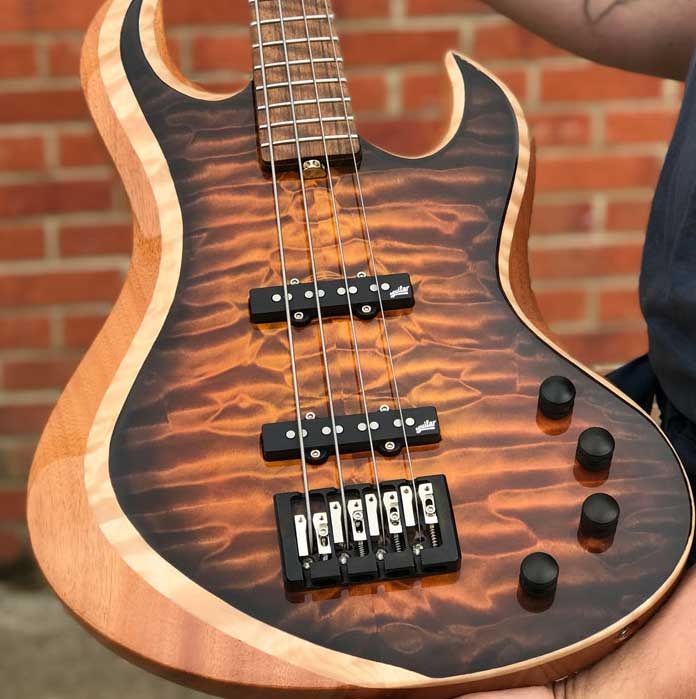
The bass that I use for the majority of my gigs is a Joe Osborn straight ahead jazz bass. I also have a PJ bass that I use from Bob Glaub series. That one is set up with flat-wound strings so it has more of a mo-town kind of sound. The round-wound bass has the Darryl Jones pickups from Aero in it. That gets a very bright, modern, percussive sound.
And I don’t have any active preamps in my basses. I use a Michael Pope outboard preamp on the floor for when I need to get some slap bass sound or to add some depth to a room. The reality is that a majority of the time I just plug the bass right in and it sounds amazing.
MK: Are most of your basses 4-string?
TA: Yeah, I primarily play 4-strings. I have really small hands. Even when I play upright I have to play with my own technique to make it feel relaxed. I can’t use traditional upright technique because I have a short pinkie finger. And so I just play basses that fit my hands.
Also just don’t find the need to play anything lower than the E and maybe an occasional D. So I use a Hipshot Detuner for when I need to grab that D.
MK: So tell me a little about the gigs that you are currently doing.
TA: I play straight ahead Chicago Blues with this great guitar player named Rick Miller. And then I play with this fantastic singer/songwriter Travis Humphrey. He plays literally over a thousand covers and a large number of originals, so the gig is unbelievable versatile.
On the Chicago Blues gig I bring the Bob Glaub with the flat rounds. For Travis I tend to bring both basses because I never know what he’s going to do. It could go from Country to Reggae to Blues to Old Soul to ‘80s pop, all in one set. The Lakland basses and the gear that I’m using are incredibly versatile and they allow me to get a lot of sounds in a variety of settings.
Check out all the great Lakland basses, pickups, and sets of strings we carry at Best Bass Gear.

Awesome interview Max!
I have been a Lakland player since 2002. I do 150-200 gigs a year on mine and they hold up! My good friend and colleage Sean Hurley first intoduced me to Laklands back in ’98. GREAT BASSES! Great interview too!!
Wow, that’s some serious gigging John. What model to you use?
United did not pay Dave. They offered to pay him after the video went up on YouTube but he told them to give it to a chritay. I have also heard though that United is using it in their training now though. I wonder if they are paying him for the rights to do so?