
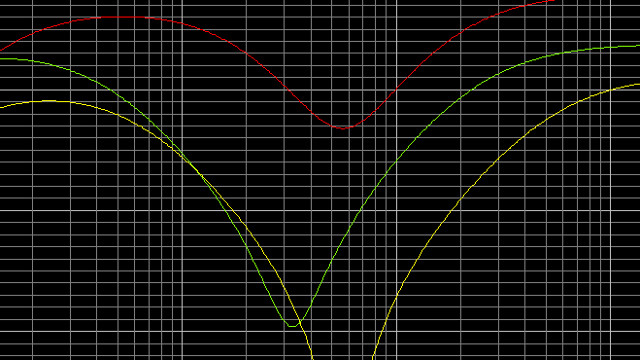
While the very name “bass guitar” would strongly indicate that a bass guitar is all about bass frequencies, in a mix the bass guitar is actually better mixed as a midrange instrument.
But before I get into that, a smiley-face curve of an EQ does in fact look like a happy face:

Sometimes this is referred to as “scooping the midrange (or mids)” because it does appear like the middle was literally scooped right out.
It’s easy to think, “Well, a bass guitar is about bass, so I should increase the bass, lower the mids and increase the highs to be best heard, right?”
That usually doesn’t work, because in the end all that does is make your mixed sound whether studio or live sound “loggy.” Sure, you’re have thundering bass frequencies and hear the clack of your frets easily because the highs have been increased, but your sounded notes will more or less be drowned right out – especially when put “against” drums and guitar.
In the sonic space you’re in as the bass player, the midrange is almost always the most accommodating in the respect that that’s the space you can use to cut through a mix effectively; this is why it’s better to tune your amplification towards the midrange instead of “all lows, all highs and nothing else.”
If you have issues cutting through a mix now, punching up the midrange EQ a few ticks may get you heard better without the need for louder equipment or an increased decibel level in the mix while in the studio.
Smiley-face/Mid-scooping is not “bad,” but at the same time usually not good for bass in a mix – or is it?
The general consensus is that mid-scooping doesn’t work very well for most mixing situations where the bass is concerned. Do you agree? Or have you found that mid-scooping worked well for you? Where did it work? And more importantly, where did it not work? Did you need to employ the use of better EQ control?
Post a comment or two with your mid-scooping experiences.


What I’ve come to realize is that taming the midrange is key, not scooping it. The “ugly” sound that I’m assuming people want to get rid of is that 200-300 frequency. Knock that down a bit, raise the upper mids a tad, and you won’t even really need to touch the subs to 100 hertz. Adjust the midrange as necessary, and you’ll cut through, with a nice, powerful bottom end as well as cutting highs. Pair that up with a good, solid re-amp (in studio), and you’re gold.
you need mids to be heard thats it
One is supposed to delete all of the harmonics to make a good sound???? As an audio engineer, when I see things like the smiley face, I know right away this person has zero idea of what a good instrument is supposed to sound like.
I was boosting the mid-low and mid-high and wasn’t that pleased with the result. Upon the advice of a guitarist friend with waaay more experience than me, I kept the mids at 12 o’clock and dropped the low and high to between 10-11. Much better sound. His theory that it’s better to CUT than to BOOST seems to work well.
I get that killing all of your mids can eliminate note clarity and cut but sweeping generalizations about EQ and settings are a bad idea because context is king. For example, a scooped EQ on an overwound humbucker may result in a frequency similar to EMG J’s (just as an example) which are reasonably popular. Point being that judging a tone based on the settings is the same thing we’re accusing these players of doing. Sounds good=good no matter what the knobs say.
I’ve have always used what I call the W instead of a smiley face except I normally don’t go all the way up on the low or high end and don’t go all the way down on mid lows or mid highs
How she sounds is the deal–cutting mids never made it for me. Tone has to be tweaked based on where,what and how…not on a blanket ‘cut the mids’ idea.
I have a solid bass with good electronics and an amp that has a slight natural mid hump. The only time I mess with the 3 band EQ (which is normally set flat) is when I have bad amp placement or room acoustics. In those situations where the main problem is that I can’t hear myself, the answer is usually a slight mid boost and bass cut.
I play around with every knob while at home until I find a setting I like then “tweak” in the studio. There is no standard setting or pretty pattern that works, there are just too many factors to consider.
BEST BASS POST EVA!
Seriously, this post will save more humpback killer penguin bass players than ANY thing else you guys have put up. It’s like a great local muso once said, “Tell the kids, tell them! Mid range is not a drink driving offence”. Seriously, the day I was taught this was one of the best days in my playing career.
I think the smiley face eq is pretty much regarded as universally god – awful. It removes way too many critical frequencies.
My instrument sounds good. Its character helps it do its job as is. Just how BAD does a bass have to sound that it needs its character obliterated?
Some scooped tones work for some slappers. The MXR M80 has that little button that scoops around 800hz and boosts top and bottom. Tons of players love that tone, that is until they try to use it with the band. I am a midrange monster. I scoop out the fuglies in the 200-350hz range and bring up the 900 to 1.6khz range pretty heavily .. brings out a great Geddy tone. But I don’t think there is a blanket generalization about EQing, it all depends on what it all depends on. Modern “Nu metal” uses a heavy scoop, but 70s rock bass uses a heavy boost in the 900 to around 2k range. So it all depends on who you are and what you’re doing.
I bump mids when I play with a group so that I can be heard, but I love the mid-scooped sound when I play by myself.
+1
Eq needs of course depends on what you feed it from the pickups. A J bass is already scooped vs a Stingray is very mid present.
Of all the words that I have seen to describe sound, “loggy” is the first one that I didn’t understand what it was trying to get at