
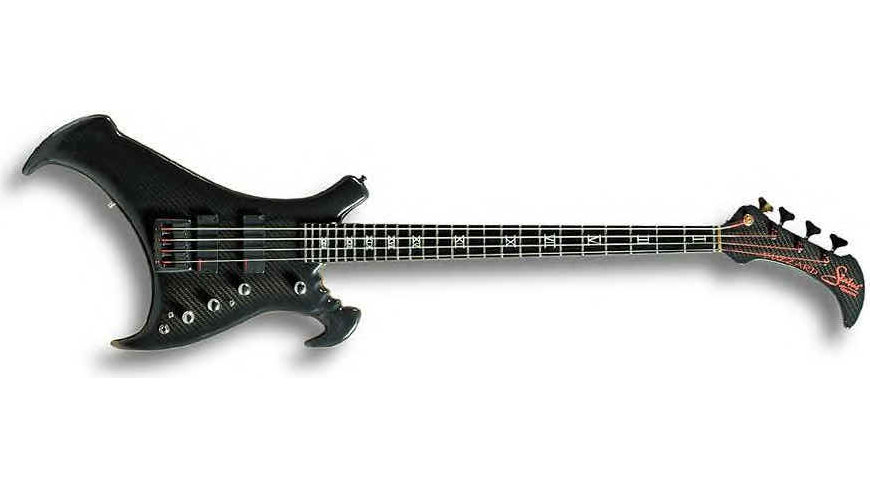
If you want to talk about custom basses, the one that John Entwistle played in his later career (as in from 1985 until his passing) is pretty much as custom as it gets.
For simplicity’s sake, the bass John played as shown above is a Buzzard bass. That’s not a company but rather a model name. Almost any tech spec sheet on this bass will describe things on this instrument as “irregular.” As in irregular body shape, irregular headstock shape, and so on.
Early versions of the Buzzard were designed by John himself and Warwick and were made from only wood. Later versions had graphite necks made by Modulus that attached to Warwick bodies. Modulus is reported to have made a total of 6 graphite necks for John’s personal Buzzard basses. Even later versions of the Buzzard were made by Status, a UK-based builder specializing in graphite composite instruments (and is still in business!)
John could, obviously, wrangle an unbelievably awesome live tone out of a Buzzard:
While John was known to use several different basses over the years (including Alembic,) the Buzzard was the bass he was most seen with live from 1985 on.
Where the Status Graphite version of the Buzzard is concerned, the body had a “basket weave” design for its overall body appearance (it was not just a straight gloss black,) neck with Roman numeral inlays, “hyperactive” pickups, 1/4″ stereo output, LED on/off switch, bass cut/boost knob, pickup blend knob, midrange on/off toggle, midrange frequency knob, and master volume knob.
Great bass? Well, the best way to answer that is that it was a great bass for John. John specifically designed the Buzzard to be as good as it could be for live performances, hence the heavy use of graphite (which does not shift anywhere near as much as regular wood does.)
For you “modern Entwistle” tone chasers out there, the Buzzard used soapbar size pickups. We carry many of those by several different brands. The kinds best suited for a modern Entwistle style tone are ones that provide tons of range, have tremendous output, promote superior even string balance and have superior shielding for the best possible live sound. An example of that would be the Bartolini Singularity, but bear in mind that is one example because again, we carry many soapbar sized pickups, so choose carefully.


I can’t hear the bass at all in this YouTube video clip. Totally being drown out by the guitar and drum players.
Did John forget to turn up the volume button?
Computer speakers don’t support much in the way of bass response generally. Try listening to the video with headsets or a system with a sub-woofer perhaps.
Hi Guys
so do you know what all the weird Bits were for , ? the handle the hook and others. There s a great true story that goes with the and JOHNS style of playing, having owned one given to me by John its cooler than you may think .
Status used their soapbars in JAE’s Buzzards, along with their custom mid sweep preamp. Those pickups (as well as the hardware) were also used in a number of other Statii. Status still makes a version of the Buzzard with a different (basswood) body shape but the same graphite neck and electronics. John designed it as, “one for the punters”. Fantastic bass with a wide range of tones available. Body is sort of a cross between a Thunderbird and a Precision.
The “beak” was a design feature created by John so that he could hang the bass on the back of a chair in the dressing room when warming up. This information comes to me from Rob Green of Status who worked closely with John to create the last and best version of this bass. Although Warwick was technically the first Company to manufacture these bases made of wood, John smashed them all to pieces because the neck moved nearly every day and he got tired of having to adjust it. When Rob completed the final design for John, he actually had two basses that he took on tour. Rob and Johns bass tech told me that he had a hard time telling the basses apart.
It was the creature in the movie “The Giant Claw.” Check it out.
Too bad Hans Peter Wilfer, owner of Warwick sued Rob Green, Status Graphite to block him selling the Buzzard. Nobody wins.
John was of course an awesome bass player. He is either using a stomp (?) or over driving his preamp. But his playing comes through quite good. Like he’s playing a lead constantly!!
Currently WIP with buzzard, build from genuine Warwick body 🙂
What is of equal interest is that it is a Zero Fret neck and he uses a HipShot, or equivalent, detuner on the the E string.