
See the business listing for this bass builder here
The feature bass this week comes from Newcastle, Australia.
Builder Rod Harper writes:
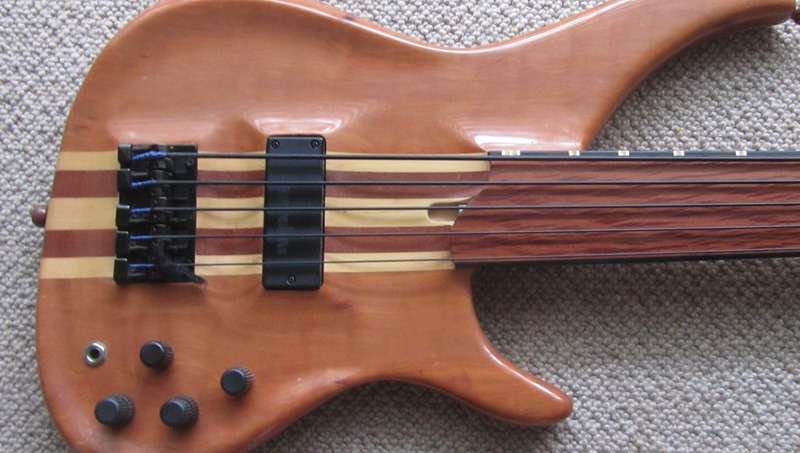
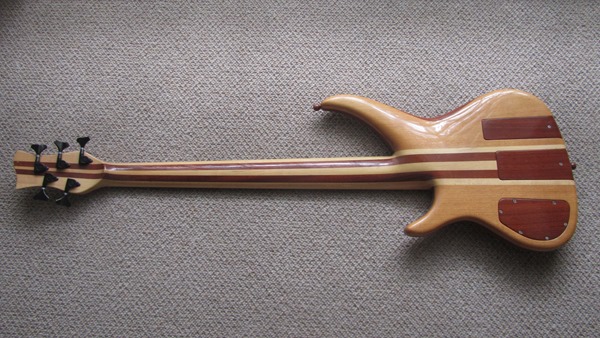
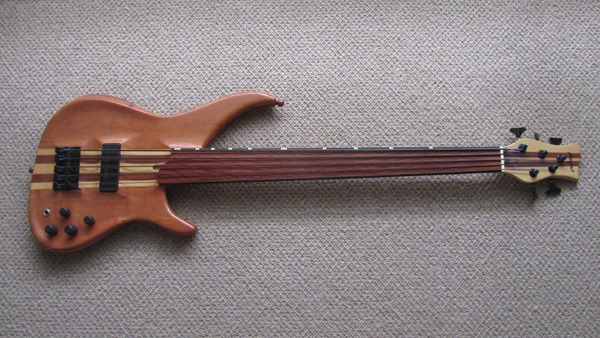
This bass is the last of 8 that I built over the 3 year period up to mid 2001, six of which I sold to professional bassists, the other I kept, is similar to this one but with frets.
This fretless I use mostly at the moment for jazz and originally I fitted it with with an EMG40DC pickup but I was always looking for a bit more body to the tone. I took the advice given by BBG tech Chris Hull and bought a Bartolini 72M45C-T from BBG. The instrument now has a lovely warm satisfying fretless purr to it.
The body wings are made from 3 Australian timbers note for their useful tone quality:
Front – Tasmanian Myrtle or Cherry Laurel
Middle – Australian Red Cedar
Back – Queensland Maple
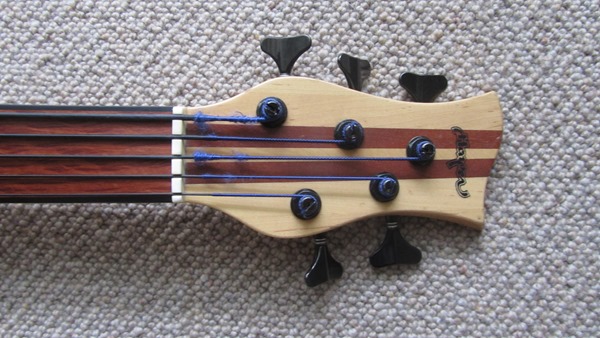
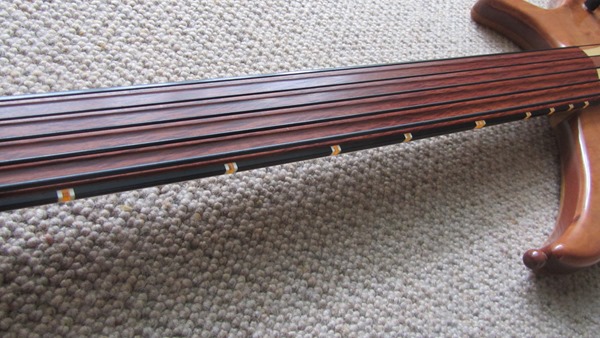
The neck is laminated from tapered pieces of Rock Maple and Mahogany and has a finger board (I guess that’s what you call it with no frets?) made from an extremely hard and dense timber called Casuarina or She Oak and is edged with ebony. I decided to make it reach up to 24 frets and on the top couple of strings took it a bit further (2 frets?) enabling a high “A” (for the more ambitious of players!) I make my own truss rods out of steel rod about 5mm round and slot them into a rout that gets deeper towards the middle of the length of the neck. A fillet of timber pushes the rod into a curve in that rout. As you tighten the rod it wants to make the most direct path between it’s 2 end anchor points thus putting a stress on the neck that opposes the strings. I know that this may not be anything new and that there are a few ways of achieving this, but this method is easy, requires very little tension and has never let me down.In addition to the truss rod I have included 2 routs that accommodate 2 thin (2 mm) strips of steel tapering from 10 mm down to 2 mm at the nut end of the neck glued into place with epoxy and I added a further 2 routs 10 mm x 10 mm that are filled with carbon fiber stippled into place with resin. This neck is extremely rigid and when you first fit it with strings, the neck and strings settle in very quickly plus it appears to have made for an amazing sustain.
I got a bit carried away with this one and decided to include LED’s in the position markers for those occasions when stage lighting or the lack of it messes with your view. The LED’s and the wiring was fitted into a rout on the underside of the fingerboard rather than in the top face of the neck itself. They are operated from a rotary switch that gives 4 levels of brightness, the brightest being the least economical with the 4 x AA batteries (6 volts) that are devoted to the lights alone.
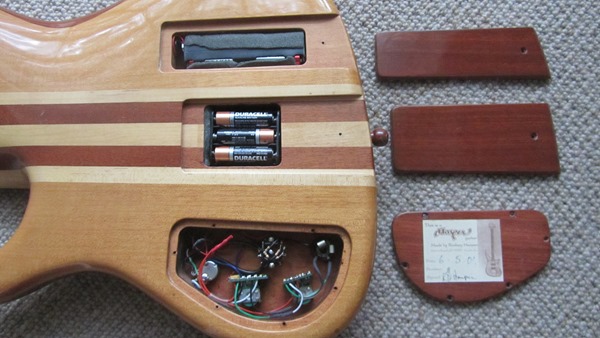
The EMG-BQC electronics are powered by 6 x AA batteries (9 volts) and the covers to them and the batteries are made from a Western Australian hardwood called Jarrah.
The 2 battery compartments have lids with a slight taper over their length and a beveled edge that dovetails into place (similar to the lids on the old school pencil boxes) so a single screw holds them firmly in place.
The strap buttons are turned from False Sandalwood.
Both the mini tuning machines and the bridge are made by Gotoh.
The bridge is made from bone.
I have recently started using D’Addario XL ETB92-5 Nylon Tapewound strings and I am very happy with them. They feel nice to play, sound great and are so kind to the fingerboard.
Well done!
Want YOUR bass to be featured for Bass of the Week?
Submit yours now using our easy web form


Well done Rod! What a beautiful job! I am particularly impressed with your neck engineering, and your choice of woods fills in a few blanks. I will be starting my first build soon, I wanted to use readily available and sustainable timbers (I’m in Sydney). Your brief description has been inspiring! Have you used the same neck construction for bolt-ons?
All I can say is a big WOW! Excellent craftsmanship & beauty! It’s one of those basses that you KNOW it will sound great by just looking at it. I especially like the way you carved the body around the neck heel, PU, & bridge. I”d love to try one out as a 4 string fretless. FANTASTIC JOB!!
Very difficult and hard to beleive that ‘a piece of art’ like this machine has been hand made by a human being… days after days I’m getting impressed by guys like you Rod !
a few pieces of wood, a little of magic, a lot of time (I guess) and that’s it !
Bravo and respect.
I remember seeing one of Rods basses for sale used in a store in Auckland NZ many years ago and, to this day, I regret not buying it. It would have to be one of the finest instruments I have ever played, right up there with Pedullas, Alembics etc. Work of art doesn’t come close.
Beautiful bass Rod, if you ever start building again……………..
Thanks guys for gratifying comments. Thanks BBG for inclusion to bass-of-the-week. Please accept my apology for typo mistake – I meant that the nut, not the bridge was made from bone…
Sorry Geoff, no all my basses have been through body necks and as much as I understand that there are a lot of good reasons for the bolt on approach, I just haven’t got around to doing it. I do believe though that the more rigid the neck, the greater the sustain wether through body or bolt on.
Fantastic bass! I hope I can try one in the future, it looks like its a great sounding bass, it has all the ingredients that I look for. Cheers! ric
Rod Harper. Further to the business about extra bracing in the neck: I have seen so many guitars and basses with neck issues – bowing, twisting etc. So once I decided to make a through body neck type bass (and long scale), realizing that the neck was becoming an integral part of the whole bass, I didn’t want any post build issues. No matter how good and careful you are at choosing and utilizing your timber, it is a living thing affected by the moisture in the air, change of seasons and temperature.
To my surprise once I’d finished the basses where I have gone to this extra trouble, I found they settled in quicker with new strings, stayed in tune better, had above average sustain and I think the tone seemed to benefit also (I also haven’t had any issues with the necks period-so far!). I’d be interested to hear comments.
Very nice,beautiful and shaped perfect,she is all that
I rarely make comments on the basses of the week, but I couldn’t pass this one by without saying what a great looking fretless 5. I am not going to ask what it might cost because I am certain it is far out of my league. Great job!
G’day from Darwin Mate – Beautiful work. Great to see those Aussie woods upfront and centre – we have some nice ones. We had a cyclone up here recently, A lot of Casuarina came down. Anyway – great to see Australian Instruments and Luthiers getting some much needed attention.
Keep up the good work.