
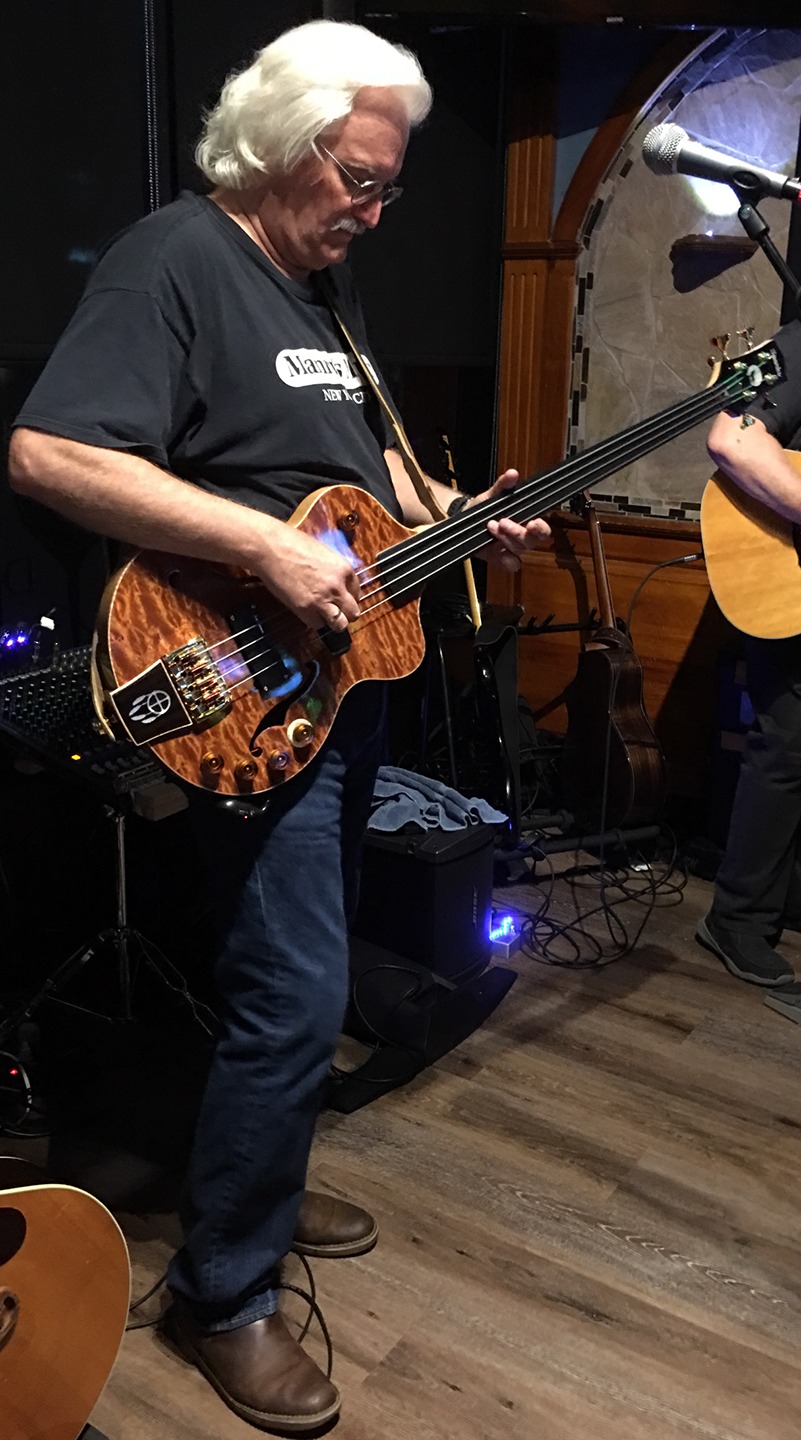
This build comes to us from Edward whose build, the Sparks TRS – 2 Fretless Bass can be seen below. Here’s what he had this to say about his build:
After a successful build of my Lily solid body electric guitar, I decided to build a sister solid body bass and I wanted it to be fretless. I built the TRS 1 bass and began gigging with it right away. As I have done with previous builds, I took photos all along the way, from drawings to completed instrument. I submitted it to Best Bass Gear back in January 2014. The TRS 1 was chosen as a bass of the week…I was thrilled! I got some excellent feedback and interesting questions from the people who responded to the feature.
https://www.bestbassgear.com/ebass/bass-of-the-week/bass-of-the-week-sparks-trs.html
I was so happy with the way the bass turned out, and how well it worked for gigging and recording, that in 2016, I decided to build a sister fretless, this time a semi hollow with F holes. This became the TRS 2.
Over the next three years, I gathered my wood and parts a little at a time, and worked on the bass in my spare time. July of 2019, the new fretless was complete and I gigged with it for the first time.
The basics of the bass are the same as the TRS 1, the body and neck woods the same, same bridge, tuners, electronics and neck pickup. The TRS 1 has a curly maple top cap over the solid body. The TRS 2 has a 1/8” African mahogany (Sapele) cap with amazing quilting, glued to the hollowed out Alder body.
The prominent differences, aside from the semi hollow body and top wood and the binding materials, are the American Indian themed inlays, Hipshot D tuner, the rear mounted battery box and the bridge pickup, a Lace Sensor unit offering more bite and a closer acoustic tone.
As to the inlays…I have, on my father’s side of the family, blood ties to the American Cherokee Nation. The family are from Georgia, where I too was born. To celebrate this heritage, I chose to use American Indian/Cherokee themed inlays of mother of pearl, vintage American Indian coins and an Indian chief “inlay.”
The inlay on the front of the bass includes: my last name “Sparks” and a wolf howling at the moon in mother of pearl on the headstock, a Mother of pearl star on the ebony truss rod cover and an American Indian “Medicine Wheel” with feathers on the faux tailpiece.
The coins are as follows:
Five American Indian head nickels inlaid into the lower curve on the back of the body. These nickels are from sequential years, 1934, 35, 36, 37 and 38. A sixth nickel is inlaid into the ebony rear control cover with the buffalo side showing. The buffalo were a food and pelt source for the Cherokee tribe in Georgia. Also inlaid into the rear control cover is a Georgia Quarter representing my Georgia family. There is also a 1901 American Indian head penny inlaid into the Sapele cover that gives access to the pickup blend pot cavity on the front upper bout. One friend remarked that the bass was worth at least 55 cents!!!
Lastly, although it may look like it, the high contrast American Indian chief bust on the rear control cavity cover is not an inlay at all. Viewed up close, the varied coloring almost looks like some kind of stone, but it is actually just simple wood filler! I mixed a powered water based wood filler and overfilled the inlay cavity, then sanded it down and finished it with nitro.
TRS 2 – Cherokee specs:
Woods:
1. Body: 2” thick solid bookmatched Alder, hollowed out with a solid block down the center.
2. Top: 1/8” thick piece of bookmatched of unusually quilted African Mahogany (Sapele).
3. Neck: One piece rock maple with an ebony fingerboard, headstock veneer and truss rod cover.
4. Faux (decorative) tailpiece: ebony with curly maple binding and a Sapele end unit.
5. Switch cavity cover and rear mounted string ferrule surround: Sapele
6. Body and tailpiece binding: Curly maple.
Electronics:
1. Pickups: Neck pickup is a Carvin radiused top bass humbucker
Bridge pickup is a Lace Sensor bass pickup generally used for acoustic basses.
2. Pots: CTS 500K pots. Two volume, two tone and one blend pot in lieu of the traditional toggle, which gives me a blend of the two pickups anywhere in the spectrum I choose.
3. Built in tuner: “N-tune” internal tuner with a rear mounted battery box. This tuner, powered by a 9 volt battery replaces the typical volume control and allows the tuner to be built into the bass. When the tuner is off the volume control functions normally. Pulling up on the knob turns on the tuner and turns off the output to the amp, for silent tuning without altering the current volume level. Pushing down on the knob turns off the tuner battery and silently reestablishes the output to the amp. I bought up four of these units before the company went out of business.
4. High and Low Impedance circuit/switch: I wired the bass with high and low Z outputs, each with its own side mounted jack and switched with a push/pull pot on the neck pickup Tone pot. Switching to the unused output jack acts as an output kill switch to keep the bass from feeding back when it is in the rack but still connected to the amp.
Hardware:
1. Gold tuners and bridge: Carvin units. The low E tuner is a Hipshot D tuner allowing me instantly to lower the E string to D with the flick of the lever.
2. Gold Dunlop strap locks.
3. All screws are gold.
My thanks go to Patrick Raymond of Raymond guitars and David Treude of Treude guitars for the nitro finish they worked on.
I am currently planning on a build video of this bass, as I did for my last few builds. It will include an introduction, a “60-second build” montage, a “Specs” section and a sound sample.




Wonderful. It looks great! When you post the build video could you also post a video of how the bass sounds.
Will do!
Truly amazing build. And that quilted mahogany — just… wow!
Thanks! Yes the Sapale is just beautiful. I just came upon it by accident from a fellow acoustic builder who said he had two book matched sets that were too small the the acoustics he builds and I bought them from him for $40! Thanks for your interest!
The dream has been captured!…….love it.
Edward, Gorgeous Bass! Excellent electronic options & details throughout.
Love the body design (fretless access to the high notes) and the nod to the Cherokee Nation.
Curious about the scale length, nut width & neck/body joint as it appears that you got away with only 2 screws. Well done!
Thanks! The scale length is a standard 34″ and the nut width is 1.53″ wide.
The neck to body join is deceiving. Although you see two “bolt on” screws, the neck is actually glued in. I use the screws to help keep the neck aligned during the clamping and glue setting process. They act as almost an internal clamp, if you will. Thanks for your interest!
Great! Always love to see the craftmanship and work of others
Thanks and thank you for your interest!
Beautiful
Thanks for your interest and comment!
Truly amazing instrument! Beautiful top and unexpectedly awesome back! First time I’ve felt compelled to comment, fwiw.
Thanks, I love doing inlay work and when I built a bass to celebrate my son’s for his 21st birthday, my wife suggested that I inlay five coins on the back…four nickels and a penny, which equals 21 cents! The four nickels are from the year he was born and the penny the year he turned 21. It was very popular among the family and so I decided to do it again on this bass. I fell if you are making a purely personal build for your own use, you have full creative license! Thanks for your interest!
Superb mr sparks.nuff said.
Stunning piece of work! I am always impressed with technical skill guys like you have. Rock on, and post video when you can. Would love to hear this thing.
Absolutely beautiful work, and right up my alley!! My only complaint – and it’s more of a request – is for larger pictures!
and then I figure out how to open the larger versions of the pictures…so…
ZERO COMPLAINTS, gorgeous work, and I too want to hear this beauty!!
I thought the same thing, especially the full body shot that cuts off the headstock and tailpiece!! How did you get it to enlarge that pictures!?!!! Thanks!
Edward,
congratulations, beautifully executed build! As in comments above, your inlay and motifs are really well thought out and executed. The shape of the bass is really cool, love that quilt sapele, binding – looks like ebony fingerboard? – all just beautiful. Nice job.
Tim Whitehouse
Thanks! The binding is curly maple and the fingerboard is ebony!
wow that is absolutely beautiful…ALmost has a hofner shape to it…really great build!!….not big on fretless but i’d totally buy that
very nice work
Wow! 5 string lined fretless please!