
You’ll notice in the sales verbiage for many higher-end bass guitars that the word “quartersawn” is thrown out there quite a bit (usually in reference to the neck). Does quartersawn wood really matter in the build of a bass guitar, and if so, how?
Before I answer that, I’ll tell you what quartersawn wood actually is.
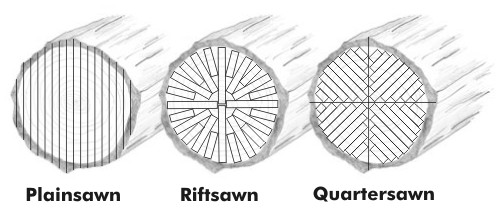
There are two major methods of cutting a log as far as guitar building is concerned, that being flat sawing (sometimes called plain sawing) and quarter sawing. The third and basically never-used method of sawing is rift sawing; the reason it’s never used is because a lot of waste is produced from cutting logs that way, and for guitar building it doesn’t really serve any useful practical advantage.
Flat is the most-used method of cutting logs into boards because it’s the easiest to do. This is where a log is passed through a blade where neither the log or the blade has its orientation changed.
Quarter is when the log is literally cut into quarters, and then each quarter is cut separately in a way where the annual rings are perpendicular to the faces. In other words, a quartersawn board has grain that is much more straight.
Concentrating on just the neck, there are two primary reasons why you would want a quartersawn board:
1. It’s pretty. When you want a board that really has that “wow” look to it in the grain, quartersawn is it. It’s most likely true the best-looking necks you’ve ever seen where the wood really has a luxury look to it was in fact a quartersawn board.
2. It’s more stable compared to flatsawn. “Stable” in this instance means “stiffer”, meaning “doesn’t flex as much”.
And with that being said…
Does quartersawn really matter?
Yes. Looks-wise, it has a very pretty appearance. Play-wise, that’s a different story.
Depending on what school of thought you subscribe to, there are those who believe that a neck made from a quartersawn board does promote better string vibration, however you shouldn’t take that “as gospel” because there’s a bunch of different factors besides just the neck cut type concerning note decay rate of a string. String metal choice, bridge type/metal choice, pickups as well as a plethora of other things all come into play (literally). In other words, if all you do is slap a quartersawn neck on a bass but don’t use any other hardware that promotes better vibration, you’re not going to notice much of a difference compared to a flatsawn neck.
It is true that a quartersawn neck is much better suited for stage environments because of its stiffness. If you’re a touring musician and need a neck that plays the same every time no matter where you go and no matter what the ambient temperature of the stage may be, quartersawn is very well suited for that. This is not to say that a quartersawn neck doesn’t flex, because it certainly does, but it doesn’t flex nearly as much as a flatsawn neck wood. A bass guitar with a quartersawn neck is in effect the gigging muscian’s best friend because the neck stiffness makes the instrument much more reliable.
How do you save a buck or two with build cost concerning quartersawn?
Guys who are familiar with lumber yards know this old trick.
It is possible to buy flatsawn wood that has straight grain very similar to quartersawn. When a log is flatsawn, the boards cut from the center are basically the same as if they were quartersawn and have that nice straight (or mostly-straight) grain you’e looking for.
The only crappy part about this is that in most lumber yards the flatsawn straight-grain pieces are never separated from the others. The logs are cut, the boards put into a big pile, and you have to go through the pile yourself to find those straight-grain planks. And that can take hours. Not all lumber yards are like this as some will actually separate the flatsawn straight-grain from the rest. But the fact of the matter is that most don’t.
Are you building a bass guitar with the intent of selling it? Then it’s totally worth it to go with the quartersawn neck or a straightest-grain-as-possible flatsawn neck.
Are you building a bass that can handle ambient temperature changes better? Quartersawn is great for that as well.
A bass guitar listed as having a quartersawn neck is not hype or sales-speak, but rather a real thing where more money was spent on the materials to actually build it, meaning yes, it genuinely is worth more.


The trick is to check the end of the planks. If the lines in the wood are parallel to each other as much as possible and perpendicular to the to faces of the plank, that is a “quarter sawn” piece essentially. Just watch out because some times you can mistake saw lines for wood grain.
Quartersawn is more stable. Stable does NOT mean doesn’t flex as much. Stable means that the neck is less prone to movement over time do to temp and humidity (warping). This means that your instrument’s neck will will be less likely to move and your setup and tuning will remain constent, keeping it more playable. Also the wood is stronger when a load is at a right angle to the grain and that will give your neck more durability (say if it takes a dive). That is the reason that it is worth more money, looks have nothing to do with it. You forgot to tell people how to tell if the neck is quartersawn. A quartersawn neck has wood grain at a right angle to the fret board.
I disagree about the ‘wow’ look:
I like flat sawn wengé more than quarter sawn. Only for the looks of a top.
But as fretboard I like it quarter sawn.
s.
@Paul Your points are well taken, particularly about the durability. Your comment is appreciated.
Even though Paul McCartney has enjeyod some success using the pick (AKA plectrum) on bass, I use the index and middle fingers to strike (as well as to pluck and claw) at the strings. This is, beyond the shadow of the doubt, the best way to play through most music categories (i.e., Classic Rock, C&W, Folk, Gospel, etc.).A lesser used method of attack is the slap and pull method. The theory behind this is easy enough to grasp, by developing and putting it in practice is challenging.I would like to add the slap and pull method and expand my horizons as a bassist.I’ve been playing both electric and upright bass for probably enough years that an admission would give my age away. I will say that You have great approach to the electric bass. It’s practical and real.
I would just like to point out that while this is completely correct for a single piece neck, it can go out the window with laminated necks. Often in a laminated neck the boards are turned 90 degrees which means a perfect quartersawn board will be in its weakest orientation.
Just glad this didnt mention tone. I used to witness some pretty gnarly debates about wood and tone and have heard some prety outlandish statements made on the subject. When they tried dragging me into it I uploaded some audio and challenged them to tell me what wood the basses they heard in the clips were made of. It got quiet after that.
I personally like quarter sawn necks. I have built a few and was genuinely startled by how much the unplugged sound of a bass changes with a different neck. The necks I made are quarter sawn but a flat sawn neck made from a board with a good tap tone could also be great (I just never use flat sawn wood for necks). I recently built a bass neck out of big leaf maple with 5A flame figure (fiddle back). It had the deepest 3D effect I have ever seen. After one winter it warped like a banana, back bow too…very disappointing! It was quarter sawn but I think the issue had more to do with the flame maple than the cut. I built two flame necks out of quarter sawn hard rock maple and they are fine. I think using Acer saccarum is the way to go. Even before the big leaf maple neck warped it sounded dull.
What about dead spots? (I’m obsessed with them.) Every one of my five basses of all different types and necks has a dead spot of differing degrees of severity, always somewhere around the 4th to the 7th fret of the G string. I’ve read some claims that quartersawn necks can eliminate dead spots. Is that true?