

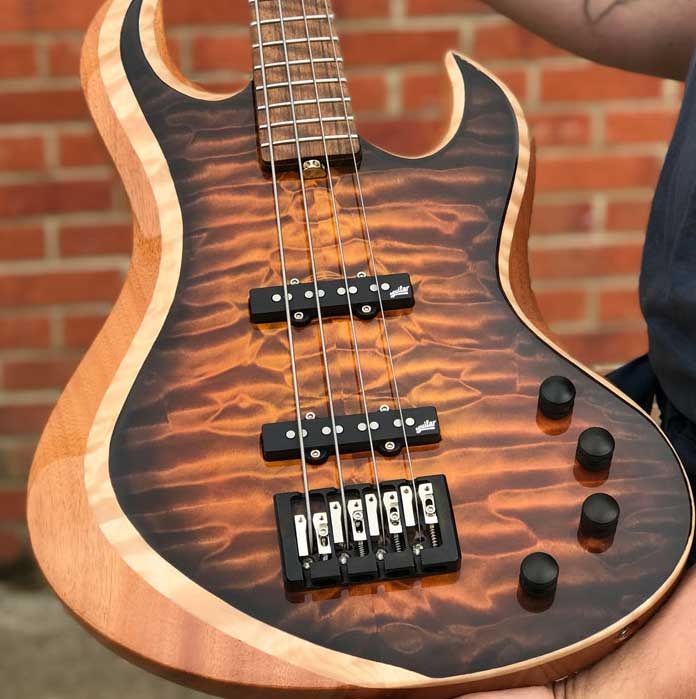
(Tip before beginning: It is typical that on most bass guitars, a properly intonated bass that does not have octave strings will have string saddles that look like a small flight of stairs as seen above, with the thickest string being the first “lowest stair.” This means that when shopping around for bass guitars in a guitar store, if all the saddles are “straight”, that’s a strong visual indication that the bass has not been intonated properly.)
Intonating a bass guitar is a very straightforward process since the majority of electric basses do not have a vibrato system on them (the ones that do require extra adjustment depending on how much the bridge floats, if it does at all).
However, before going to intonate your bass, there are 5 things to do first, else your intonation may end up being slightly “out”, requiring you to do it all over again.
1. Are the strings stretched properly?
Whether you’re using roundwound, flatwound, round-core, hex-core or something different, if it’s a new set of strings, stretching is required. Fortunately, most bass strings don’t require much stretching. Once stretched to the point they don’t go out-of-tune, you should only have to intonate once for that particular string set.
What happens if you don’t stretch before intonating? As the steel in the string settles, this can result in the intonation going out slightly, requiring you to intonate again. For example, if you put on a new set, don’t stretch, and then intonate, it will intonate correctly today, but tomorrow after the steel settles, the intonation will most likely be out.
2. Is the truss rod aligned properly?
Any change to the truss rod will change the bow of the neck, and that causes small changes all over the fretboard. It is always best to get the truss rod aligned to your liking before intonating.
3. Are the frets level?
If the frets are uneven and you get string buzz when fretting the 12th fret, getting proper intonation will be difficult at best.
4. Are your bridge saddles adjusted to your preferred height?
You may say, “Of course they are!” and you’re probably correct – unless you just switched to a different type of string.
If for example you always play roundwound and decided to try out flatwound, you will be adjusting the height of the strings. Do this before you intonate and not after.
5. Is your pickup height set properly?
Generally speaking, the goal here is to avoid overtones that make it next to impossible to get proper intonation. If you find that you get overtones when intonating, temporarily lower the pickups a few turns, intonate, then return the pickups back to your preferred height.


any tip for tweaking the intonation on the electric alternative to a double bass, the electric bass?