
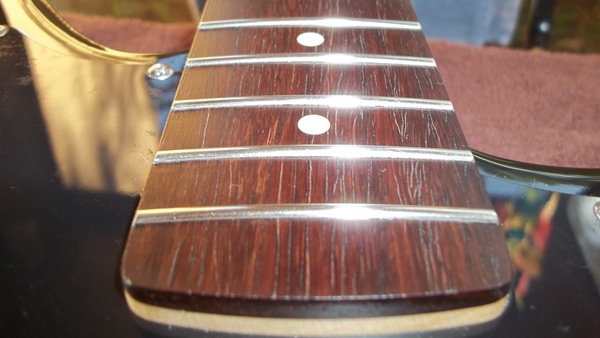
The short scale bass is an interesting animal because there are times you have to take certain things into consideration to solve issues with them.
On a bass BBG worked on recently, an inexpensive Squier Vintage Modified Jaguar Special SS (the SS meaning short scale), there was a peculiar issue where fretted notes played on the 4 (E) and 3 (A) strings produced overtones, and not the desirable kind. It sounded as if two notes were being played at once, with one being slightly out-of-tune even with just single notes played.
Step 1. Neck, body and pickups check
The neck was inspected to make sure it was mounted properly and had the correct bow, which it did. The body was also checked to see if there was any damage not immediately visible that would otherwise cause problems. None were found.
The pickups were then lowered away from the strings to see if that would resolve the issue (a “chorusing” effect typically happens when the strings are too close). Unfortunately, it didn’t.
Step 2. Electronics check
It’s a known fact that where Squier cuts cost more than any place else is with the electronics.
All electronics were tested and checked out, however the potentiometers were replaced with better ones, and the guitar had a wiring modification done where the volume/volume/tone (the bass is a P/J pickup layout) was changed to a volume/blend/tone.
However, this did not solve the overtone problem.
Step 3. Bridge check
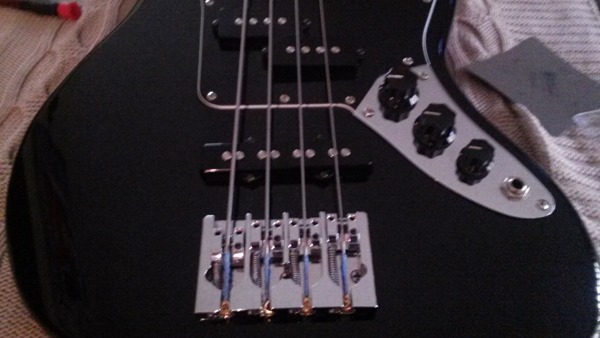
The stock bridge, which was rather on the chintzy side, was replaced with something with a lot more metal to it, pictured above.
(Note: Yes, this bass is a top-loader and not string-thru.)
While the guitar was able to intonate better with this bridge, it did not cure the overtone problem.
Step 4. Switchover to a balanced string set
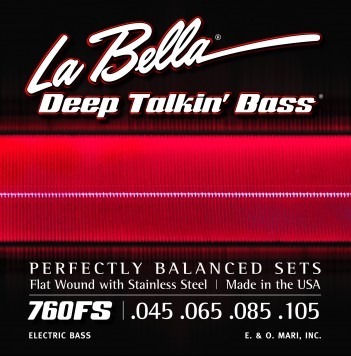
We tried a La Bella 760FS-S string set to see if it would cure the overtone problem.
Given the Jag short scale bass is a top-loader, it could have flats installed on it without a problem.
On test of the instrument, the overtone problem was cured and was not present now that it had a proper balanced flatwound string set on it.
Does a balanced string set really make that much of a difference?
There are times when “weird tone problems” on an electric bass can be cured just by using strings that are engineered to be balanced properly.
We are not saying that balanced strings cure oddball tone issues 100% of the time. But if you have a bass, be it standard scale, long scale or short scale, have one of those weird tone problems and have tried everything else without success, give a balanced string set a try.
For flatwound, La Bella‘s Deep Talkin’ Bass sets are great, and we also carry the recently introduced Low Tension for those that like a flatwound that has the same sound but with less tension on the string for more comfort when playing.
For those of you that prefer roundwound, D’Addario’s Balanced Tension sets are a great choice.
“What if I don’t like those brands, but still want a proper balanced string set?”
On our home page, you’ll see we carry several brands of string. However, if you have questions about which brand would have a balanced set that works right for you, contact us and ask. We’ll be happy to help.
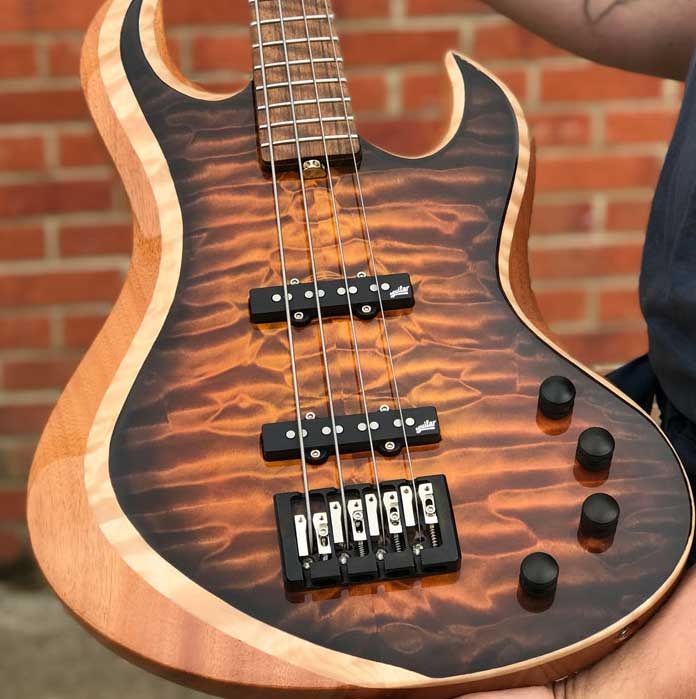


dogged pursuit of the proper solution…no wasteful goat sacrifice to the Bass Gods!
I would love to hear exactly what makes a set “balanced” as opposed to a set with gauges that I pick out for my personal taste. Also, I have had this type of issue before, and a refret solved the problem very nicely. I bet Squiers have less-than-perfect fretwork when they leave the factory…
Sound-wise, the strongest indication of a balanced set is that the volume and tension of the strings is much more evened out. Concerning volume, the thicker strings shouldn’t overpower the thinner ones, and the tension between strings should be much more consistent where one doesn’t feel looser and the others tighter. The fretwork on the Squier wasn’t the issue because you could hear the overtones all over the board. You could blame bad frets if certain spots were bad and others weren’t, but when it’s all over the board, that’s a different story.
Balanced string sets are designed such that the tension is as close as possible to equal across all strings in the set. It’s not exactly equal, but they should be within 1 or 2 pounds of each other.
Also, you might get the overtones just by having the pickups too high, too close to the strings where the magnetic pull of the pickups will begin to affect the tone. So to block this possibility from the equation it might be a good idea to first try if the problem disappears by just lowering the pickups. Naturally different strings have different magnetic properties so the optimal pickup distance varies from string set to another.
Hooray!
Having restrung my T bird BEAD, despite careful tuning and, even moving the bridge back 1/4″, I was getting a dissonance if I fretted heavily above the 12th frett. It was as if both lengths of string, above and below the fret, were sounding. Dropped the pups, 1 full turn of the screw was enough, and, voila! No more overtones.
Thank you Anonymous!
The post above about magnetic pull and pickup adjustment height is correct. I’ve been a guitar/bass guitar tech for over 40 years. I own 5 short scale basses. 95% of the time overtones are caused by the pickup being adjusted too high, ESPECIALLY with slug magnet single coil pickups, which have stronger string pull than traditional humbuckers. Granted, the oriental strings that may come on a cheap bass may cause problems, but ANY major brand string will work properly if the pickups and mechanics are set up correctly. Cheap junk strings or defective strings can cause this problem, but this seems a lot like a ploy to sell strings you may be overstocked on.
Was there any drilling done to the body to accommodate the new hi mass bridge?
Accept this bass for its positive qualities–lightweight, fun to play, sounds decent enough. It is a Short Scale bass–30″–and you can’t change physics. You must change the factory strings to heavy gauge, 110 (E String) at least. A SS bass will always lack sustain and the “feel good” harmonics compared to a full size 34″ bass. You’ll see a lot of advice about how to fix intonation issues with a short-scale bass, such as use strings ONLY made for Short Scale Basses only because otherwise the windings wrap around the tuning post and cause intonation to go out of whack, or they’ll break, seriously??!! its freakin steel. The guys at Guitar Center were also confident this is the cure, but you still have other problems even with Short Scale bass strings, where the windings at the ball end are too long and go over the bridge–even worse in my opinion. I tried everything, and found heavy gauge strings–at least a 110 on E–minimizes those weird harmonics, and makes a huge difference. And guess what??!! They don’t make short scale bass strings at 110 or higher! But i just use full length strings without any problems. however the same problem happens at the bridge or ball end, whether or not they’re short scale or regular long scale strings–the double windings there go over the bridge and that must cause worse problems with tone. so you can add a few little washers or a metal spacer at the end of the string to lengthen it so the point where the wrap over windings stop before it gets the bridge.