Updated November 14, 2026
What is a passive tone control?
A Passive Tone control is a low pass filter comprised of a three-way variable resistor (potentiometer), and a capacitor.
How does a passive tone control work?
The passive tone control on your electric bass guitar is a subtractive device. The capacitor allows high frequencies to pass or be bled to ground, and the pot allows you to control the amount of signal delivered to the capacitor. A tone control can only reduce frequencies being let through and not add anything extra. In fact, where the tone control is commonly placed is commonly the cause of lackluster results.
Can my bass have better use of the tone control?
Yes. The way in which many electric bass guitars have the passive tone control implemented is less than ideal for what this little circuit can accomplish. Using a Fender Jazz Bass as an example, the main issue is the placement of the tone control in the signal chain. A common Jazz Bass issue, as many owners are full aware, is that unless the neck pickup, bridge pickup, or both are at full volume the tone control “feels weak.” The reason for this is due to where the control is in the signal chain. The illustration below is the standard Jazz Bass wiring common to many if not all Jazz Bass models that utilize three controls.

Is there a better way of doing this?
Absolutely! The tone control can be changed out and replaced with a tandem tone pot, along with rewiring how the pickups are connected to the controls, resulting in much better control of your instrument’s overall tone. The illustration below is an example of how you can rewire your existing controls.

Where can I find this tandem tone pot?
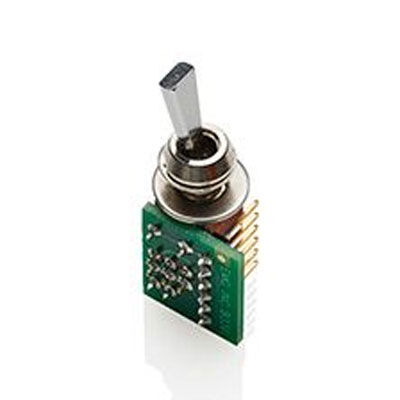
Best Bass Gear currently stocks one version of this particular pot. It is available here:
https://www.bestbassgear.com/acg-passive-tone-control-module-only.htm
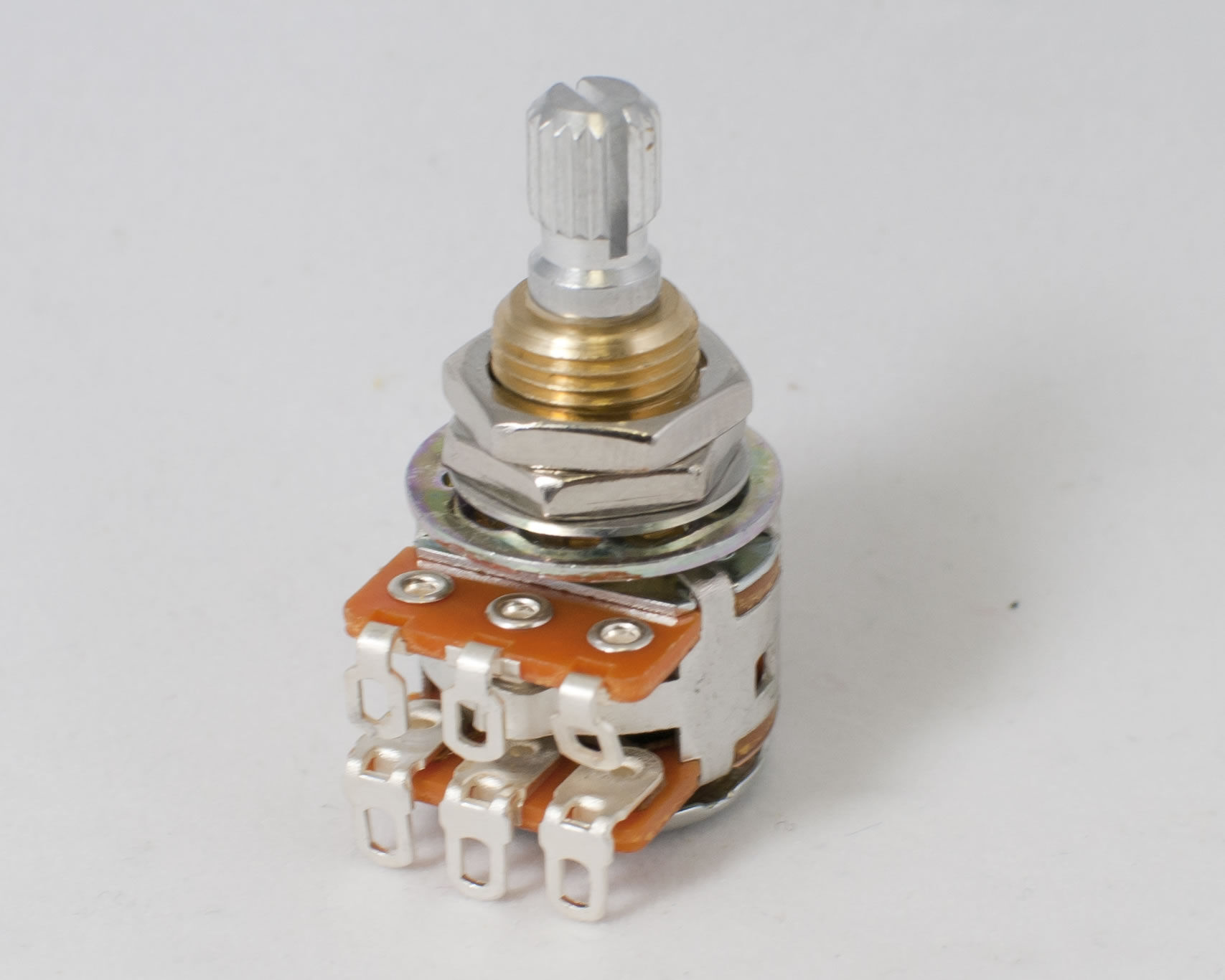
This is not a stacked potentiometer, but rather a pot that has 6 connections and a single shaft. Using a tandem tone pot not only has benefits of allowing tone control on both neck and bridge pickup independently, but also allows two different capacitors to be used for each pickup. For example, you may want less high frequencies to come through on the neck pickup, but prefer more for the bridge pickup. In that is your goal, you may want to use a 0.047µF for the neck, and a 0.022µF for the bridge.
What capacitor value should I use?
The answer to that question depends on what you are looking for out of your tone control.
Using higher value capacitors shifts the frequency cutoff point, cutting further down into the upper midrange and heads towards the lower midrange.
A lesser value moves the cutoff frequency point higher preserving more of the high midrange when the control is used.
For an instrument with passive pickups, a good starting point is in the range of 0.022µF to 0.047µF. With active pickups such as EMGs, 0.1µF would work. From there, you can experiment with many different values to get a feel for what is possible and pleasing to your ears.
Cap values at a glance
Here’s how the common values line up. Same rule as above: bigger value, darker when you roll the tone down. Smaller value, you keep more of the upper mids. All of these are on the shelf here.
| Value | What you hear with the tone rolled down | Where we’d use it | Our part |
|---|---|---|---|
| 0.022µF | Lightest cut of the bunch. Keeps more of the high mids. | Passive pickups. Good on a bridge pickup when you want it to stay a little bright. | Orange Drop 715P, 100VDC |
| 0.033µF | In between. A bit darker than .022. | Passive pickups, when .022 isn’t enough and .047 is too much. | .033µF, 100V, ±5% |
| 0.047µF | Darker. Cuts further down into the mids. | Passive pickups. Good on a neck pickup. It’s what we put in our prewired J Bass harness. | .047µF, 100V, ±10% |
| 0.068µF | Darker still. | Past the usual passive starting range. Try it if .047 still isn’t dark enough for you. | Orange Drop 715P, 100VDC |
| 0.1µF | Deepest cut here. | Active pickups like EMGs. | Orange Drop, 200VDC |
Caps are cheap. If you’re not sure, pick up two values and listen. Your ears decide this one, not the chart.
What types of capacitors should I use?
Electrolytic or tantalum capacitors are not recommended.
Recommended capacitor types are Paper in Oil, Ceramic Disk, Mylar, or Poly-Film. There is no significant advantage or disadvantage to using one over another, as performance will be generally equal no matter which type you choose. The value of the capacitor (as in its capacitance and not price) is more important than what the capacitor is constructed from.
Swapping your tone cap: bench notes
This is one of the easier jobs on a bass. A few things so it goes smoothly:
- Take a picture of the wiring before you desolder anything. Seriously, it saves a lot of headaches.
- Note where the old cap goes. One leg is on the tone pot, the other usually goes to ground on the back of a pot. The new cap goes in the same two spots.
- Orange Drop and film caps don’t care which way they go in. That’s one more reason to skip electrolytic and tantalum caps, which are usually polarized.
- Keep the leads short and tidy so nothing touches the shielding or the other lugs when the cavity cover goes back on.
- Plug in and listen before you close it up. Roll the tone all the way down and back up. If it hums after the swap, it’s almost always a ground. Check the bridge ground wire and the backs of the pots first.
Parts for this job
- Passive Tone Control Module – adds a passive tone control to one- or two-pickup preamp setups, and works in active or passive mode.
- CTS 250K solid shaft audio pot – a standard replacement tone pot.
- Noll 250k stacked volume/tone push-pull – volume and tone on one shaft, plus a switch. The tone side needs a cap.
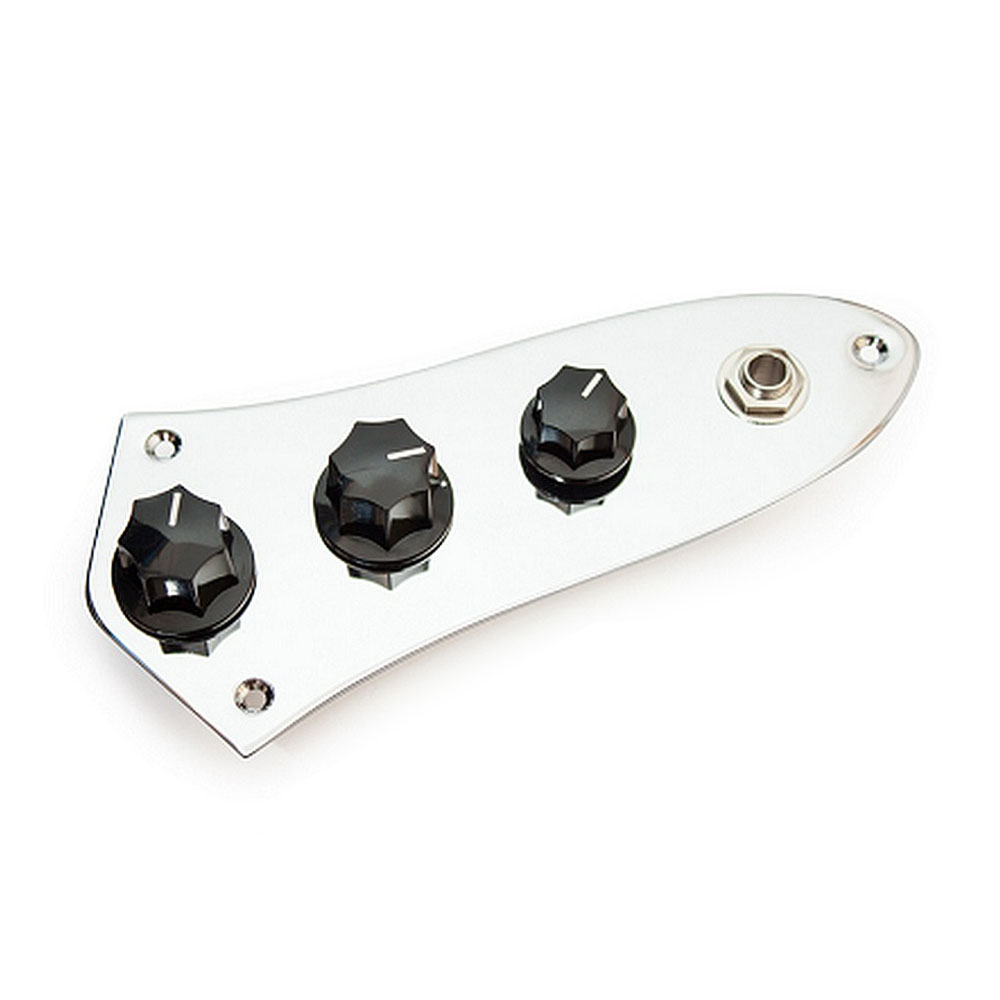
- Prewired J Bass harness (volume-blend-tone) – built here by hand with Noble 250k audio pots and a .047µF Orange Drop. Solderless pickup connections.
FAQ
What value tone cap should I use in a Jazz Bass?
With passive pickups, start between 0.022µF and 0.047µF. Our prewired J harness uses 0.047µF. Go smaller if you want to keep more high mids when the tone is rolled down.
Does the type of capacitor change the tone?
Not in any way that matters much. Paper in oil, ceramic disk, Mylar and poly film all work. The value is what changes the sound. Skip electrolytic and tantalum.
What tone cap do I use with active pickups like EMGs?
0.1µF is a good place to start.
Can a passive tone control add treble?
No. It can only take highs away. If you want to boost, that’s a job for a preamp.
Why does the tone knob on my Jazz Bass feel weak?
It’s where the tone control sits in the circuit. Unless one or both pickups are all the way up, it doesn’t do much. A tandem tone pot and some rewiring fixes that, like the second diagram above shows.
Not sure which way to go? Send me what you’re playing and I’ll help you figure it out. Email sales@bestbassgear.com or call 877-839-3531.
Is it possible to do this without the need for a tandem pot?
No. It is best to use a tandem pot for this. We will have more information on doing this very shortly.
yes, the tandem pot has the nice benefit that you only have to turn 1 knob. For more control, however, you could use a dual pot or just 2 pots, 1 for each pickup so you can either always set them at the same position OR adjust them individually.
No. It is best to use a tandem pot for this.
Potentiometers must be used, otherwise volume cannot be increased or reduced; so as the tone cannot be higher or darker.
By independent tone control you mean the different caps can produce slightly different tones for each pickup; the shaft is still controlling both outputs at the same time to the same degree?
If I never use the tone control: should I leave it out and remove it?
“This is not a stacked potentiometer, but rather a pot that has 6 connections and a single shaft. ”
In what way are these different? Sounds like the same thing to me? – 2 pots rotating the same on one shaft? Are you not getting confused with a log versus lin taper or maybe a concentric pot?
The 6 connections pot in which 3 connect to neck pickup and other 3 connect to bridge pickup. Therefore when you switch between these 2 pickups you can re-adjust the tones (different pickups might have different tones).
If only one pickup, one 3 connections pot is used.
What if I want on/off switches for each pickup, and one volume knob?
The proper name is dual potentiometer, and they’re readily available from Alpha and other manufacturers, along-side the regular pots that we use in guitar and bass builds, without paying $19 and suffering a ridiculous knurled shaft.
https://www.amplifiedparts.com/products/potentiometer-alpha-audio-dual
Dual pots are very common.
Does anyone have a schematic for a passive bass: 2 tone controls (1 for each pick up) and 1 volume? I’m hitting a wall with my set up atm. Please feel free to email!!!