Seymour Duncan Bass Wiring Diagrams
Seymour Duncan bass wiring diagrams, written out as text: all 35 Seymour Duncan (Basslines) sheets in our library, covering P, J and P-J basses, Jazz Bass stacks, Music Man pickups, passive and active soapbars, Blackouts, the STC-3, STC-2 and STC-BO preamps and the Rickenbacker replacements. Find your bass and pickups for the controls and where each pickup lead goes, then follow the hookup wire by wire. Each has Seymour Duncan's original drawing and a PDF download.
Before you start
- Pot values follow the pickup: 250K for passive pickups, 100K for Basslines active pickups, 25K for Blackouts. The STC preamps use a 10K master volume and 100K EQ pots.
- On almost every SD bass pickup, white is hot and black or bare is ground. The exceptions are the J stacks (black is hot) and the Music Man pickup (red and black together are hot), noted in each section.
- Anything with a battery (active pickups, STC preamps) needs a stereo output jack: the battery's black goes to the ring, so plugging in turns it on. Unplug when you're done.
- On SD's drawings the grey "Solder" spots are on the backs of the pot casings: that's where grounds go, and every casing is linked to the others.
- The STC-3M3 / STC-3M4 Music Man preamp and the SRB-1 Rickenbacker pickups have their own pages: STC-3M3 / STC-3M4 wiring and SRB-1 Rickenbacker wiring. This page links to them rather than repeating them.
Find your bass
Passive P, J and P-J basses
- Standard P-Bass
- P-Bass with one single-coil pickup: 1 volume, 1 tone
- Standard Jazz Bass
- Standard P-J Bass
- Jazz Bass stacks (Classic Stack and Hot Stack): 2 volumes, 1 tone
- P-Bass with a P pickup and a Jazz Bass stack: 2 volumes, 1 tone
- Jazz Bass with master volume, blend and master tone
- P-J Bass with master volume, blend and master tone
- Jazz Bass with a push/pull for series/parallel: 2 volumes, 1 tone
- P-Bass with a mini-toggle series/parallel switch
- P-Bass with a push/pull volume for series/parallel
Music Man pickups
- Music Man pickup, passive: 1 volume, 1 tone (coils in parallel)
- Music Man pickup, passive: 2 volumes (one per coil), 1 tone
- Music Man and P-Bass pickups, passive: 2 volumes, 1 tone
- Music Man replacement system (pickup with 3-band preamp)
- Music Man and P-Bass pickups with the STC-3P preamp
Soapbar pickups (passive, active and Blackouts)
- Passive soapbars: 2 volumes, 1 tone
- Active soapbars: 2 volumes, 1 tone
- Blackouts soapbars: 2 volumes, 1 tone
- Passive soapbars with the STC-3P preamp
- Active soapbars with the STC-3A preamp
- Passive soapbars: 2 volumes with the STC-BO preamp
- Blackouts for bass: 2 volumes with the STC-BO preamp
Active P, J and P-J pickups
Tone circuits and preamps
- 3-band tone circuits (STC-3A and STC-3P): basic wiring
- 3-band tone circuit with 2 volumes
- 2-band tone circuit (STC-2A and STC-2P)
- Jazz Bass with the STC-2P or STC-3P preamp
- Jazz Bass with the STC-BO tone circuit
- P-J Bass with the STC-BO tone circuit
- P-Bass with one volume and the STC-BO tone circuit
Rickenbacker
The hookups, wire by wire
- Passive, two pickups: volume, volume, master tone
- Passive, one pickup: volume and tone
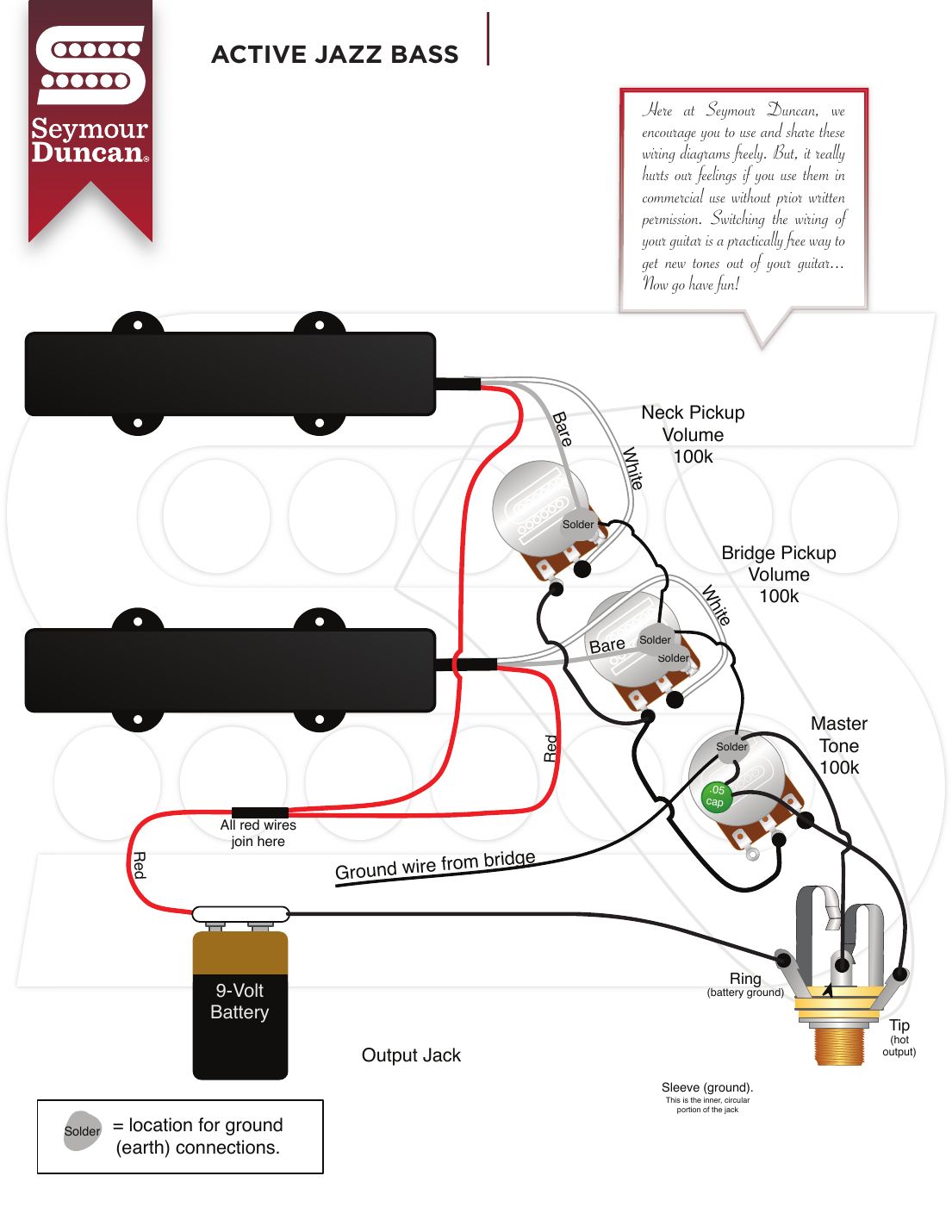
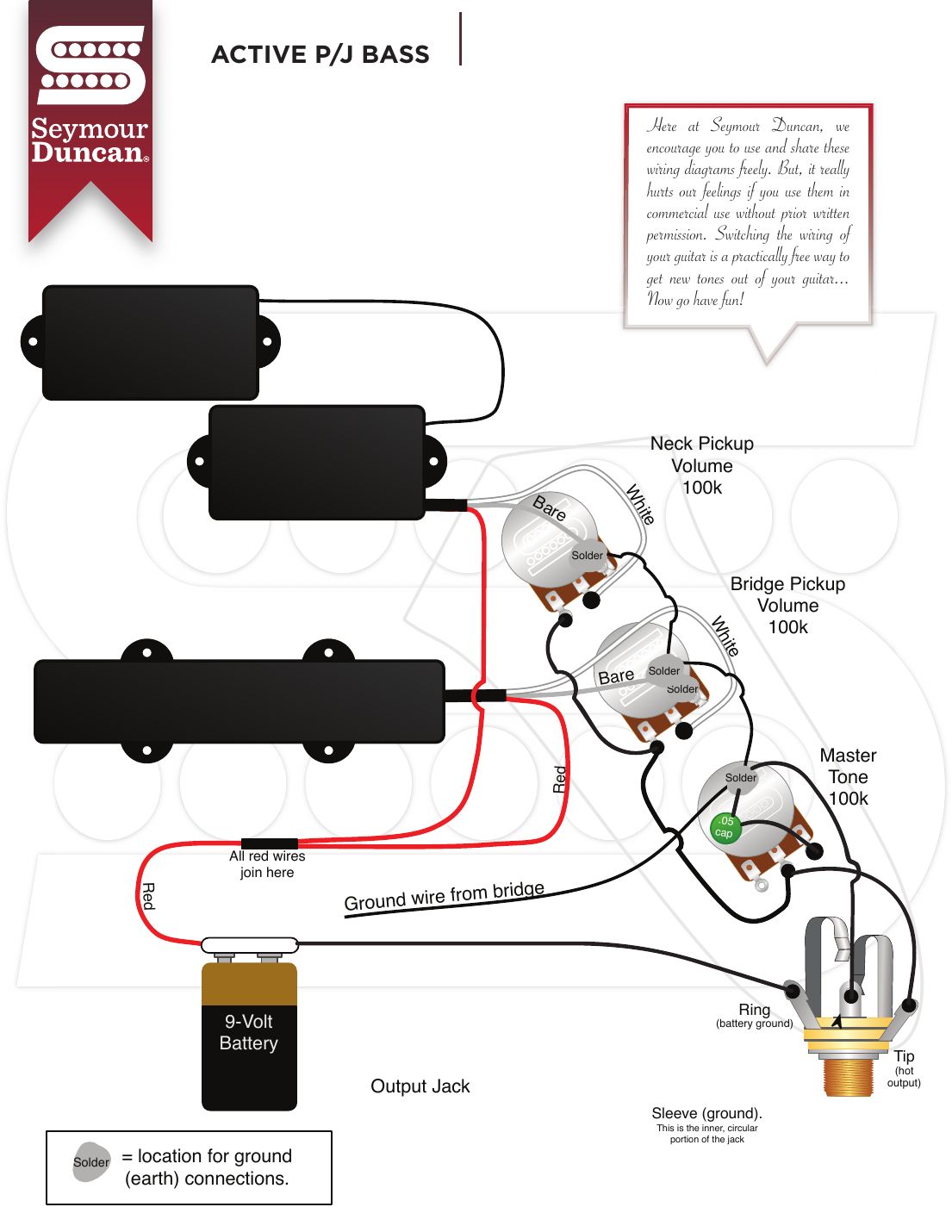
- Active pickups (Basslines active and Blackouts): volume, volume, tone, battery and stereo jack
- Master volume, blend, master tone (Jazz Bass and P-J)
- Series/parallel switching: P-Bass (mini-toggle or push-pull) and Jazz Bass (push-pull)
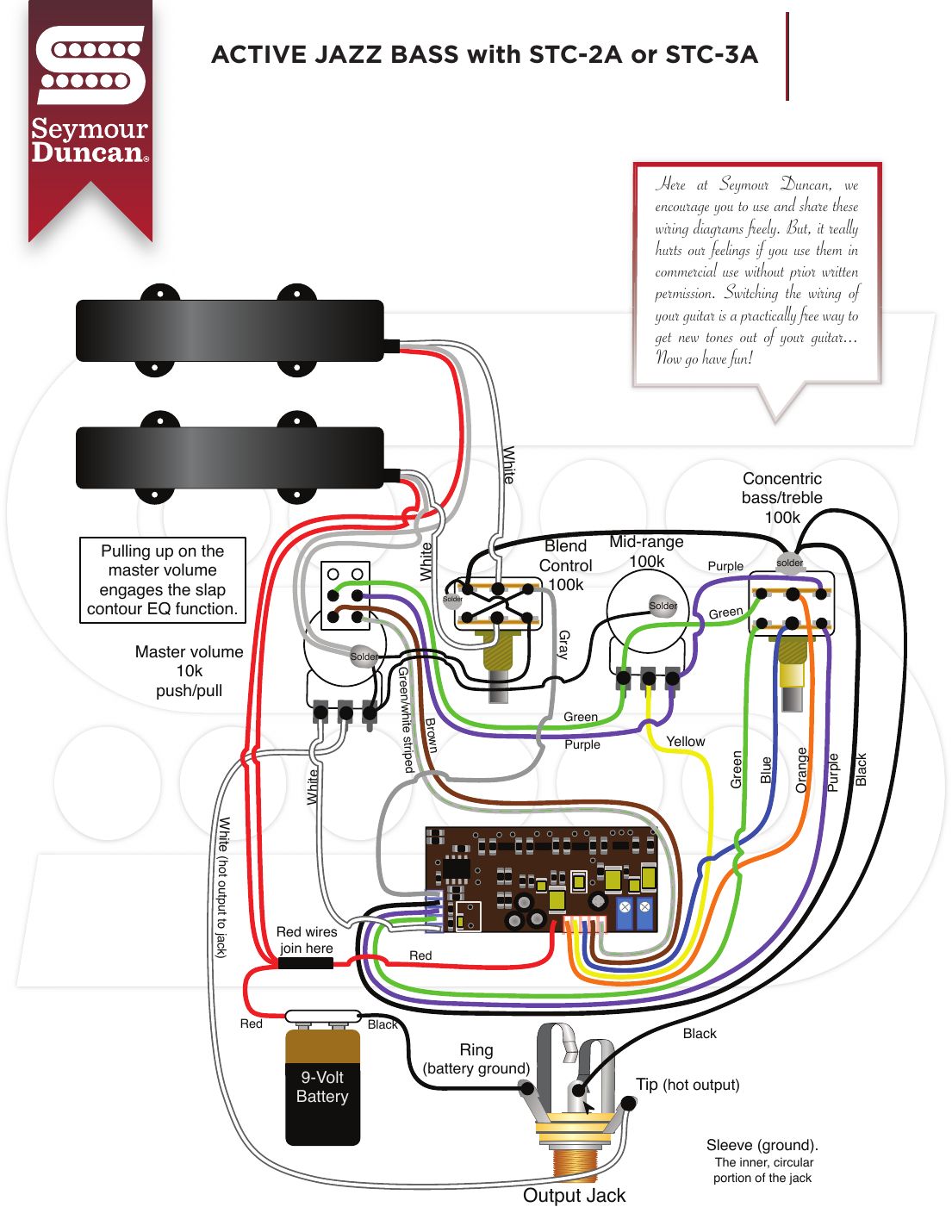
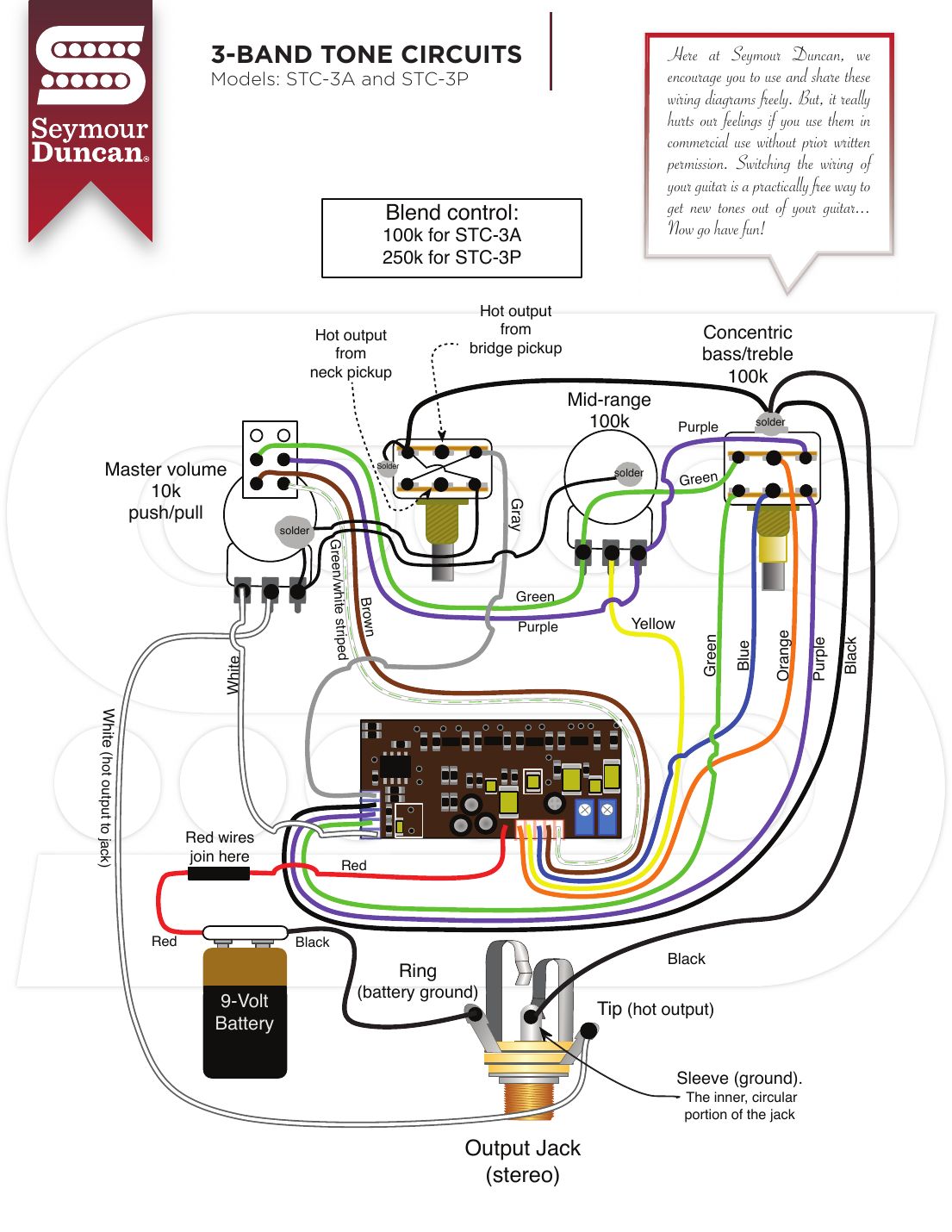
- STC-3A, STC-3P, STC-2A and STC-2P preamps: the harness, colour by colour
- STC-BO 2-band EQ (the Blackouts preamp) in place of the tone pot
Seymour Duncan diagrams by bass and pickup
Passive P, J and P-J basses
Standard P-Bass
The stock Precision Bass layout for any Seymour Duncan split-coil P pickup: one volume, one tone.
Controls: 250K volume, 250K tone, .05 µF cap, mono jack.
| # | Wire | Goes to |
|---|---|---|
| 1 | White (hot) | Volume input lug |
| 2 | Black (ground) | Volume casing |
| 3 | Black link between the two halves | Leave it: it puts the halves in series |
| 4 | Ground wire from bridge | Volume casing |
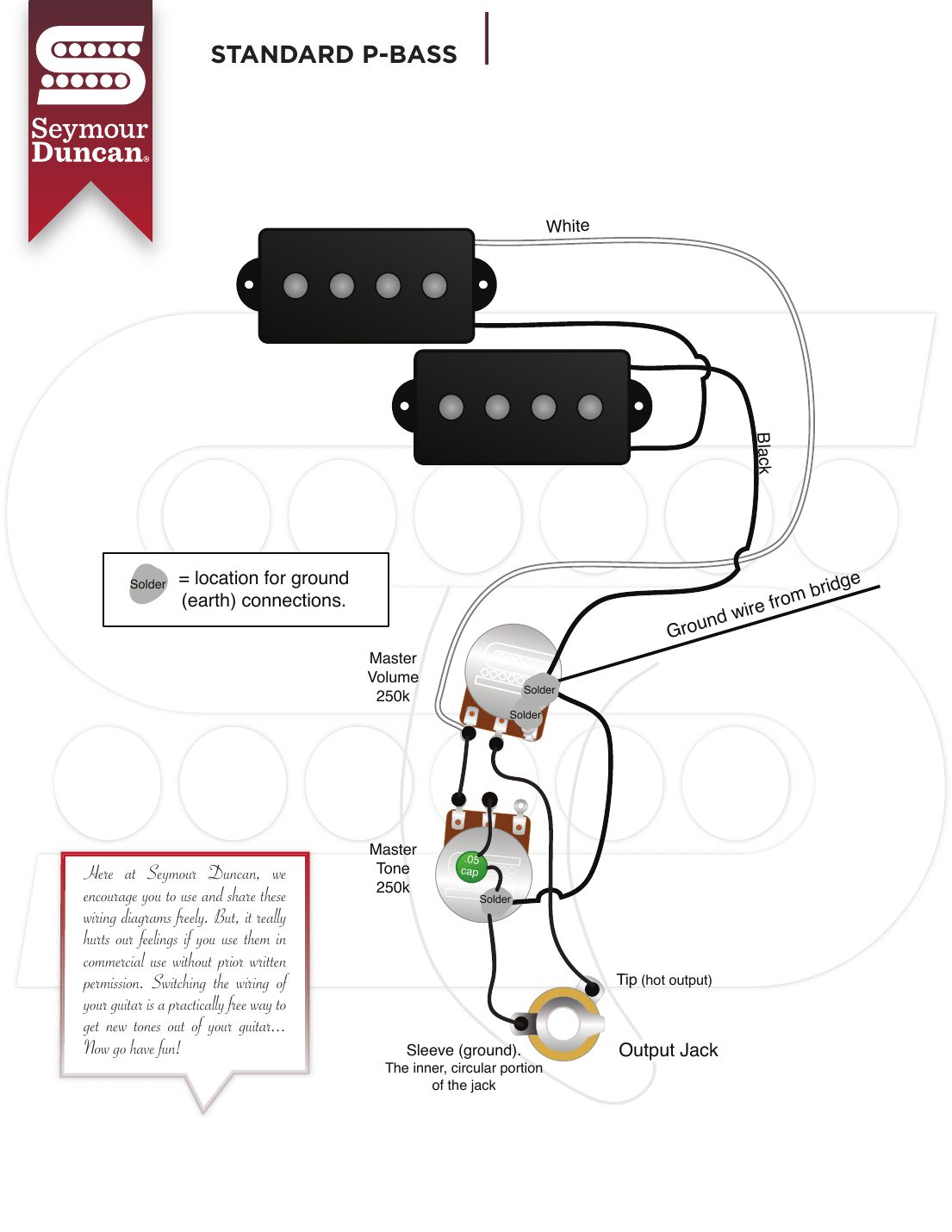
Wire it with
P-Bass with one single-coil pickup: 1 volume, 1 tone
A single-coil pickup in a P-Bass (the '51 Precision layout): one volume, one tone.
Controls: 250K volume, 250K tone, .05 µF cap, mono jack.
| # | Wire | Goes to |
|---|---|---|
| 1 | White (hot) | Volume input lug |
| 2 | Black (ground) | Volume casing |
| 3 | Ground wire from bridge | Volume casing |
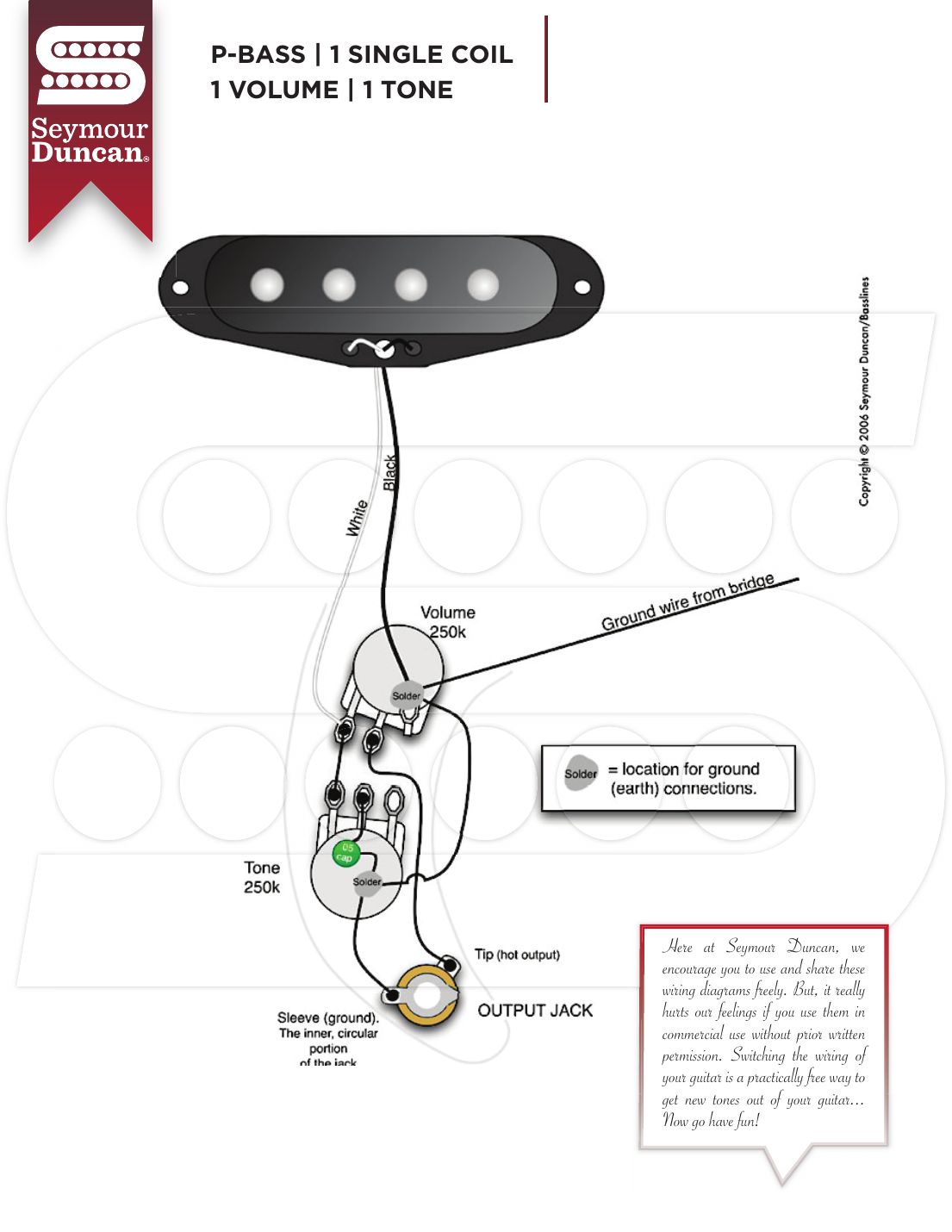
Wire it with
Standard Jazz Bass
The stock Jazz Bass layout: neck volume, bridge volume, master tone, pickups in parallel.
Controls: 250K neck volume, 250K bridge volume, 250K master tone, .05 µF cap, mono jack.
| # | Wire | Goes to |
|---|---|---|
| 1 | Neck: white (hot) | Neck volume input lug |
| 2 | Neck: black (ground) | Neck volume casing |
| 3 | Bridge: white (hot) | Bridge volume input lug |
| 4 | Bridge: black (ground) | Bridge volume casing |
| 5 | Ground wire from bridge | Tone pot casing |
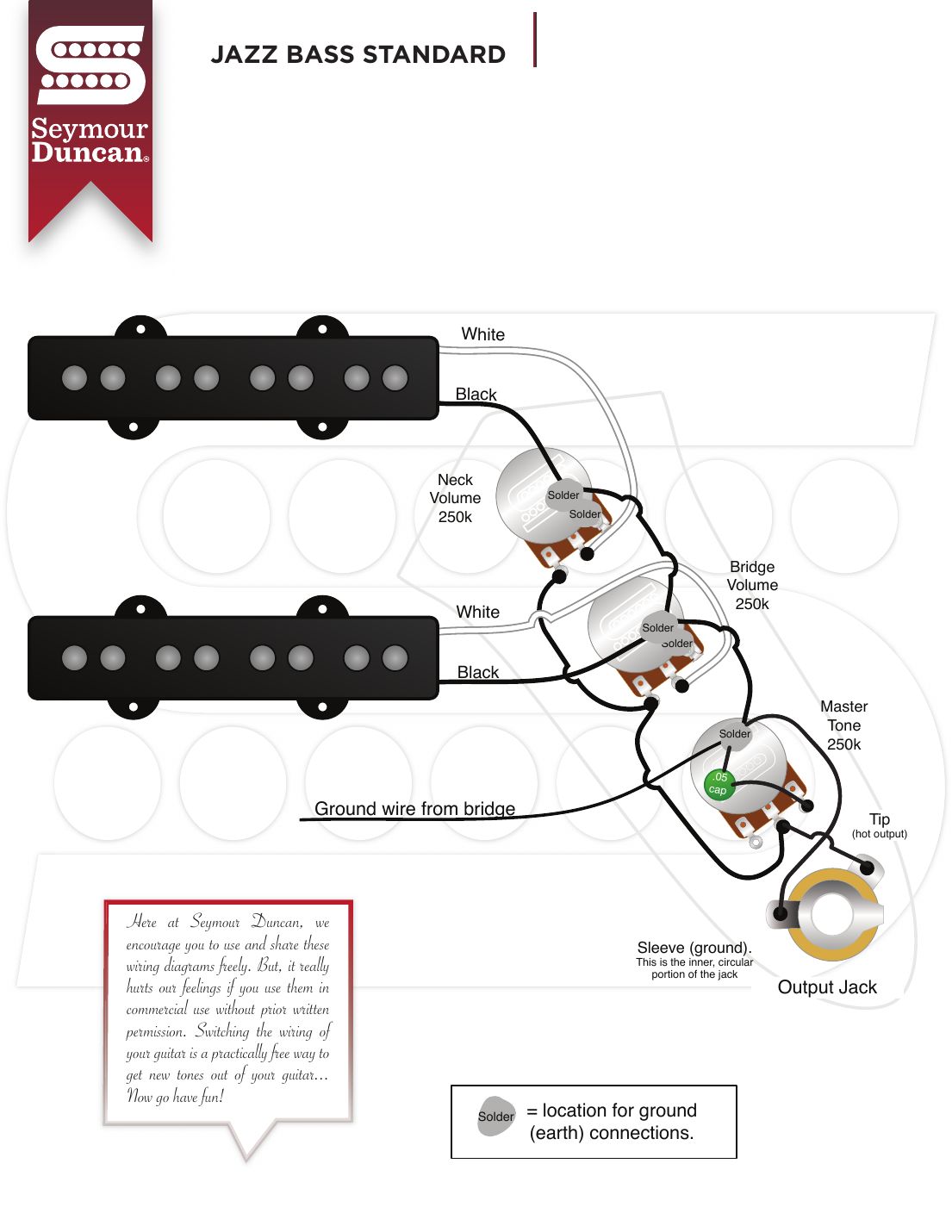
Wire it with
Standard P-J Bass
A split-coil P in the neck position and a J at the bridge, wired like a Jazz Bass: two volumes and a master tone.
Controls: 250K neck (P) volume, 250K bridge (J) volume, 250K master tone, .05 µF cap, mono jack.
| # | Wire | Goes to |
|---|---|---|
| 1 | P: white (hot) | Neck volume input lug |
| 2 | P: black (ground) | Neck volume casing |
| 3 | J: white (hot) | Bridge volume input lug |
| 4 | J: black (ground) | Bridge volume casing |
| 5 | Ground wire from bridge | Tone pot casing |
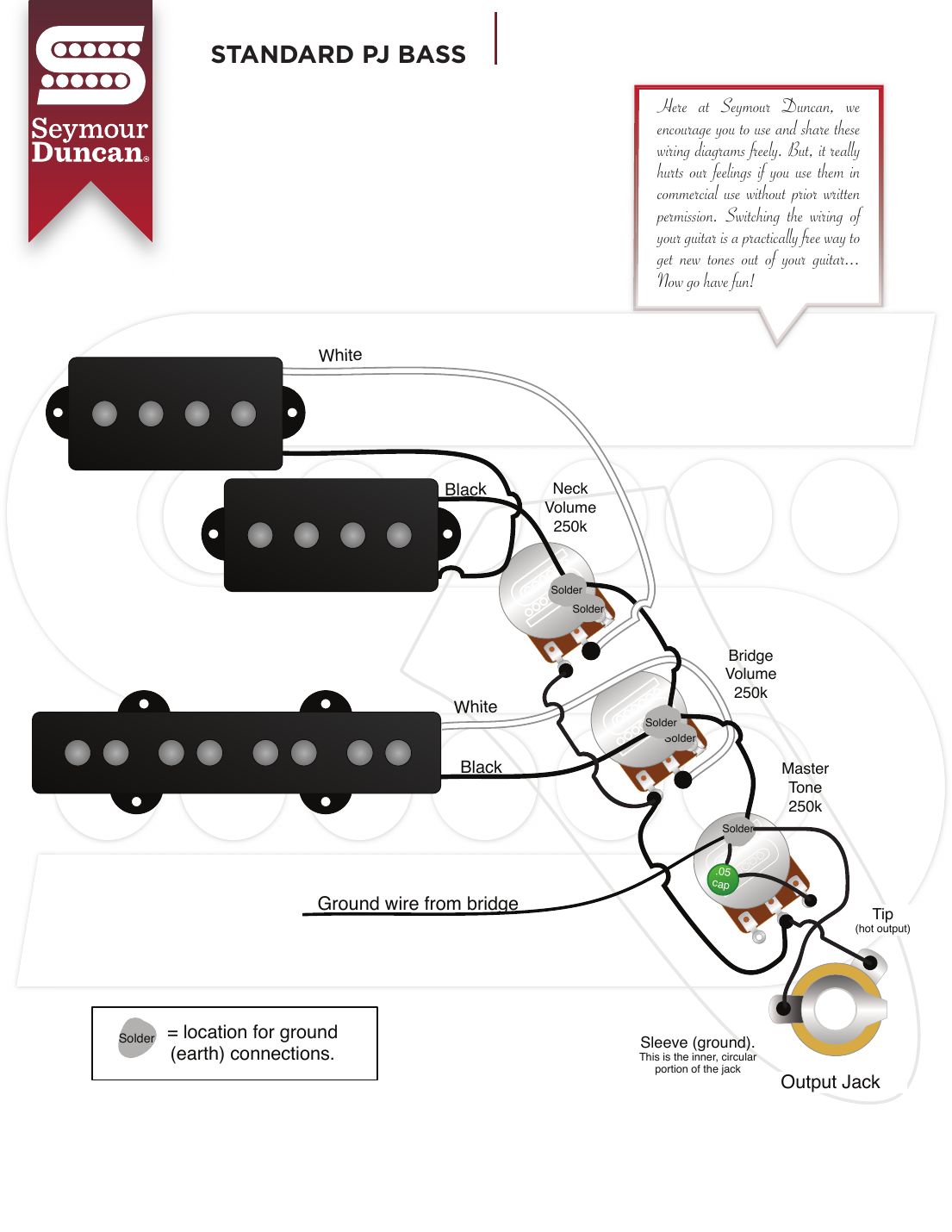
Wire it with
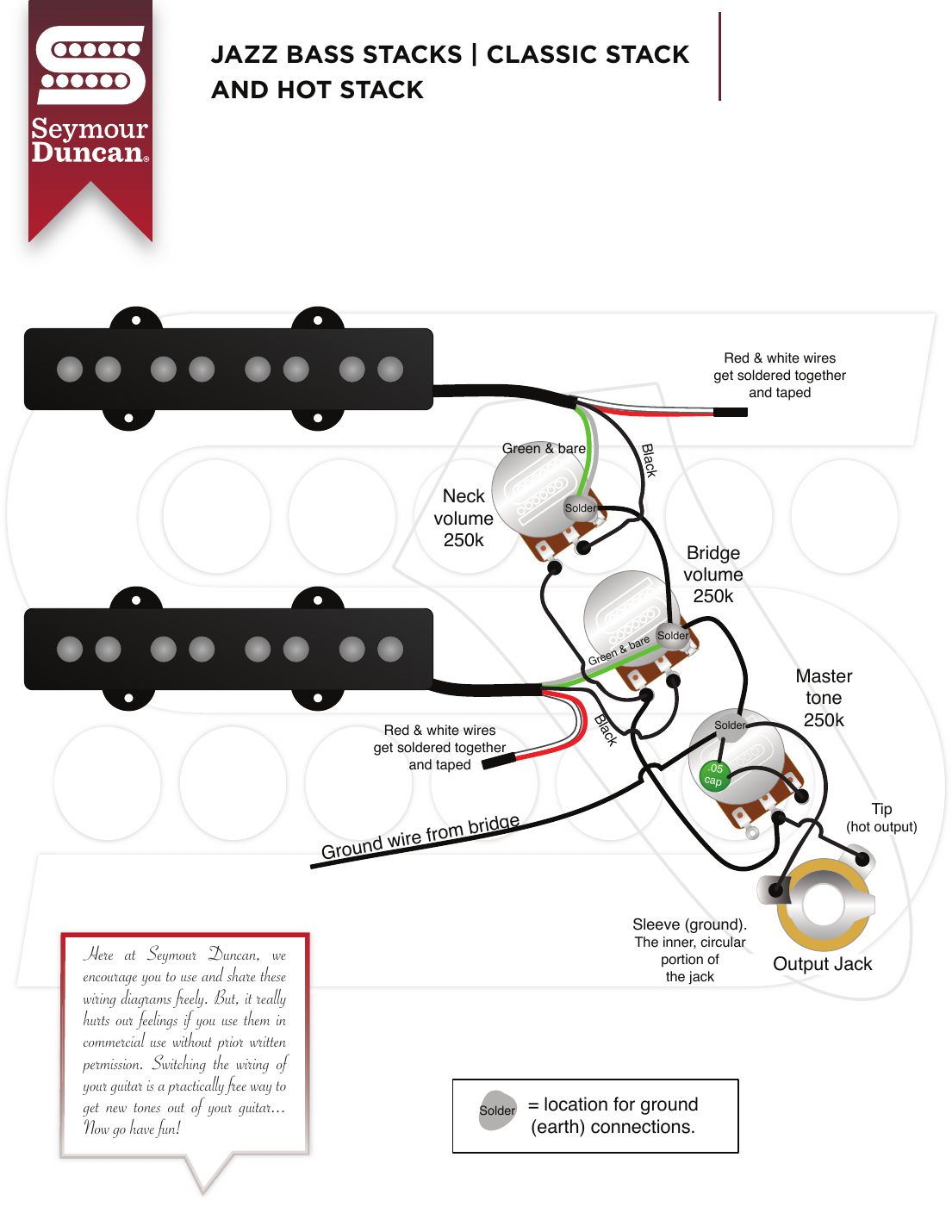
Jazz Bass stacks (Classic Stack and Hot Stack): 2 volumes, 1 tone
Seymour Duncan's stacked, hum-cancelling J pickups in the standard Jazz Bass layout. The stacks have four leads plus a bare shield, so two get joined and taped.
Controls: 250K neck volume, 250K bridge volume, 250K master tone, .05 µF cap, mono jack.
| # | Wire | Goes to |
|---|---|---|
| 1 | Black (hot) | Its volume's input lug |
| 2 | Green and bare (ground) | Its volume's casing |
| 3 | Red and white | Solder together and tape (not connected to anything) |
| 4 | Ground wire from bridge | A pot casing |
Wire it with
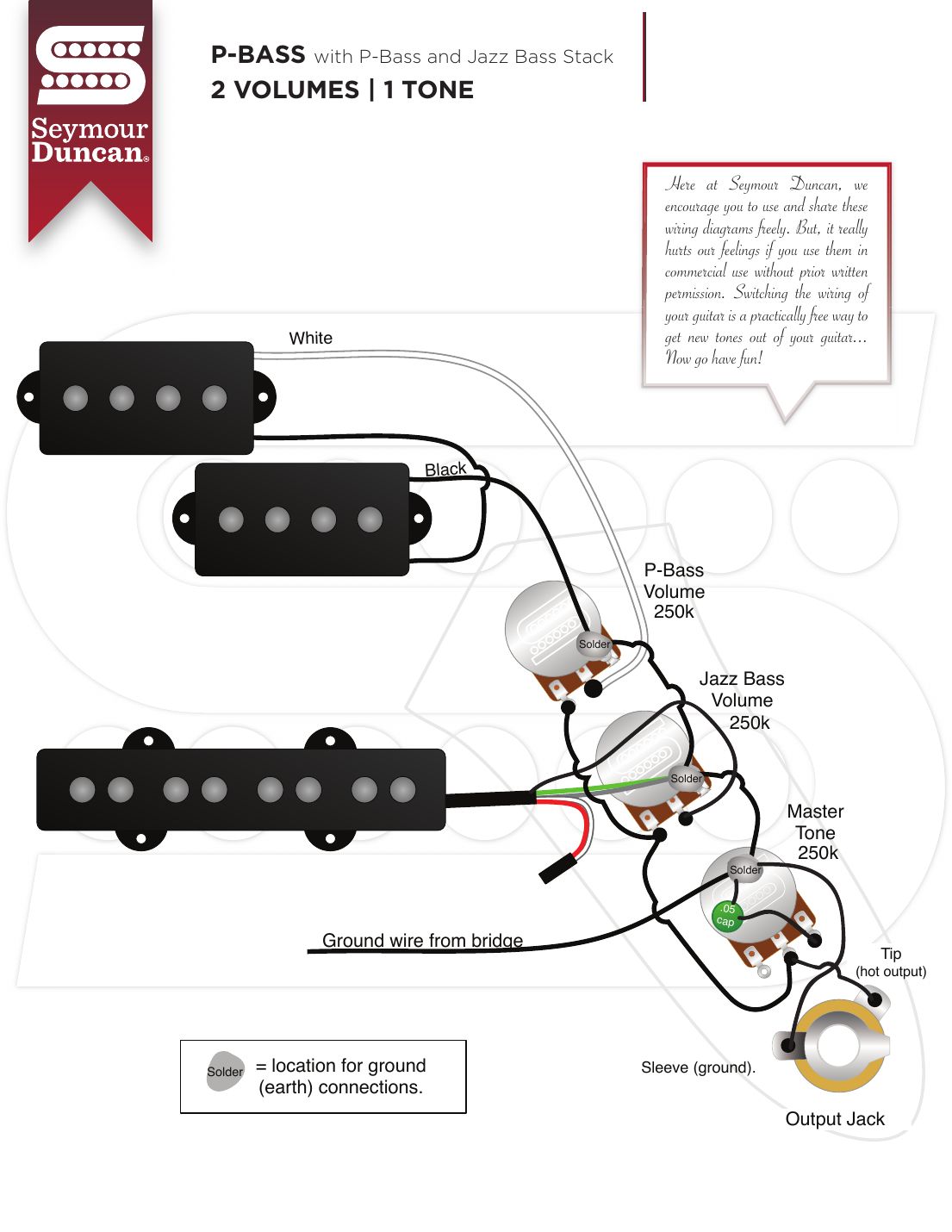
P-Bass with a P pickup and a Jazz Bass stack: 2 volumes, 1 tone
A P pickup at the neck and an SD stacked J at the bridge, in the two-volume layout.
Controls: 250K P volume, 250K J volume, 250K master tone, .05 µF cap, mono jack.
| # | Wire | Goes to |
|---|---|---|
| 1 | P: white (hot) | P volume input lug |
| 2 | P: black (ground) | P volume casing |
| 3 | J stack: black (hot) | J volume input lug |
| 4 | J stack: green and bare (ground) | J volume casing |
| 5 | J stack: red and white | Solder together and tape |
| 6 | Ground wire from bridge | Tone pot casing |
Wire it with
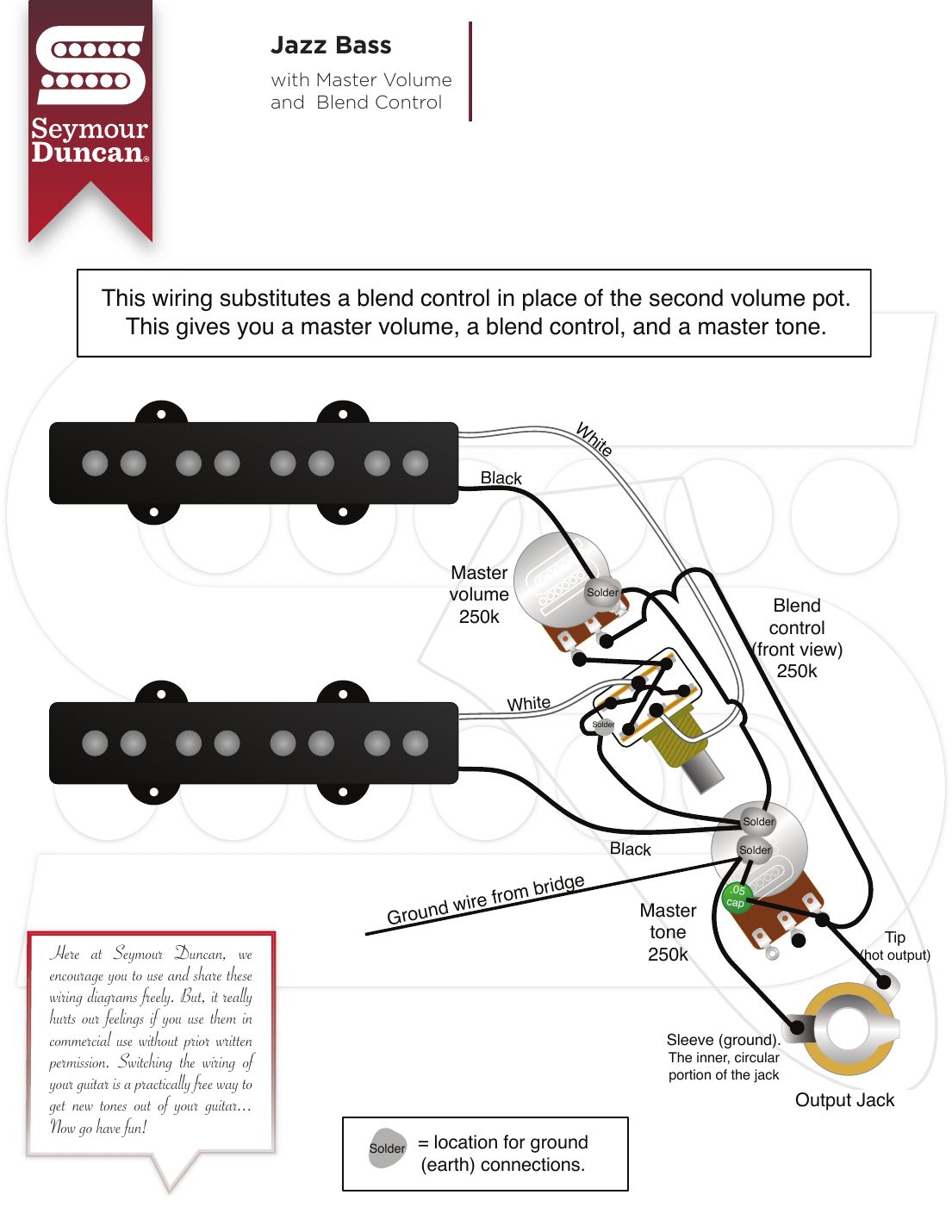
Jazz Bass with master volume, blend and master tone
SD: "This wiring substitutes a blend control in place of the second volume pot. This gives you a master volume, a blend control, and a master tone."
Controls: 250K master volume, 250K blend, 250K master tone, .05 µF cap, mono jack.
| # | Wire | Goes to |
|---|---|---|
| 1 | Neck: white (hot) | Blend, front section |
| 2 | Neck: black (ground) | Master volume casing |
| 3 | Bridge: white (hot) | Blend, back section |
| 4 | Bridge: black (ground) | Tone pot casing |
| 5 | Ground wire from bridge | Tone pot casing |
Wire it with
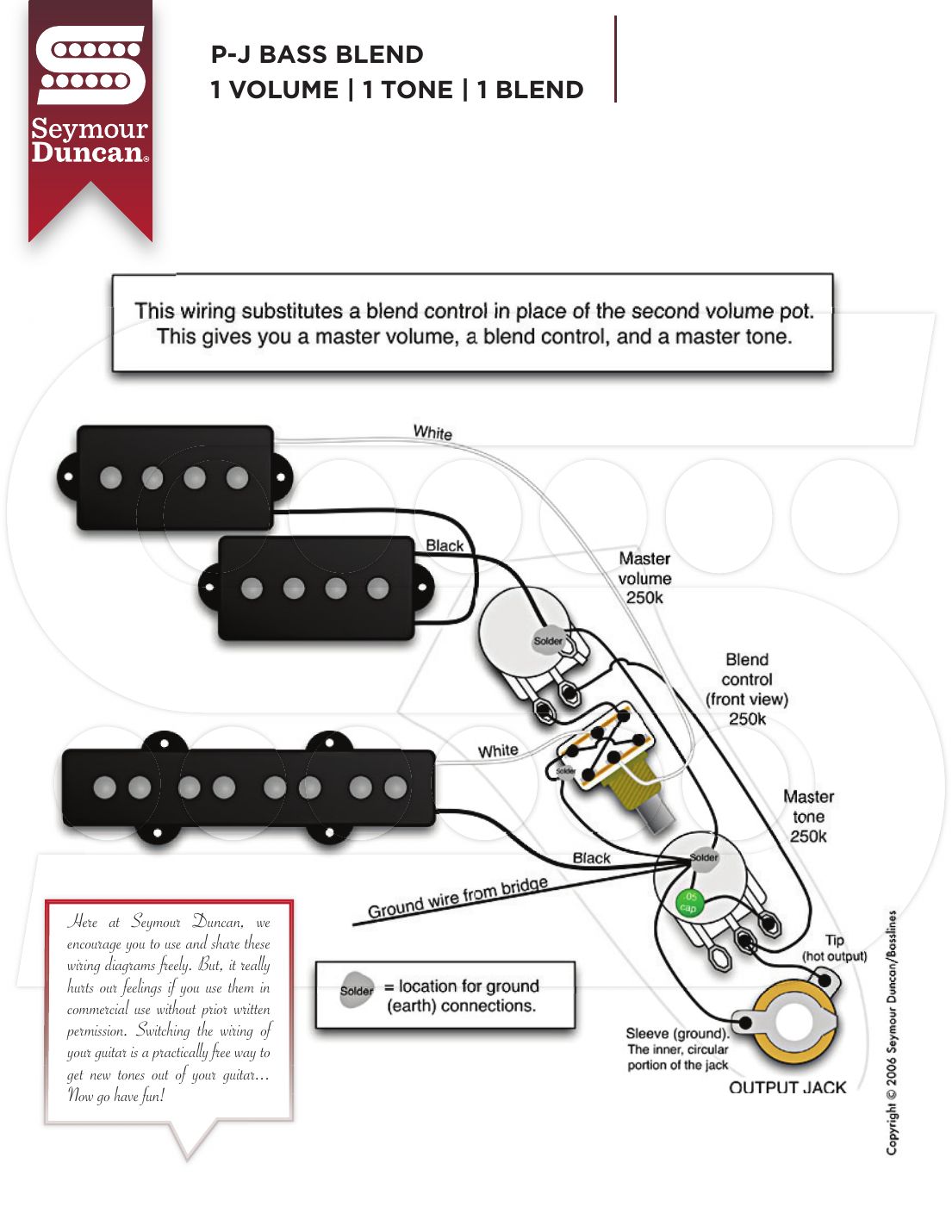
P-J Bass with master volume, blend and master tone
The same blend layout for a P-J: the P pickup's white goes to one side of the blend, the J's white to the other.
Controls: 250K master volume, 250K blend, 250K master tone, .05 µF cap, mono jack.
| # | Wire | Goes to |
|---|---|---|
| 1 | P: white (hot) | Blend, one section |
| 2 | P: black (ground) | Master volume casing |
| 3 | J: white (hot) | Blend, other section |
| 4 | J: black (ground) | Tone pot casing |
| 5 | Ground wire from bridge | Tone pot casing |
Wire it with
Jazz Bass with a push/pull for series/parallel: 2 volumes, 1 tone
SD: standard J-Bass wiring is parallel; switching to series gives a boost in output and in the mids. UP = series, DOWN = parallel. The push/pull is on the neck volume.
Controls: 250K push/pull neck volume, 250K bridge volume, 250K master tone, .05 µF cap, mono jack.
| # | Wire | Goes to |
|---|---|---|
| 1 | Neck: white and black | Push/pull switch on the neck volume, as drawn |
| 2 | Bridge: white (hot) | Bridge volume input lug |
| 3 | Bridge: black (ground) | Bridge volume casing |
| 4 | Ground wire from bridge | A pot casing |
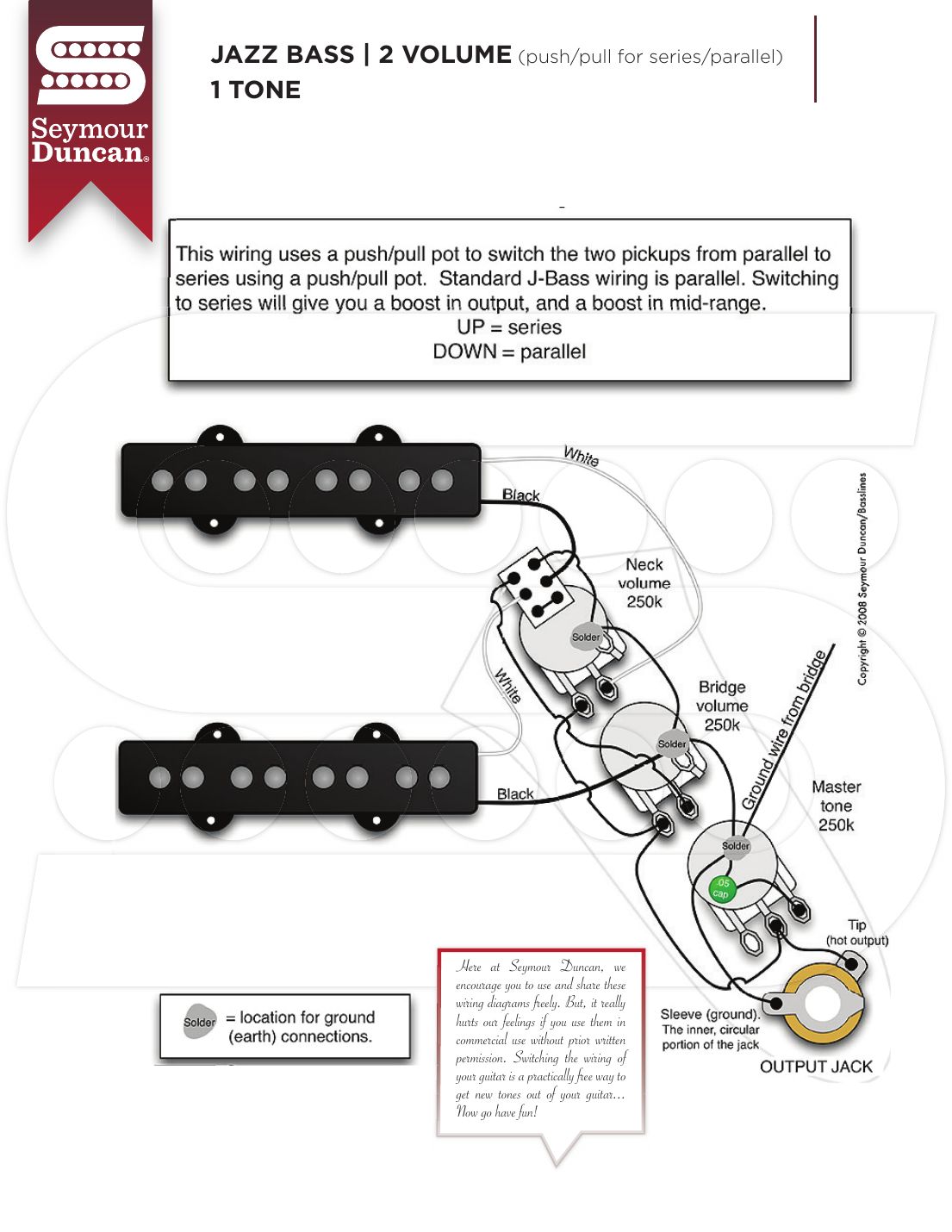
Wire it with
P-Bass with a mini-toggle series/parallel switch
A DPDT mini-toggle switches the P pickup's two halves between series (stock) and parallel.
Controls: 250K volume, 250K tone, DPDT mini-toggle, .05 µF cap, mono jack.
| # | Wire | Goes to |
|---|---|---|
| 1 | Link wire between the two halves | Cut in the middle; both ends to the toggle |
| 2 | White (hot) | Toggle, as drawn |
| 3 | Black (ground) | Toggle, as drawn |
| 4 | Toggle outputs | Volume input lug and ground |
| 5 | Ground wire from bridge | Volume casing |
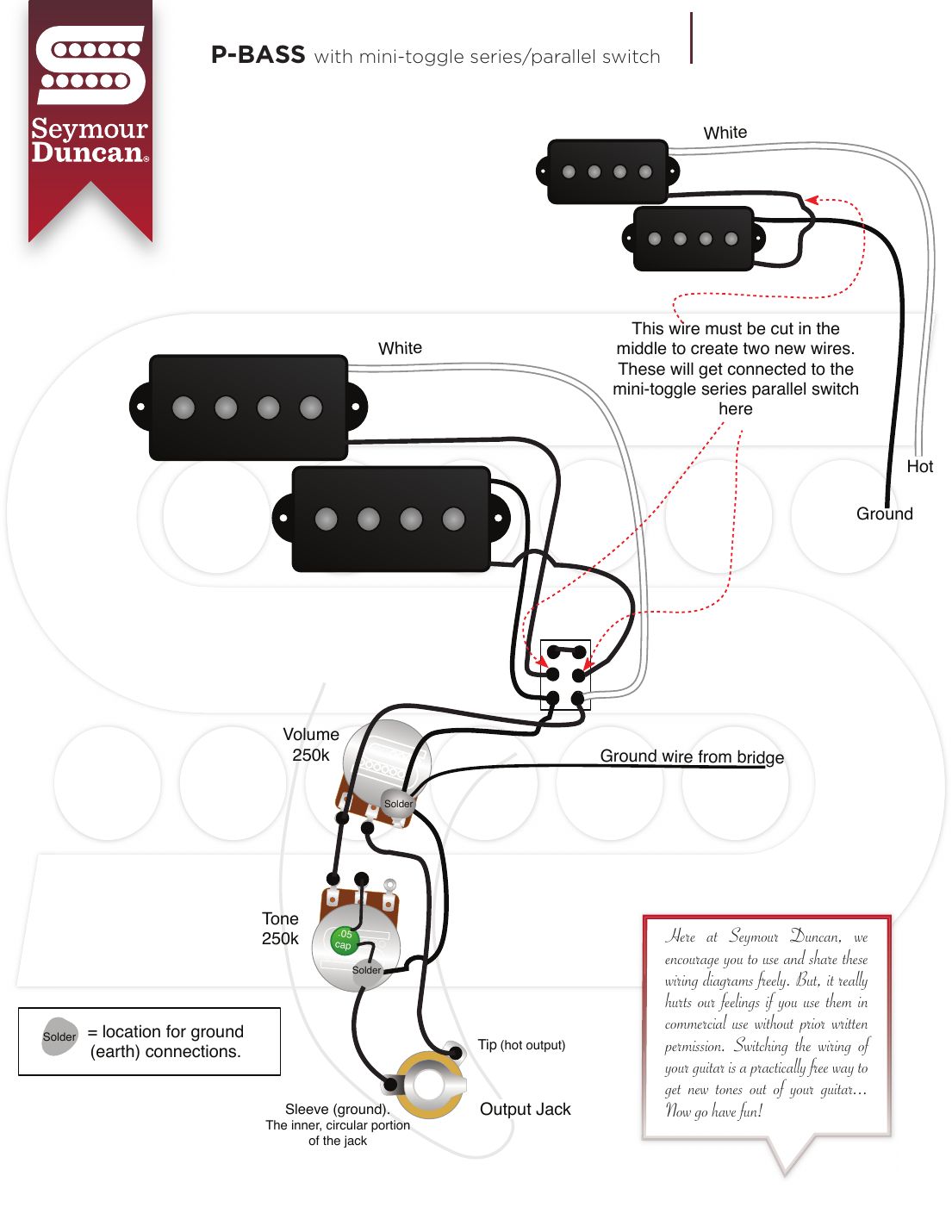
Wire it with
P-Bass with a push/pull volume for series/parallel
The same series/parallel switching as the mini-toggle sheet, using the switch on a push/pull volume so there's no extra hole.
Controls: 250K push/pull volume, 250K tone, .05 µF cap, mono jack.
| # | Wire | Goes to |
|---|---|---|
| 1 | Link wire between the two halves | Cut in the middle; both ends to the push/pull switch |
| 2 | White (hot) | Switch, as drawn |
| 3 | Black (ground) | Switch, as drawn |
| 4 | Switch outputs | Volume input lug and ground |
| 5 | Ground wire from bridge | Volume casing |
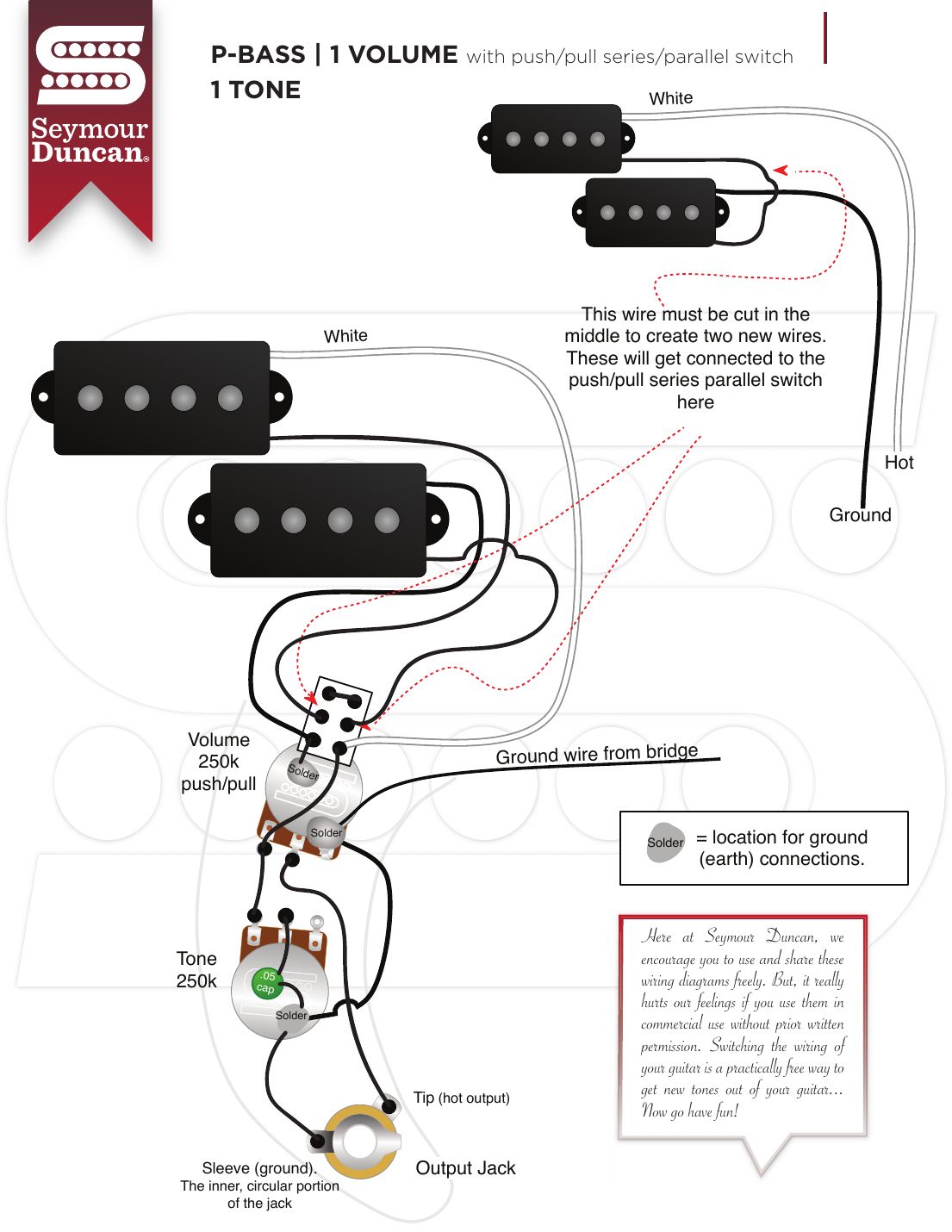
Wire it with
Music Man pickups
Music Man pickup, passive: 1 volume, 1 tone (coils in parallel)
A passive SD Music Man pickup with no preamp. Joining red and black as the hot wires the two coils in parallel, as the sheet title says.
Controls: 250K volume, 250K tone, .05 µF cap, mono jack.
| # | Wire | Goes to |
|---|---|---|
| 1 | Red and black together (hot) | Volume input lug |
| 2 | Green, white and bare (ground) | Volume casing |
| 3 | Ground wire from bridge | Volume casing |
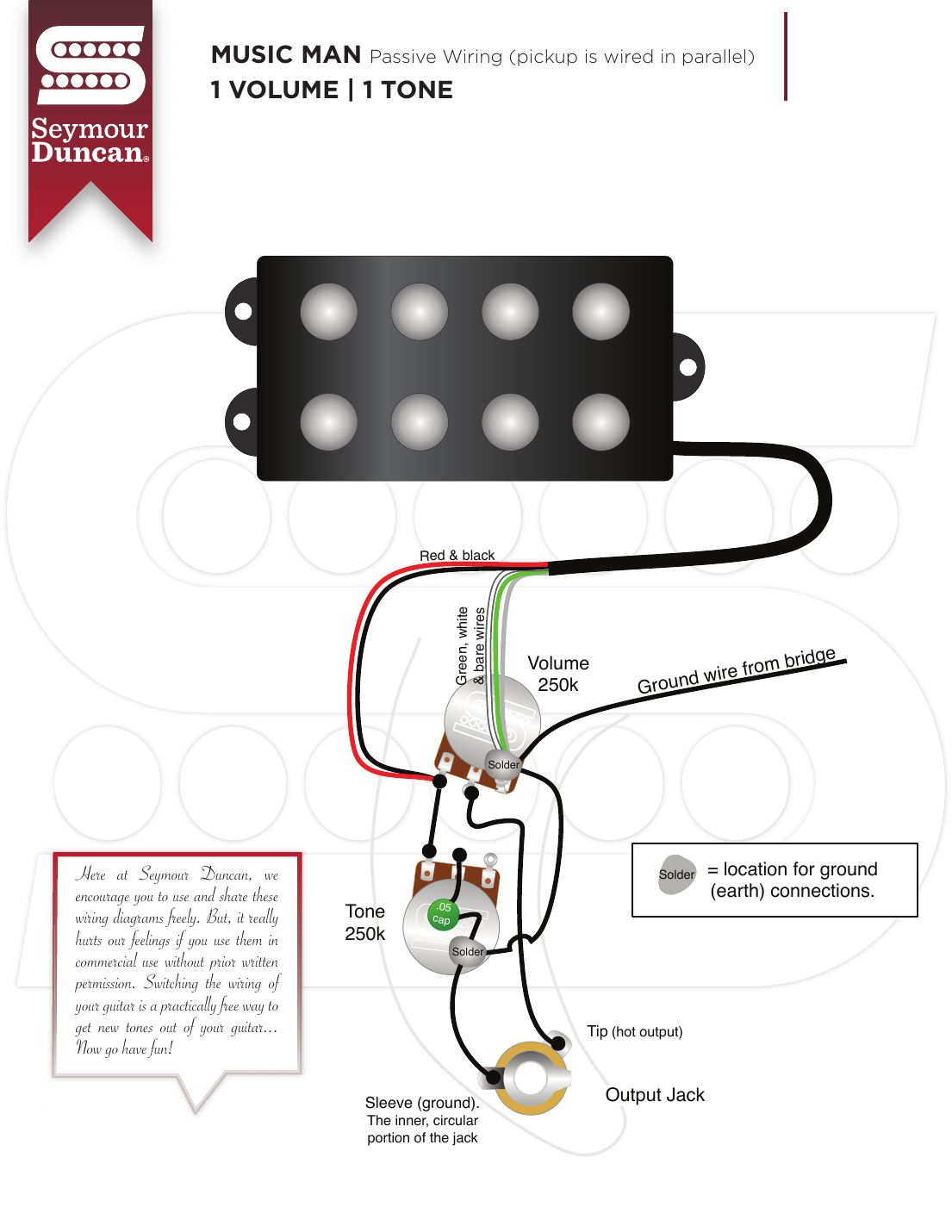
Wire it with
Music Man pickup, passive: 2 volumes (one per coil), 1 tone
Each coil of the Music Man pickup gets its own volume, so you can blend the front and rear coils like two pickups.
Controls: 250K front coil volume, 250K rear coil volume, 250K master tone, .05 µF cap, mono jack.
| # | Wire | Goes to |
|---|---|---|
| 1 | Black (front coil hot) | Front coil volume input lug |
| 2 | Red (rear coil hot) | Rear coil volume input lug |
| 3 | Green, white and bare (ground) | Front coil volume casing |
| 4 | Ground wire from bridge | Tone pot casing |
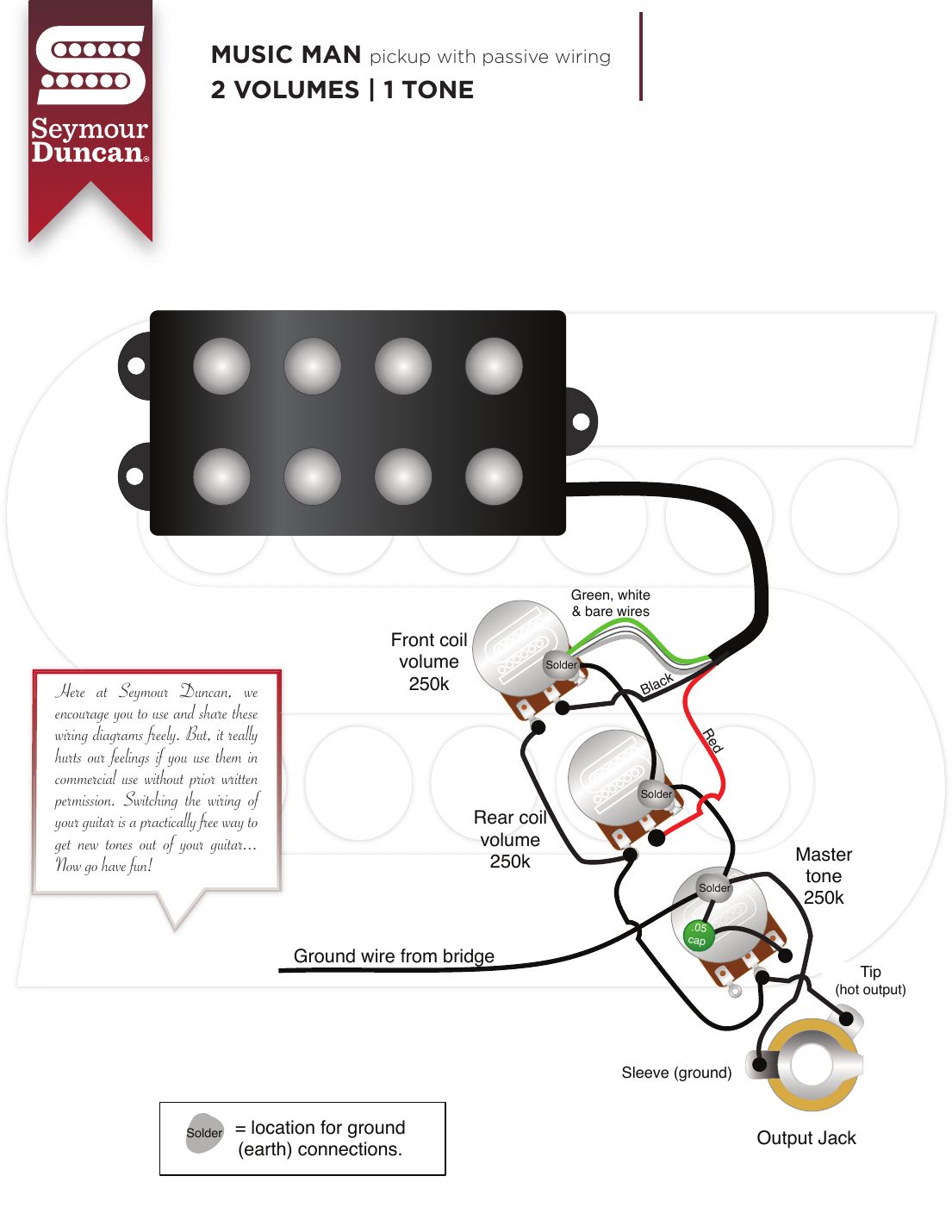
Wire it with
Music Man and P-Bass pickups, passive: 2 volumes, 1 tone
A P pickup at the neck and a Music Man pickup at the bridge, both passive, in the two-volume layout.
Controls: 250K P-Bass volume, 250K Music Man volume, 250K master tone, .05 µF cap, mono jack.
| # | Wire | Goes to |
|---|---|---|
| 1 | P: white (hot) | P-Bass volume input lug |
| 2 | P: black (ground) | P-Bass volume casing |
| 3 | Music Man: red and black (hot) | Music Man volume input lug |
| 4 | Music Man: green, white and bare (ground) | Music Man volume casing |
| 5 | Ground wire from bridge | Tone pot casing |
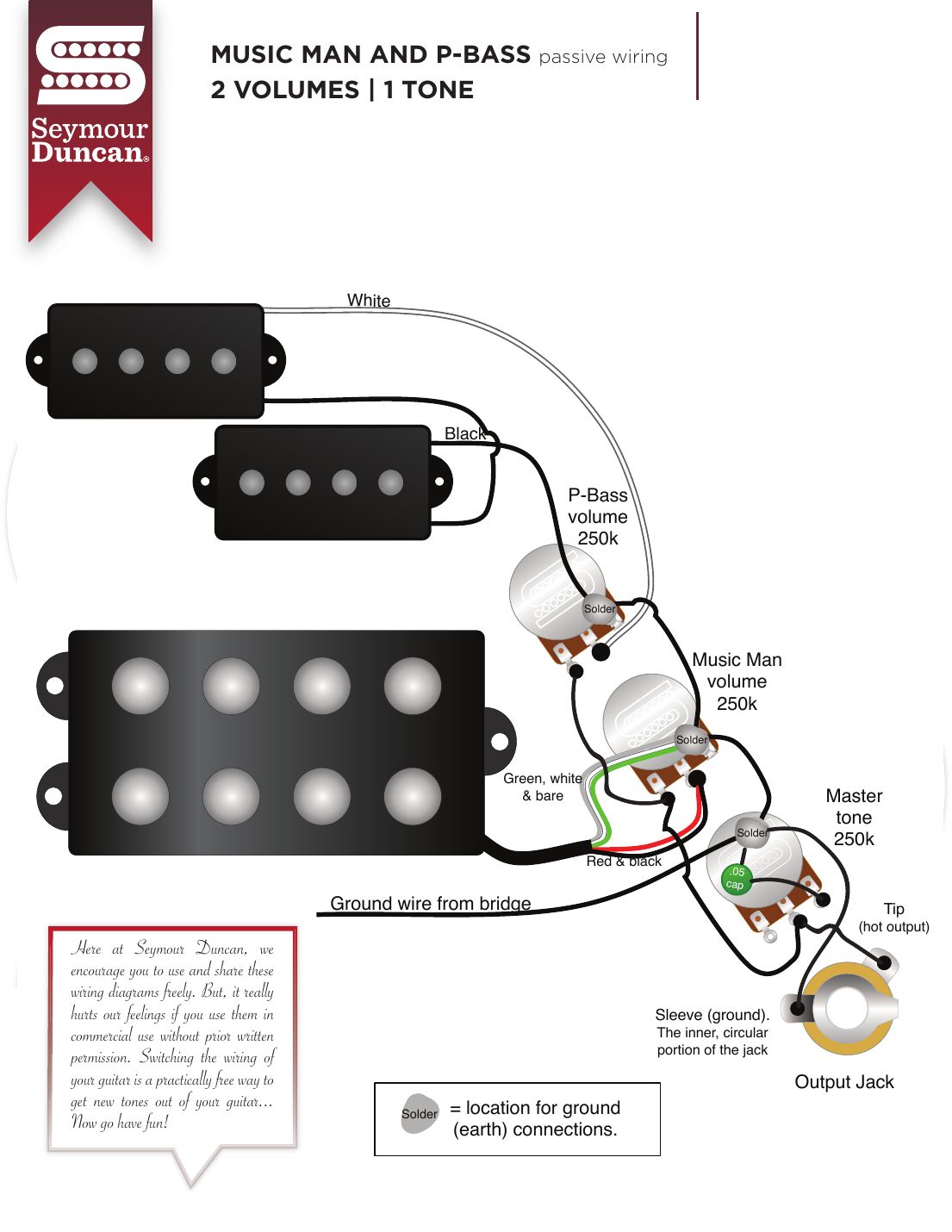
Wire it with
Music Man replacement system (pickup with 3-band preamp)
SD's replacement for a StingRay-style bass with its own preamp: master volume (push/pull), treble, mid and bass.
Controls: 10K push/pull master volume, 100K treble, 100K mid, 100K bass, stereo jack, 9 V battery.
| # | Wire | Goes to |
|---|---|---|
| 1 | Pickup: red and black | Joined to the harness gray (preamp input) |
| 2 | Pickup: green, white and bare | Bass pot casing (ground) |
| 3 | Harness: green/white striped and brown | Master volume push/pull switch |
| 4 | Harness: orange | Treble pot |
| 5 | Harness: yellow | Mid pot |
| 6 | Harness: blue | Bass pot |
| 7 | Harness: green and purple | Run along all three EQ pots, as drawn |
| 8 | Harness: white | Jack tip (hot output) |
| 9 | Harness: black | Jack sleeve |
| 10 | Harness: red | Battery red |
| 11 | Battery black | Jack ring |
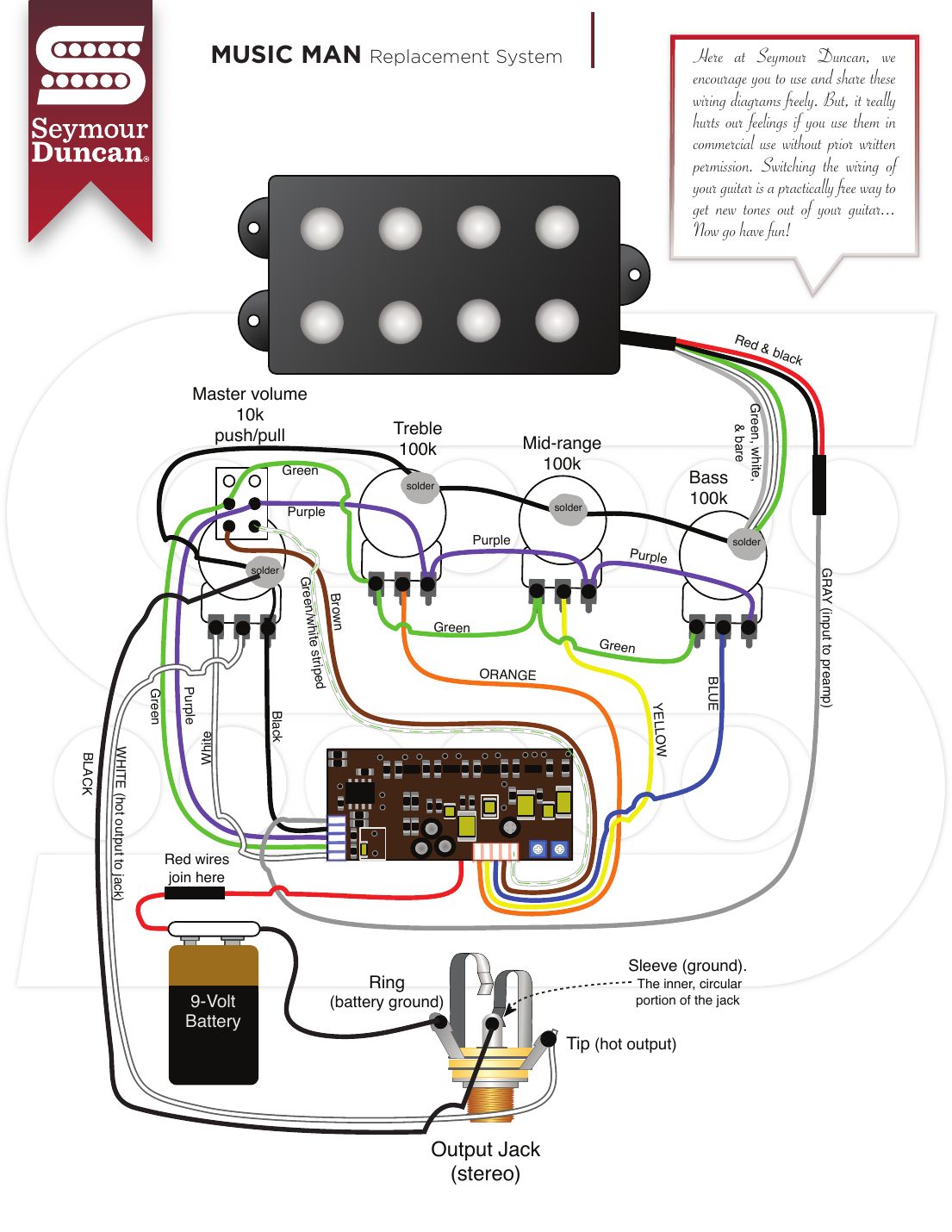
- The pickup-and-jack hookup for SD's Music Man preamps (STC-3M3 and STC-3M4) is written out wire by wire on our STC-3M3 / STC-3M4 wiring page; this page doesn't repeat it.
Music Man and P-Bass pickups with the STC-3P preamp
P at the neck, Music Man at the bridge, both feeding the STC-3P's blend. Pull up on the master volume for the slap contour EQ.
Controls: 10K push/pull master volume, 250K blend, 100K mid, 100K concentric bass/treble, stereo jack, 9 V battery.
| # | Wire | Goes to |
|---|---|---|
| 1 | P: white (hot) | Blend, one section |
| 2 | Music Man: hot leads | Blend, the other section |
| 3 | Both pickups' grounds | Pot casings |
| 4 | Everything after the blend | STC harness, colour by colour |
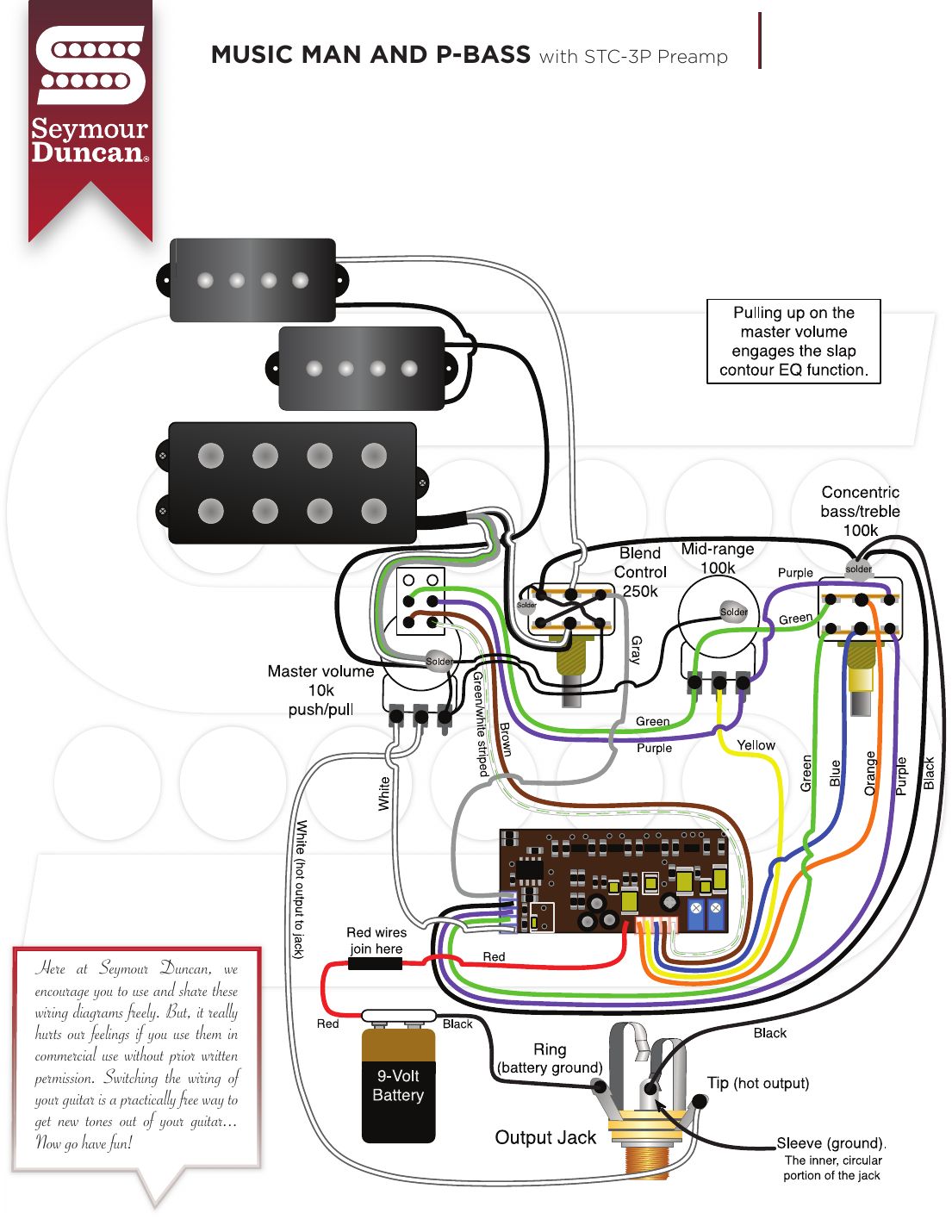
Wire it with
Soapbar pickups (passive, active and Blackouts)
Passive soapbars: 2 volumes, 1 tone
Two passive SD soapbars in the standard two-volume layout.
Controls: 250K neck volume, 250K bridge volume, 250K master tone, .05 µF cap, mono jack.
| # | Wire | Goes to |
|---|---|---|
| 1 | White (hot) | Its volume's input lug |
| 2 | Bare (ground) | Its volume's casing |
| 3 | Ground wire from bridge | Tone pot casing |
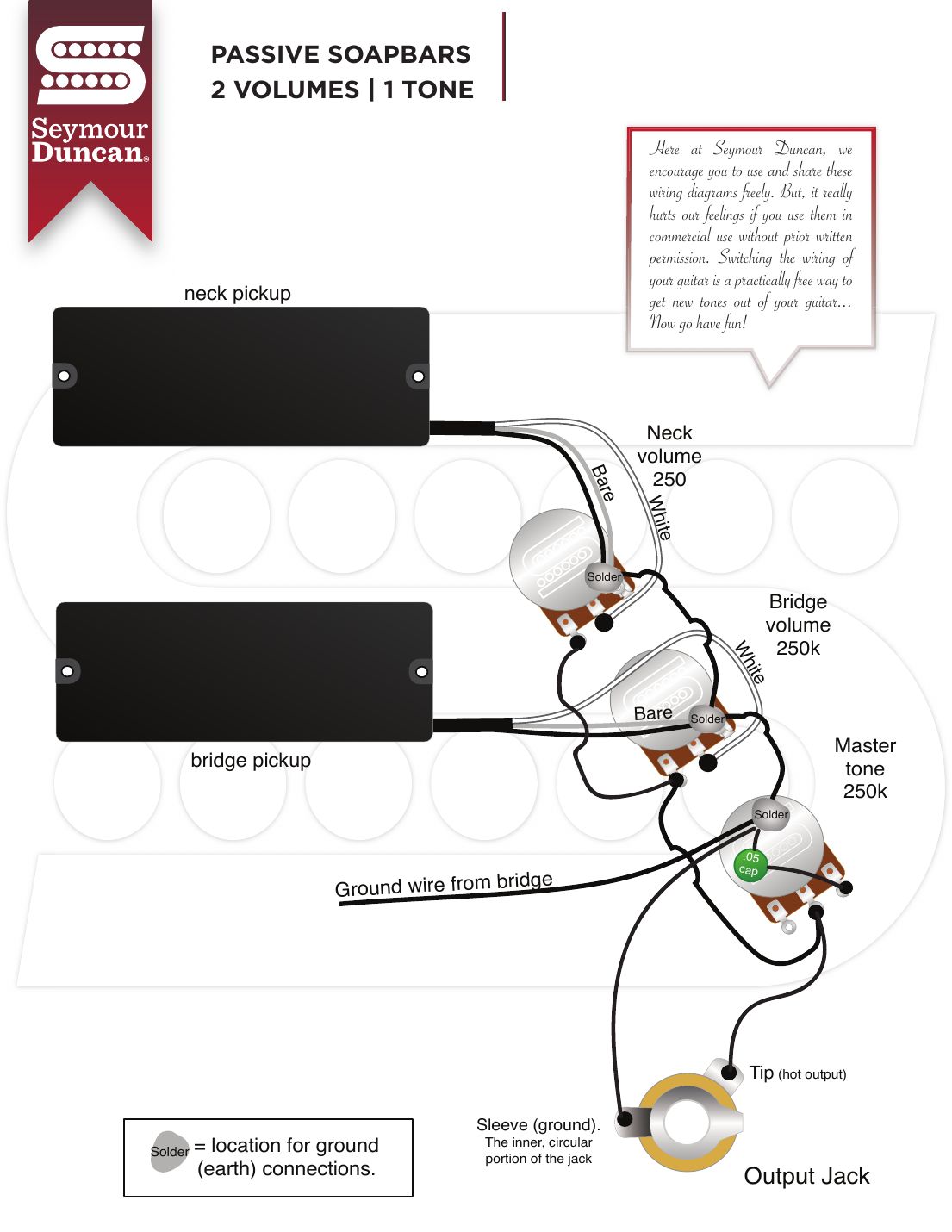
Wire it with
- The neck volume is labelled "250" on SD's drawing; it's the same 250K pot as the others.
Active soapbars: 2 volumes, 1 tone
Two SD active soapbars with a battery and a stereo jack.
Controls: 100K neck volume, 100K bridge volume, 100K master tone, .05 µF cap, stereo jack, 9 V battery.
| # | Wire | Goes to |
|---|---|---|
| 1 | White (hot) | Its volume's input lug |
| 2 | Bare (ground) | Its volume's casing |
| 3 | Red | Joined with the other red and the battery red |
| 4 | Battery black | Jack ring |
| 5 | Ground wire from bridge | Tone pot casing |
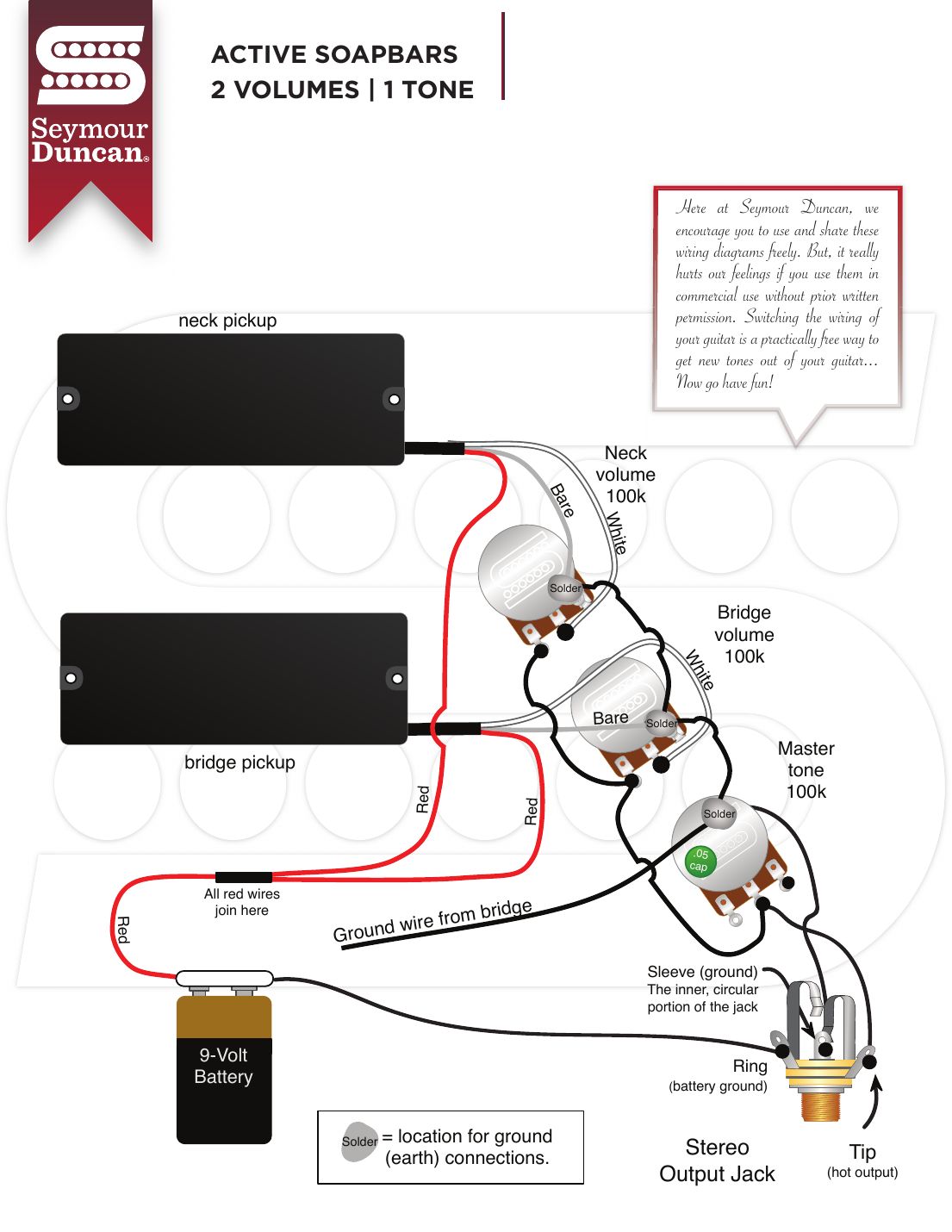
Wire it with
Blackouts soapbars: 2 volumes, 1 tone
Seymour Duncan Blackouts for bass: the same active hookup with 25K pots.
Controls: 25K neck volume, 25K bridge volume, 25K master tone, .05 µF cap, stereo jack, 9 V battery.
| # | Wire | Goes to |
|---|---|---|
| 1 | White (hot) | Its volume's input lug |
| 2 | Bare (ground) | Its volume's casing |
| 3 | Red | Joined with the other red and the battery red |
| 4 | Battery black | Jack ring |
| 5 | Ground wire from bridge | Tone pot casing |
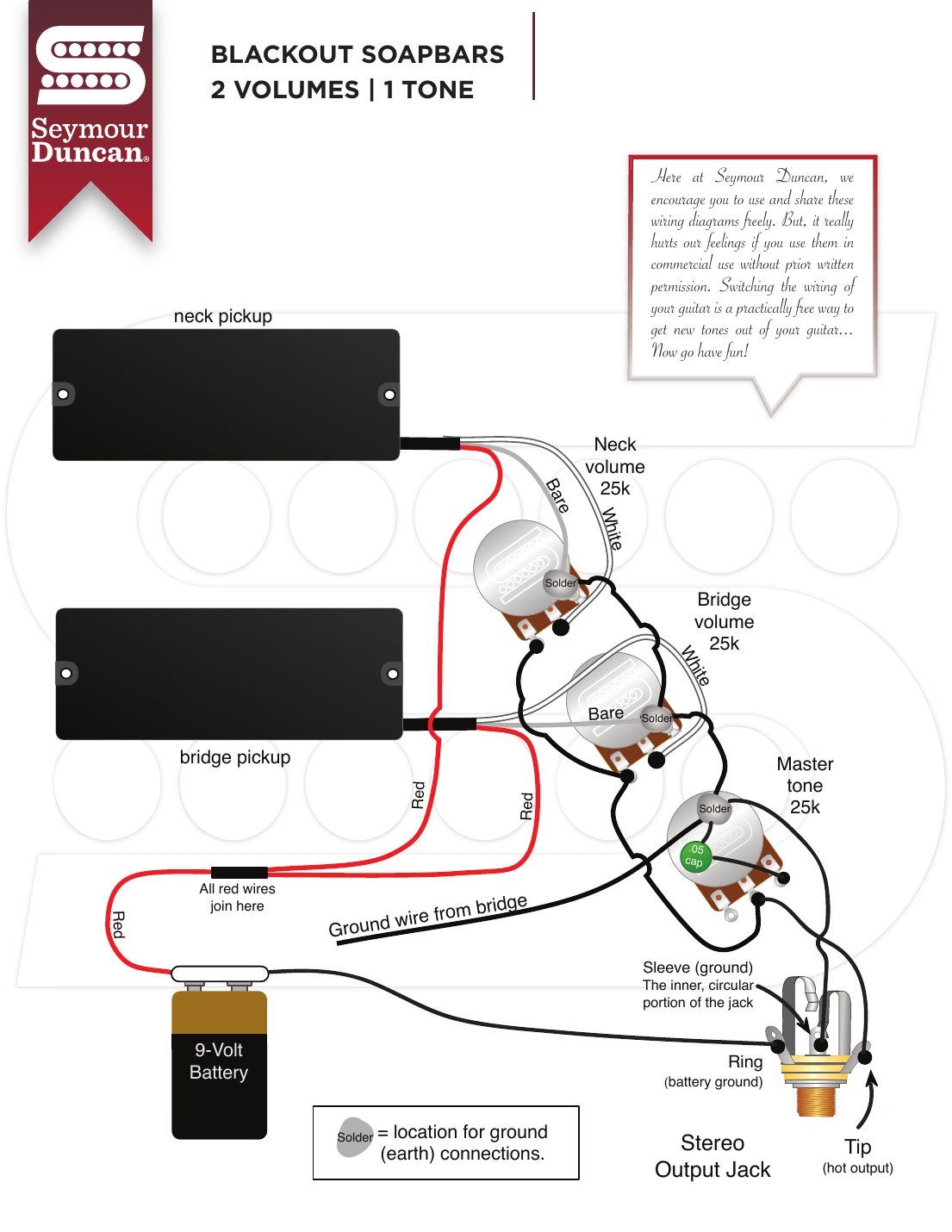
Wire it with
Passive soapbars with the STC-3P preamp
Two passive soapbars into the STC-3P's 250K blend. Pull up on the master volume for the slap contour EQ.
Controls: 10K push/pull master volume, 250K blend, 100K mid, 100K concentric bass/treble, stereo jack, 9 V battery.
| # | Wire | Goes to |
|---|---|---|
| 1 | Each soapbar: white (hot) | Blend, one section each |
| 2 | Each soapbar: bare (ground) | Pot casings |
| 3 | Everything after the blend | STC harness, colour by colour |
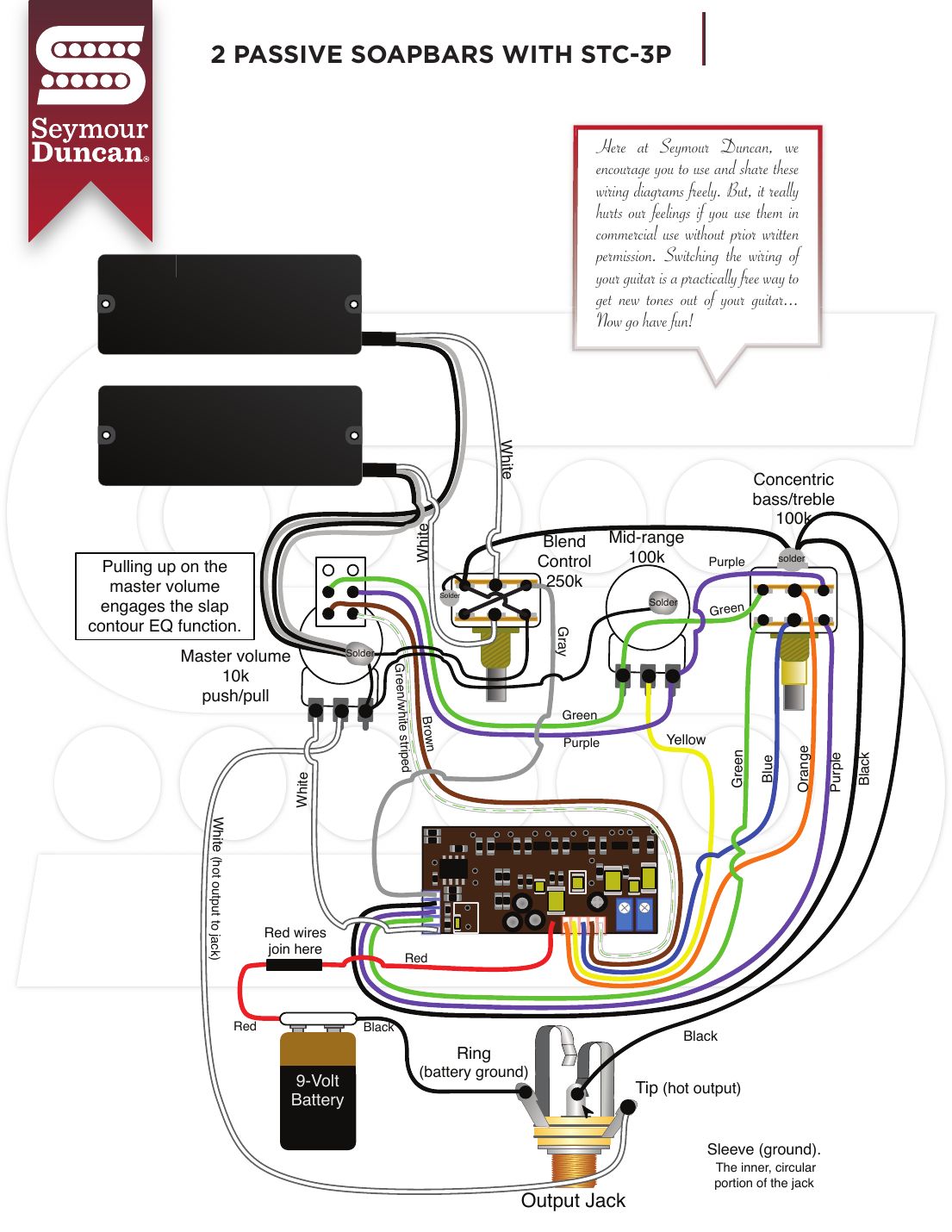
Wire it with
Active soapbars with the STC-3A preamp
Two active soapbars into the STC-3A's 100K blend. The pickups' red wires join the battery red with the preamp's.
Controls: 10K push/pull master volume, 100K blend, 100K mid, 100K concentric bass/treble, stereo jack, 9 V battery.
| # | Wire | Goes to |
|---|---|---|
| 1 | Each soapbar: white (hot) | Blend, one section each |
| 2 | Each soapbar: bare (ground) | Pot casings |
| 3 | Each soapbar: red | Joined with the harness red and the battery red |
| 4 | Everything after the blend | STC harness, colour by colour |
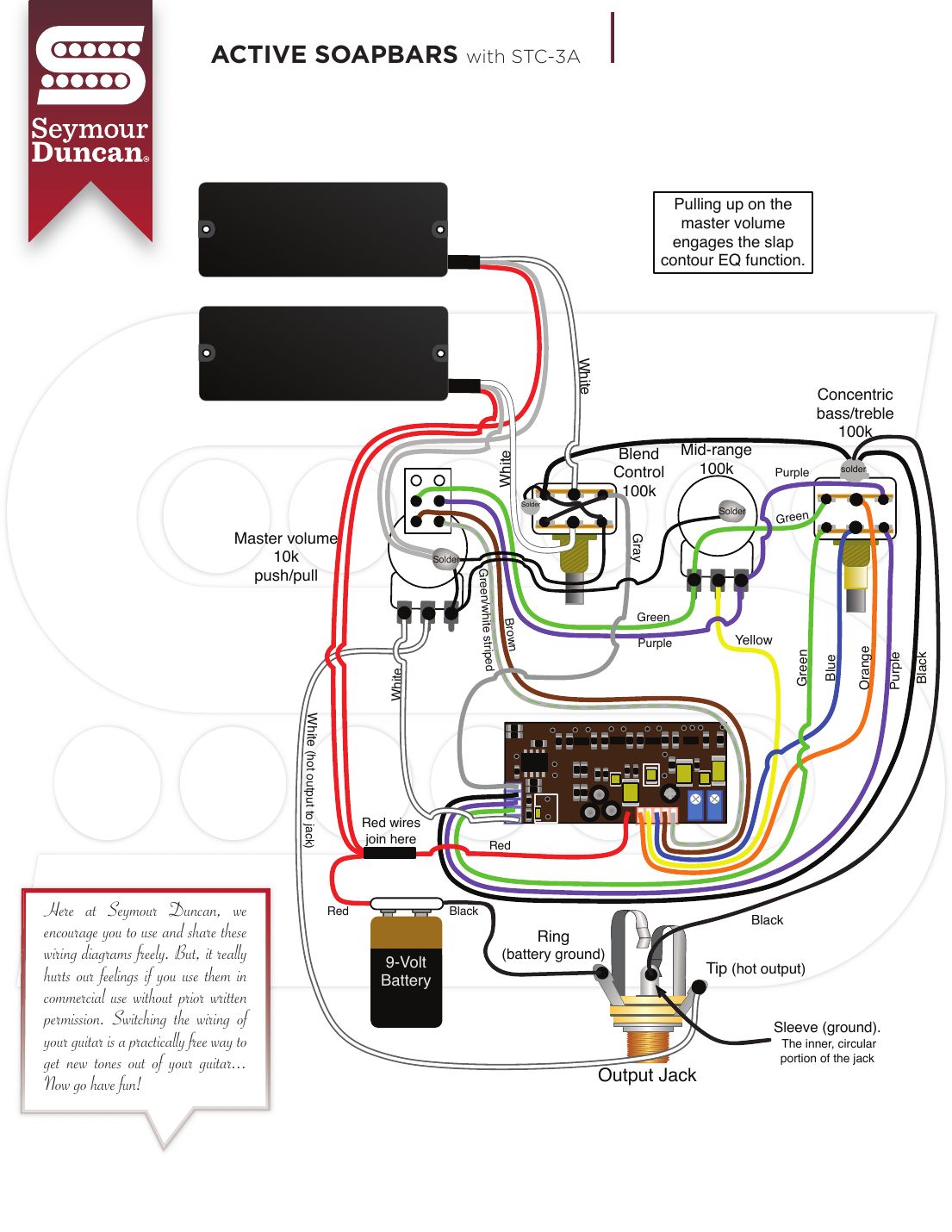
Wire it with
Passive soapbars: 2 volumes with the STC-BO preamp
Two passive soapbars, two volumes, and the STC-BO 2-band EQ in place of the tone pot.
Controls: 2 volumes, STC-BO with 25K concentric bass/treble, stereo jack, 9 V battery.
| # | Wire | Goes to |
|---|---|---|
| 1 | Each soapbar: white (hot) | Its volume's input lug |
| 2 | Each soapbar: bare (ground) | Its volume's casing |
| 3 | Bridge volume middle lug | STC-BO Input (white) |
| 4 | Pot casing | STC-BO Ground (black) |
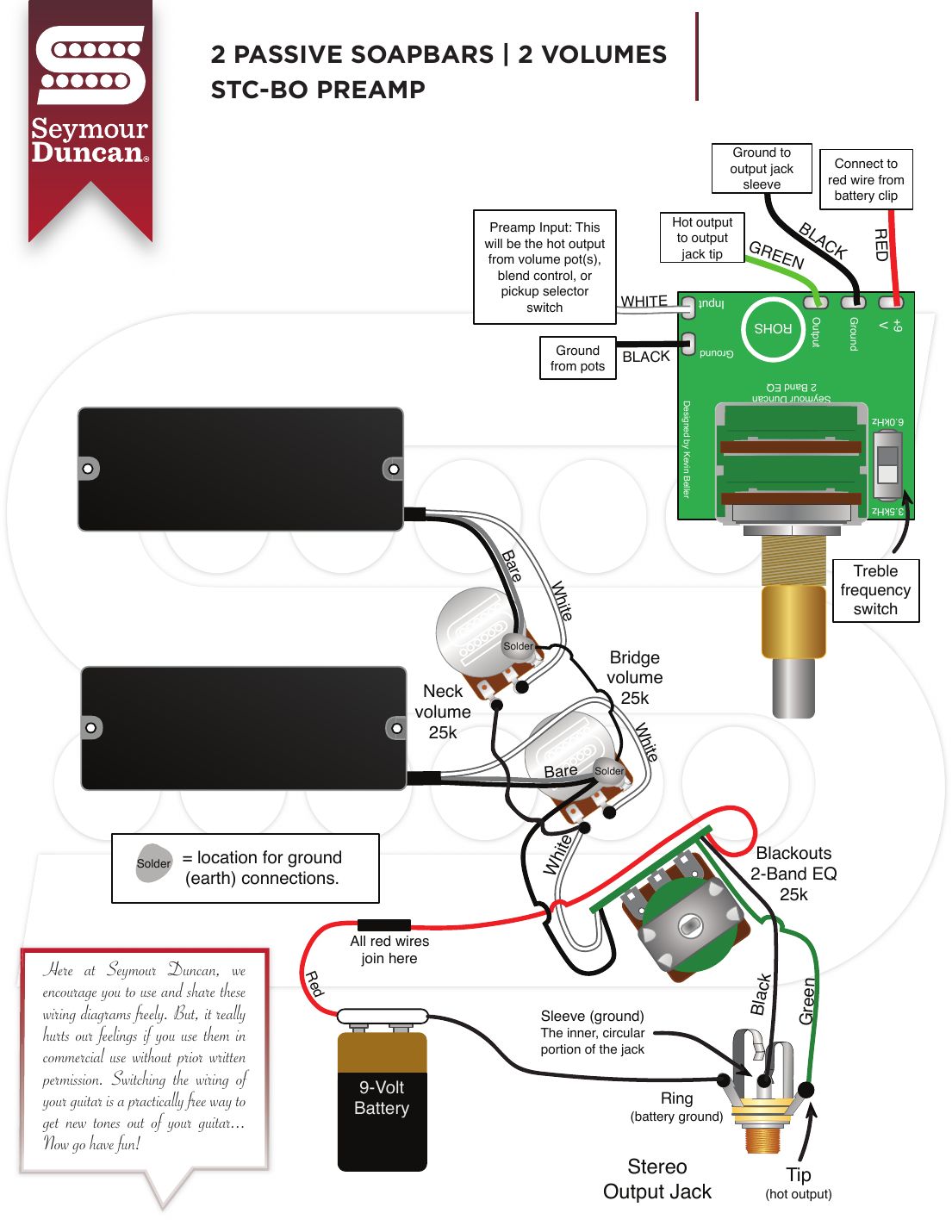
Wire it with
- SD's drawing labels both volumes 25K, the value for Blackouts. Passive soapbars normally use 250K volumes; we'd fit 250K here.
Blackouts for bass: 2 volumes with the STC-BO preamp
Blackouts soapbars with the STC-BO, their matching preamp. The pickups' reds and the board's +9 V red all join the battery red.
Controls: 25K neck volume, 25K bridge volume, STC-BO with 25K concentric bass/treble, stereo jack, 9 V battery.
| # | Wire | Goes to |
|---|---|---|
| 1 | Each pickup: white (hot) | Its volume's input lug |
| 2 | Each pickup: bare (ground) | Its volume's casing |
| 3 | Each pickup: red | Joined with the battery red and the STC-BO red |
| 4 | Bridge volume middle lug | STC-BO Input (white) |
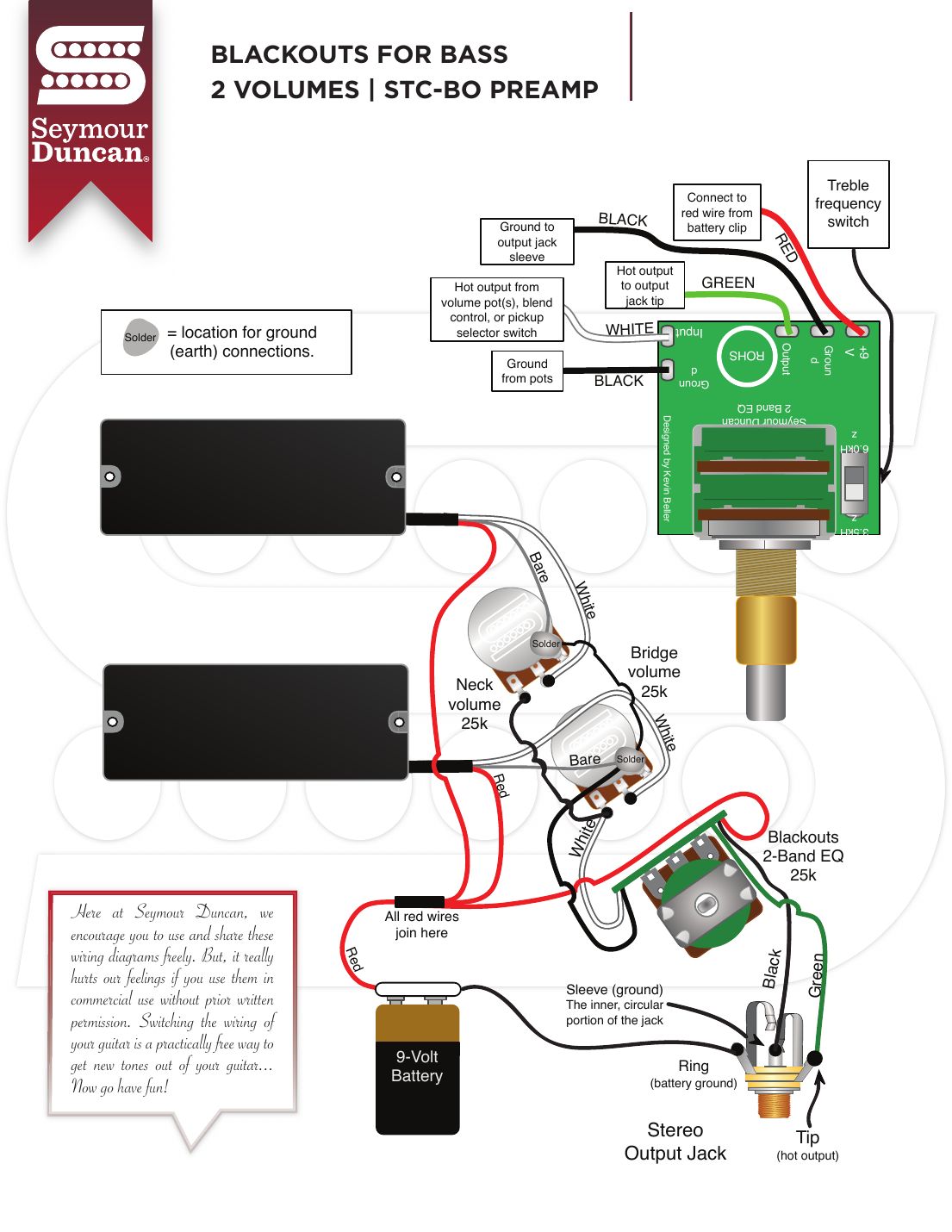
Wire it with
Active P, J and P-J pickups
Active P-Bass
An SD active P pickup: one volume, one tone, a battery and a stereo jack.
Controls: 100K volume, 100K tone, .05 µF cap, stereo jack, 9 V battery.
| # | Wire | Goes to |
|---|---|---|
| 1 | White (hot) | Volume input lug |
| 2 | Bare (ground) | Volume casing |
| 3 | Red | Battery red |
| 4 | Battery black | Jack ring |
| 5 | Ground wire from bridge | Tone pot casing |
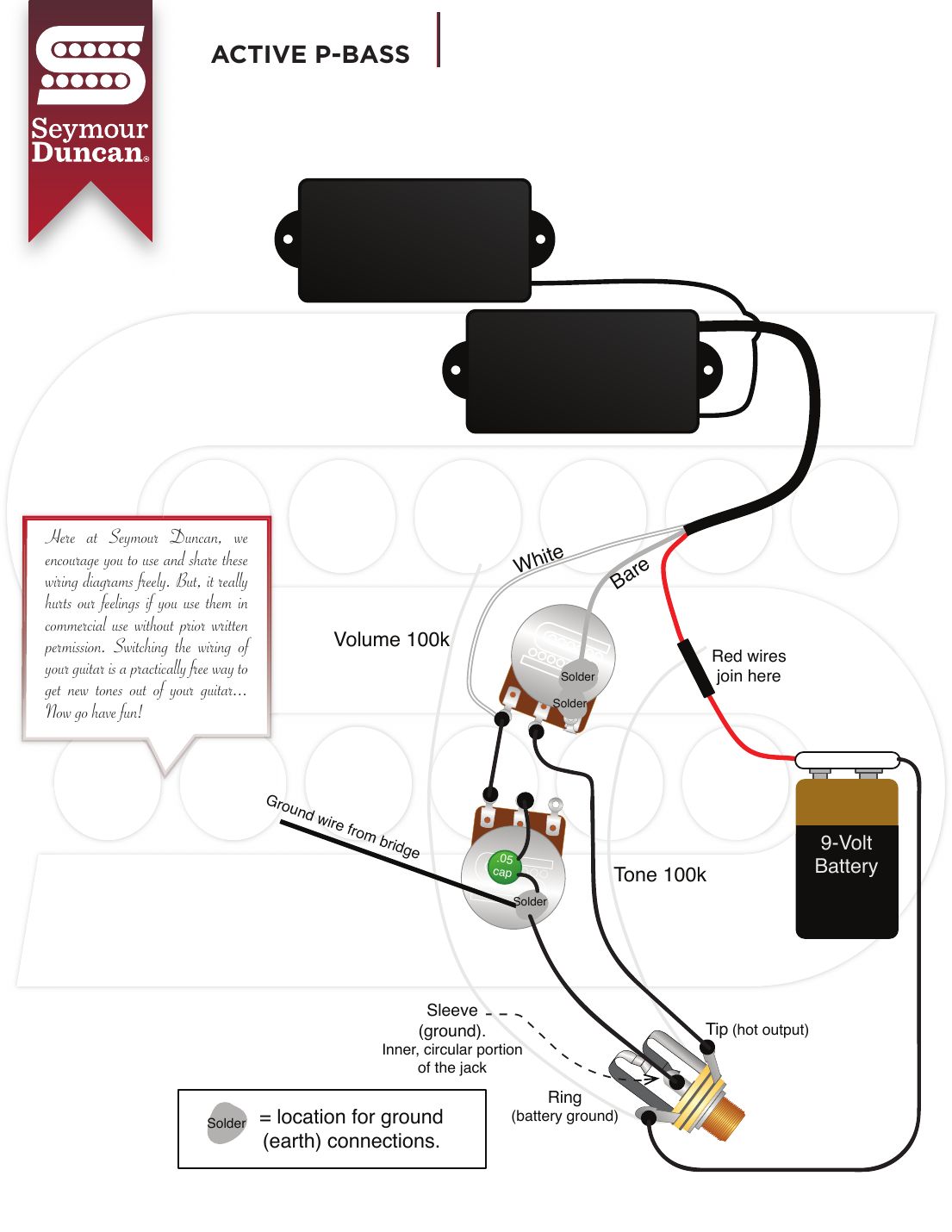
Wire it with
Active Jazz Bass
Two SD active J pickups: two volumes, master tone, battery and stereo jack.
Controls: 100K neck volume, 100K bridge volume, 100K master tone, .05 µF cap, stereo jack, 9 V battery.
| # | Wire | Goes to |
|---|---|---|
| 1 | White (hot) | Its volume's input lug |
| 2 | Bare (ground) | Its volume's casing |
| 3 | Red | Joined with the other red and the battery red |
| 4 | Battery black | Jack ring |
| 5 | Ground wire from bridge | Tone pot casing |
Wire it with
Active P-J Bass
An active P at the neck and an active J at the bridge, same layout as the Active Jazz Bass.
Controls: 100K neck volume, 100K bridge volume, 100K master tone, .05 µF cap, stereo jack, 9 V battery.
| # | Wire | Goes to |
|---|---|---|
| 1 | White (hot) | Its volume's input lug |
| 2 | Bare (ground) | Its volume's casing |
| 3 | Red | Joined with the other red and the battery red |
| 4 | Battery black | Jack ring |
| 5 | Ground wire from bridge | Tone pot casing |
Wire it with
Active Jazz Bass with the STC-2A or STC-3A preamp
Active J pickups into the STC's 100K blend. The sheet covers both the 2-band STC-2A and 3-band STC-3A; the STC-2A has no mid pot.
Controls: 10K push/pull master volume, 100K blend, 100K mid (STC-3A only), 100K concentric bass/treble, stereo jack, 9 V battery.
| # | Wire | Goes to |
|---|---|---|
| 1 | Each pickup: white (hot) | Blend, one section each |
| 2 | Each pickup: bare (ground) | Pot casings |
| 3 | Each pickup: red | Joined with the harness red and the battery red |
| 4 | Everything after the blend | STC harness, colour by colour |
Wire it with
Tone circuits and preamps
3-band tone circuits (STC-3A and STC-3P): basic wiring
The general STC-3 sheet: any two pickups into the blend, then the harness. Blend control: 100K for the STC-3A, 250K for the STC-3P.
Controls: 10K push/pull master volume, blend (100K or 250K), 100K mid, 100K concentric bass/treble, stereo jack, 9 V battery.
| # | Wire | Goes to |
|---|---|---|
| 1 | Hot output from the neck pickup | Blend, one section |
| 2 | Hot output from the bridge pickup | Blend, the other section |
| 3 | Everything after the blend | STC harness, colour by colour |
Wire it with
3-band tone circuit with 2 volumes
The STC-3 with a volume per pickup instead of a blend and master volume. The volume outputs join to the gray input wire, and the harness white goes straight to the jack.
Controls: Neck and bridge volumes (250K for passive pickups, 100K for active), 100K mid, 100K concentric bass/treble, stereo jack, 9 V battery.
| # | Wire | Goes to |
|---|---|---|
| 1 | Hot from neck pickup | Neck volume input lug |
| 2 | Hot from bridge pickup | Bridge volume input lug |
| 3 | Both volume outputs | Harness gray |
| 4 | Harness white | Jack tip |
| 5 | Slap contour (green/white striped and brown) | Another push/pull or a mini-toggle |
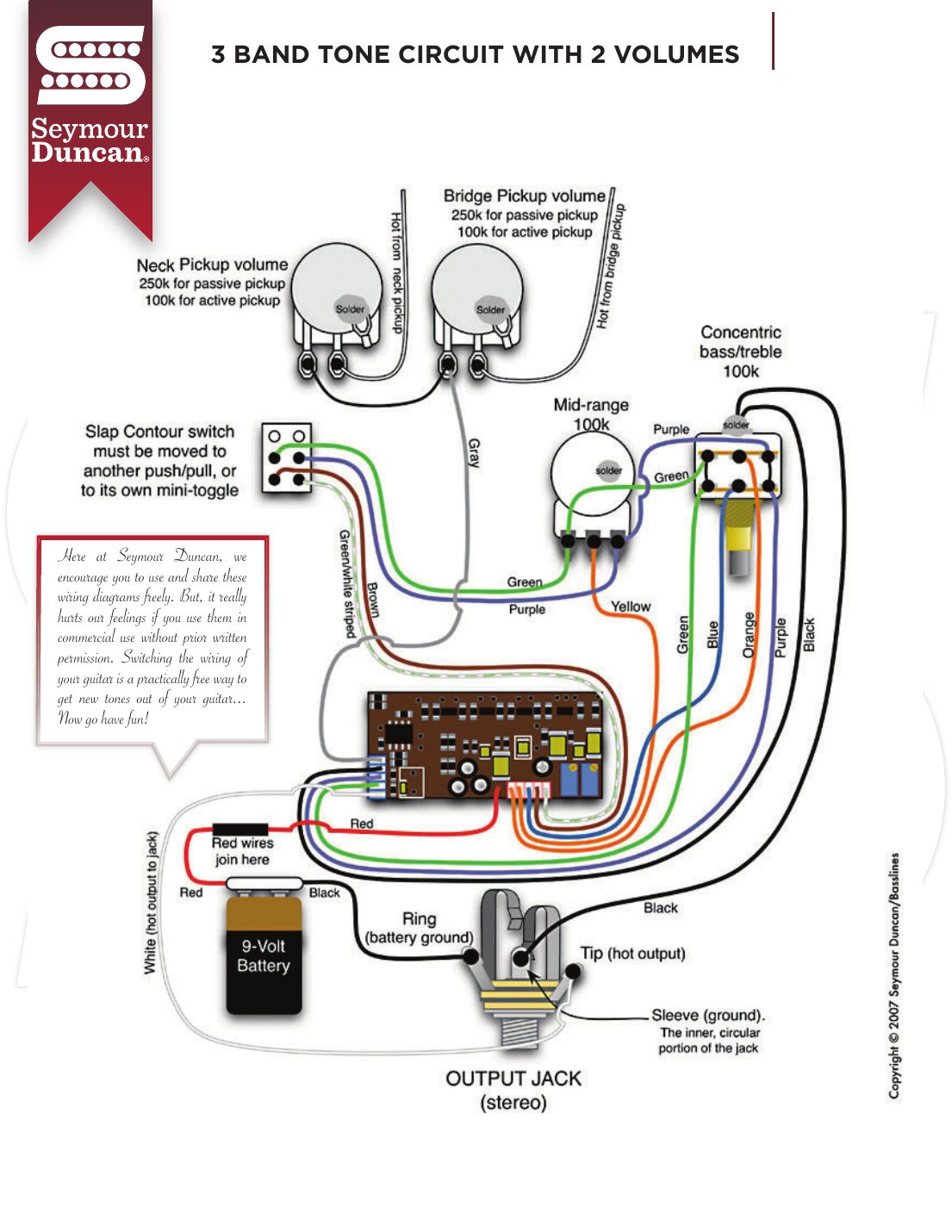
Wire it with
2-band tone circuit (STC-2A and STC-2P)
The 2-band STC: same harness as the STC-3 without the mid pot. Blend control: 100K for the STC-2A, 250K for the STC-2P.
Controls: 10K push/pull master volume, blend (100K or 250K), 100K concentric bass/treble, stereo jack, 9 V battery.
| # | Wire | Goes to |
|---|---|---|
| 1 | Hot output from the neck pickup | Blend, one section |
| 2 | Hot output from the bridge pickup | Blend, the other section |
| 3 | Harness green and purple | Straight to the concentric pot (no mid pot) |
| 4 | Everything else | STC harness, colour by colour |
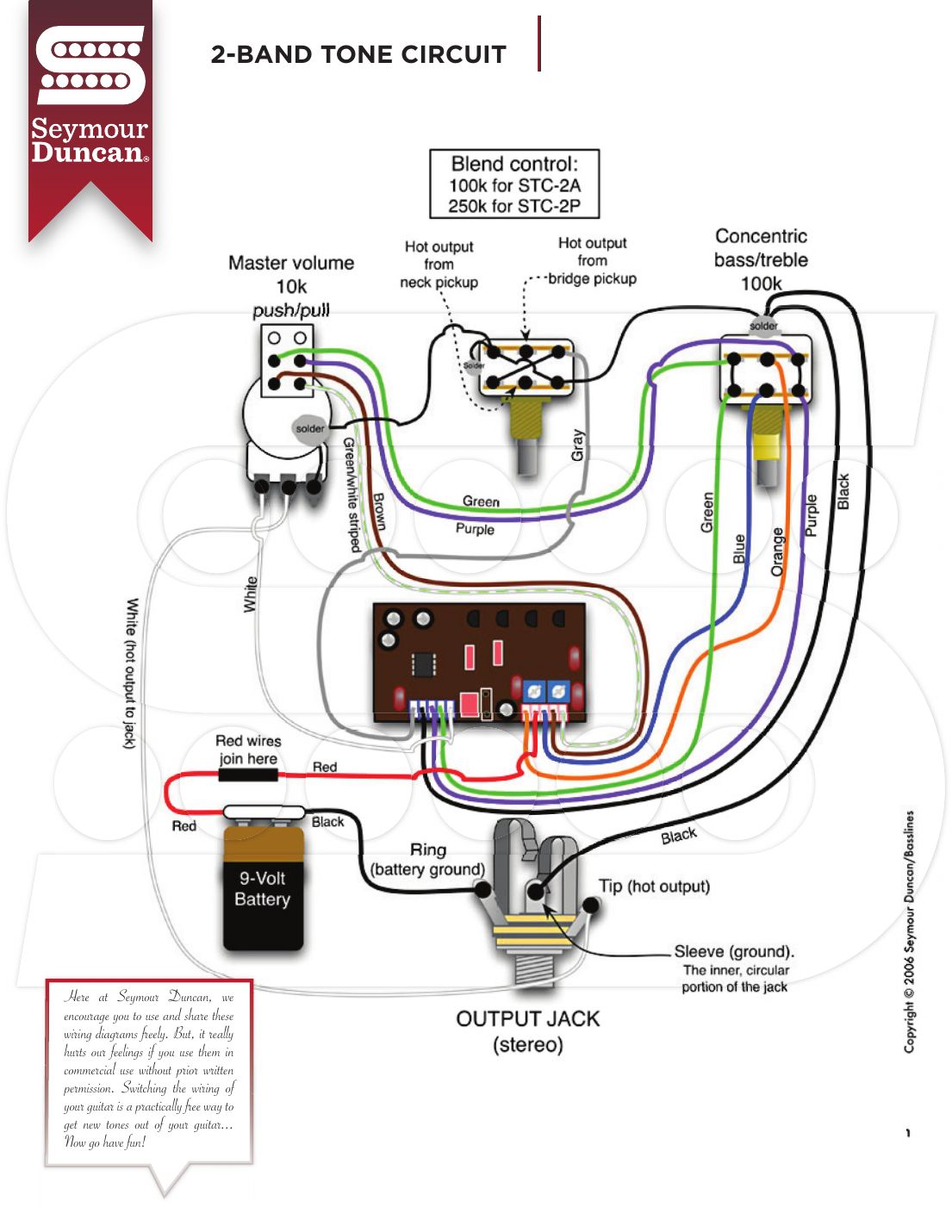
Wire it with
Jazz Bass with the STC-2P or STC-3P preamp
Passive J pickups into the STC's 250K blend. The STC-2P is the same without the mid pot.
Controls: 10K push/pull master volume, 250K blend, 100K mid (STC-3P only), 100K concentric bass/treble, stereo jack, 9 V battery.
| # | Wire | Goes to |
|---|---|---|
| 1 | Neck: white (hot) | Blend, one section |
| 2 | Bridge: white (hot) | Blend, the other section |
| 3 | Black (ground) | Pot casings |
| 4 | Everything after the blend | STC harness, colour by colour |
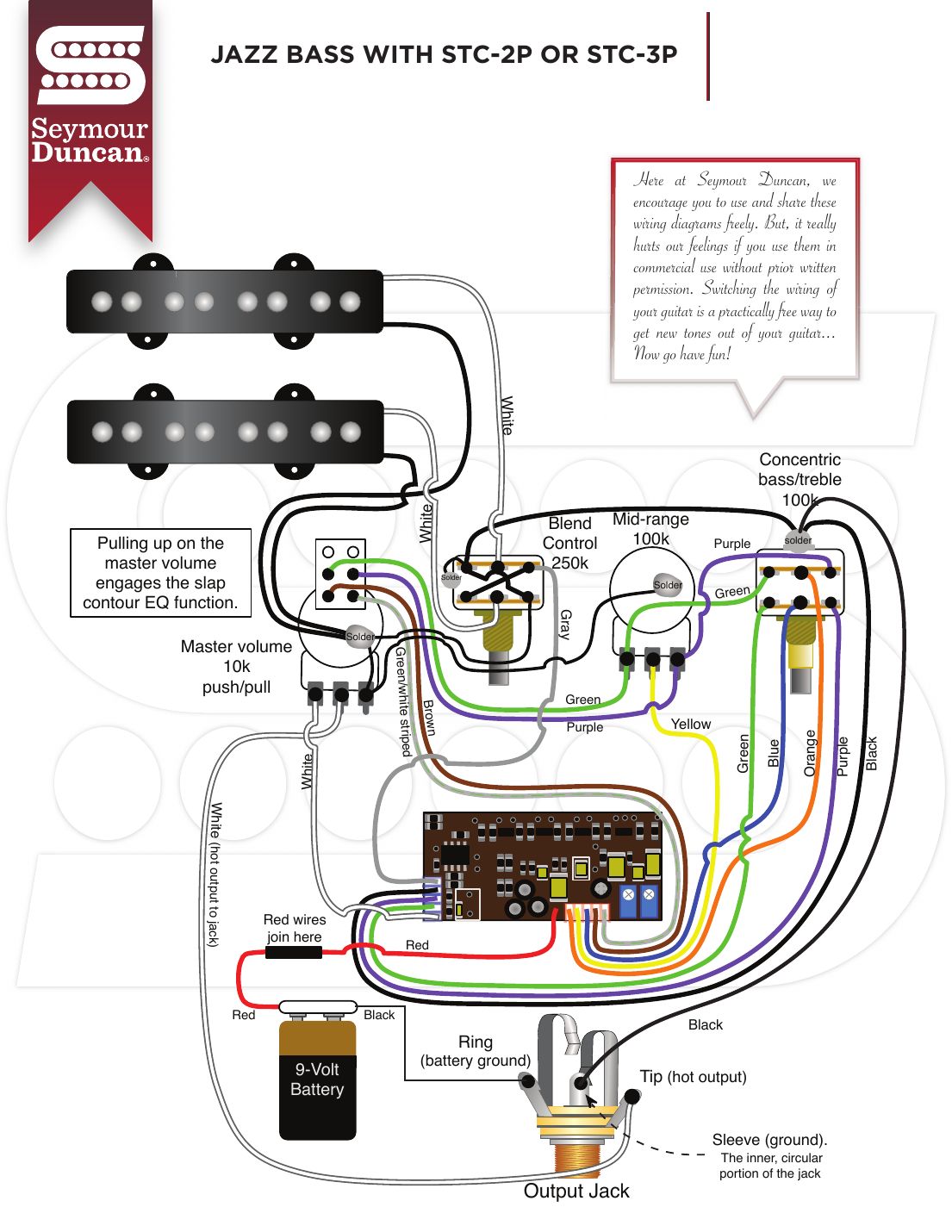
Wire it with
Jazz Bass with the STC-BO tone circuit
SD: "The STC-BO preamp replaces the traditional tone control." Two volumes stay; the STC-BO goes in the tone hole.
Controls: 250K neck volume, 250K bridge volume, STC-BO with 25K concentric bass/treble, stereo jack, 9 V battery.
| # | Wire | Goes to |
|---|---|---|
| 1 | Neck: white (hot) | Neck volume input lug |
| 2 | Bridge: white (hot) | Bridge volume input lug |
| 3 | Black (ground) | Its volume's casing |
| 4 | Bridge volume middle lug | STC-BO Input (white) |
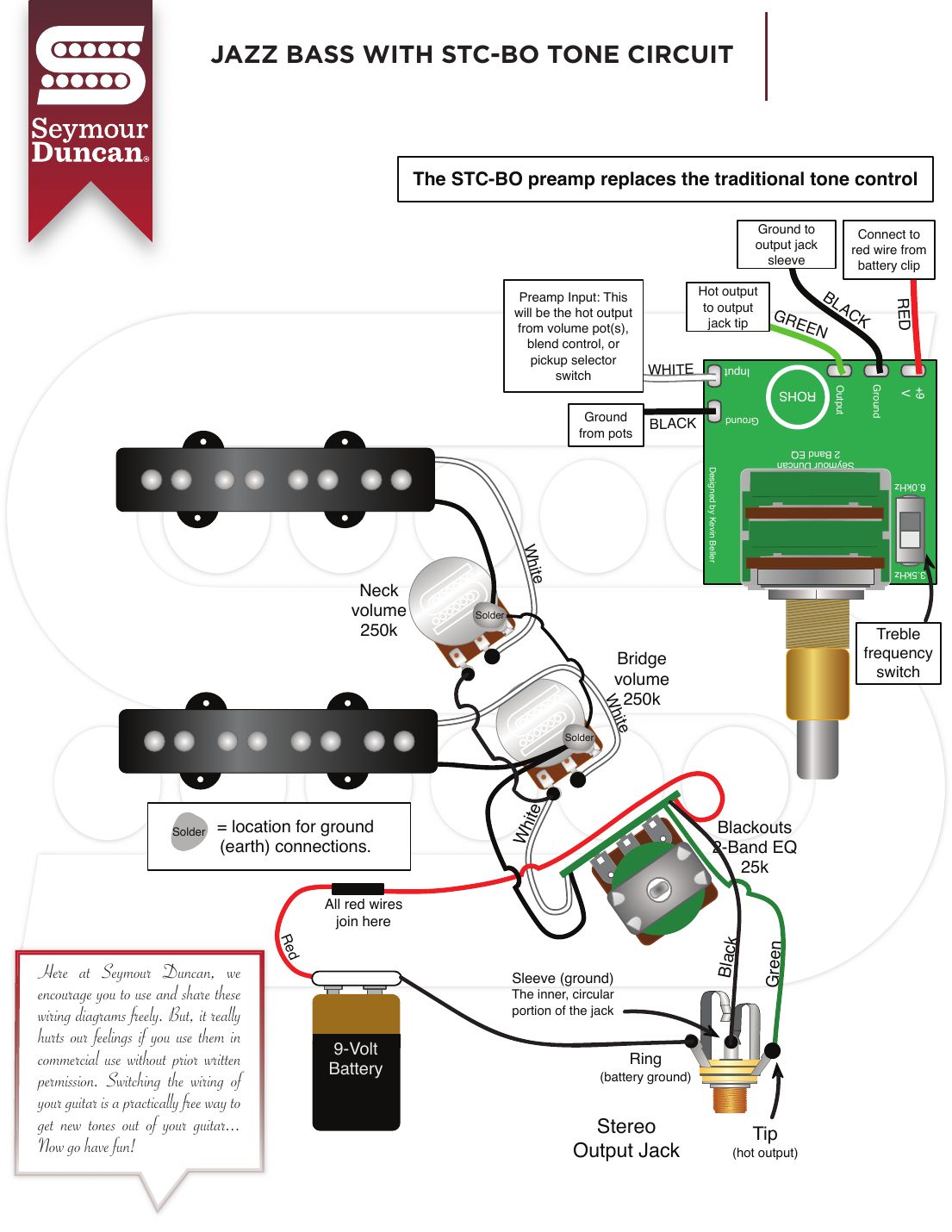
Wire it with
P-J Bass with the STC-BO tone circuit
P and J pickups with two volumes and the STC-BO in place of the tone pot.
Controls: 250K neck volume, 250K bridge volume, STC-BO with 25K concentric bass/treble, stereo jack, 9 V battery.
| # | Wire | Goes to |
|---|---|---|
| 1 | P: white (hot) | Neck volume input lug |
| 2 | J: white (hot) | Bridge volume input lug |
| 3 | Black (ground) | Its volume's casing |
| 4 | Bridge volume middle lug | STC-BO Input (white) |
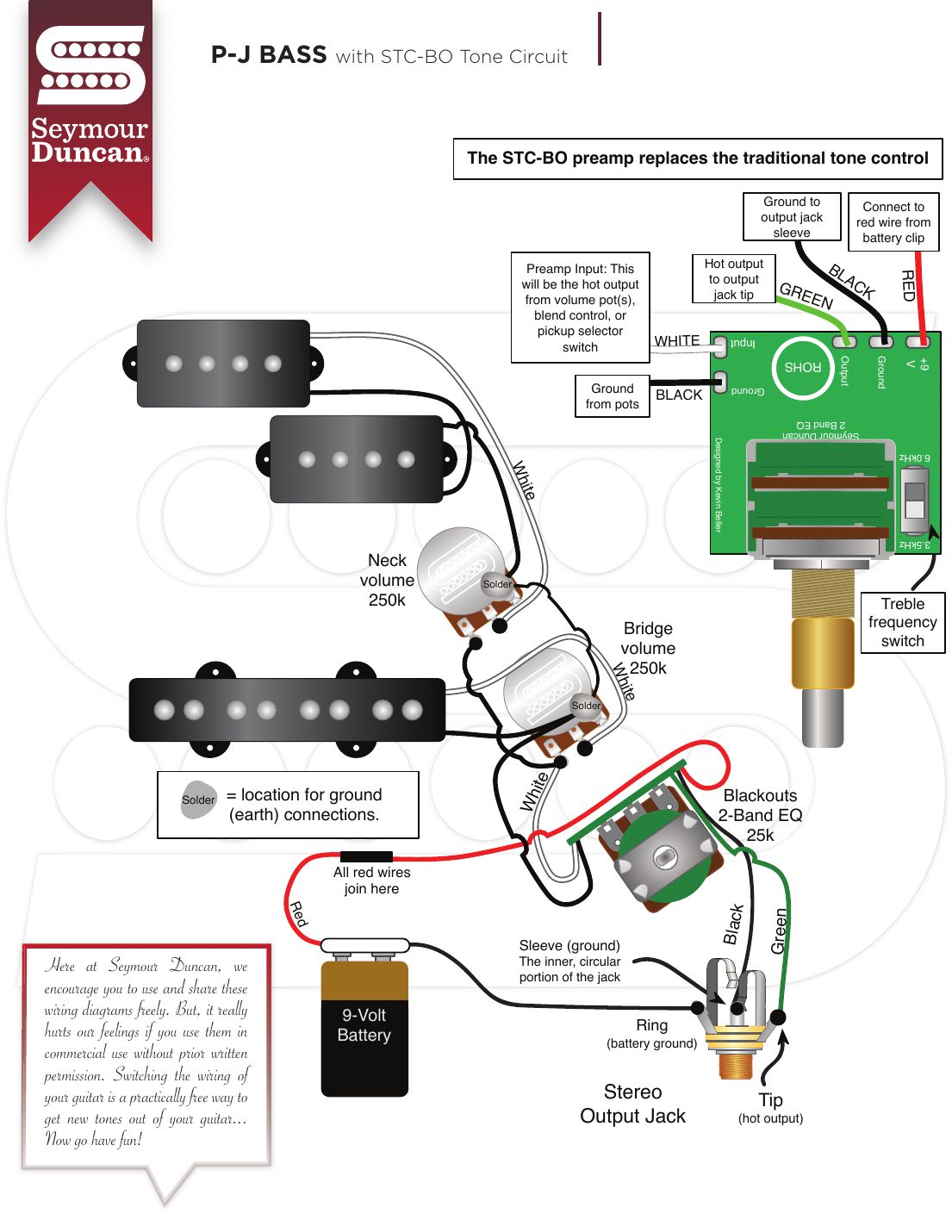
Wire it with
P-Bass with one volume and the STC-BO tone circuit
A P pickup, one volume, and the STC-BO where the tone pot was. SD: connect the hot output from the volume pot to the preamp input.
Controls: 250K volume, STC-BO with 25K concentric bass/treble, stereo jack, 9 V battery.
| # | Wire | Goes to |
|---|---|---|
| 1 | White (hot) | Volume input lug |
| 2 | Black (ground) | Volume casing |
| 3 | Volume middle lug | STC-BO Input (white) |
| 4 | Pot casing | STC-BO Ground (black) |
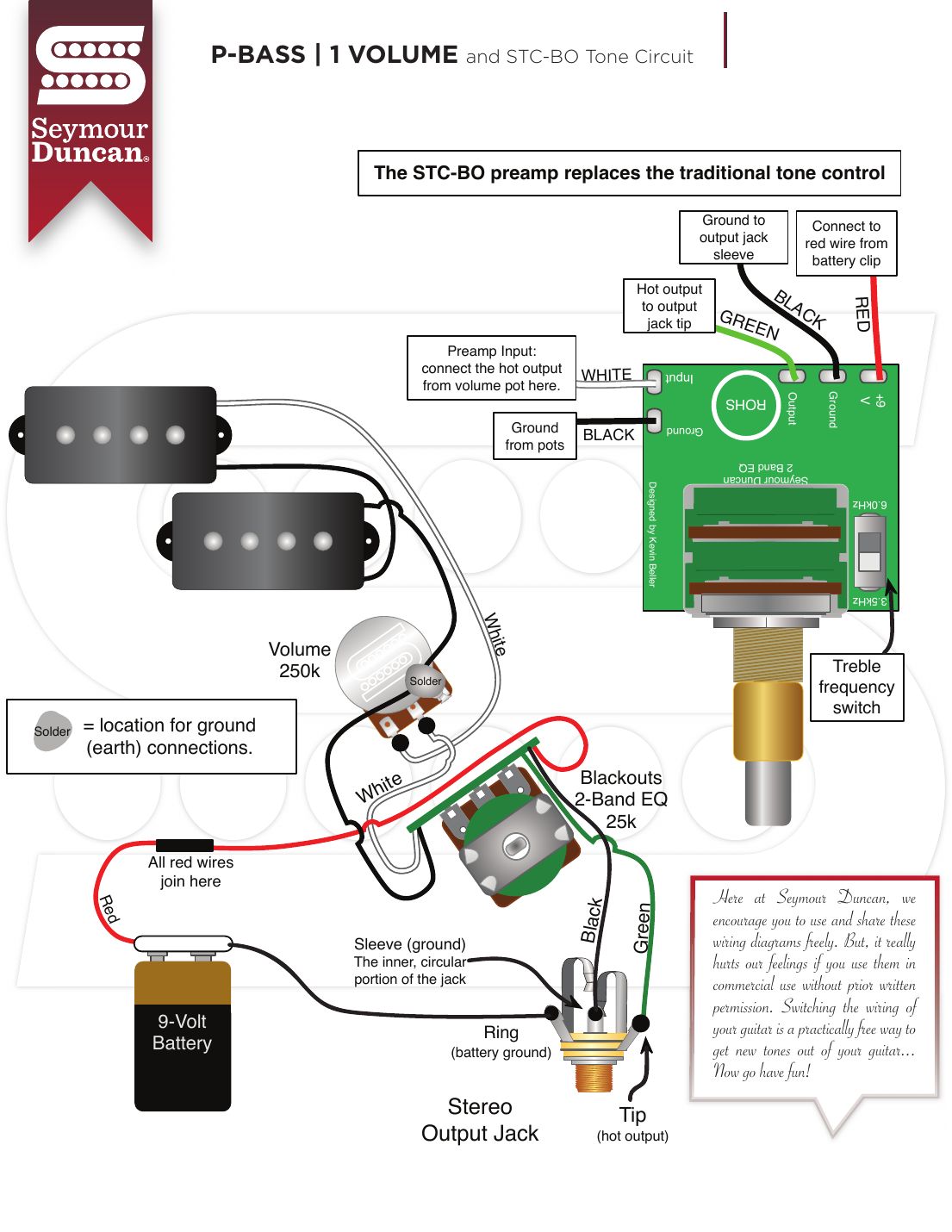
Wire it with
Rickenbacker
Rickenbacker replacement pickups
SD's Basslines pickups for a Rickenbacker 4001/4003. SD: the wiring should only need connections from the pickups to the 3-way switch; the Ric's own pots and jacks stay as they are.
Controls: Rickenbacker harness as fitted: 250K neck and bridge volumes, 500K neck and bridge tones, .047 µF caps, 3-way switch, stereo (Rick-O-Sound) and mono switching jacks.
| # | Wire | Goes to |
|---|---|---|
| 1 | Each pickup: red and white | Solder together and tape |
| 2 | Each pickup: hot lead | 3-way switch, where the old pickup's hot was |
| 3 | Each pickup: ground and shield | Ground, where the old pickup's ground was |
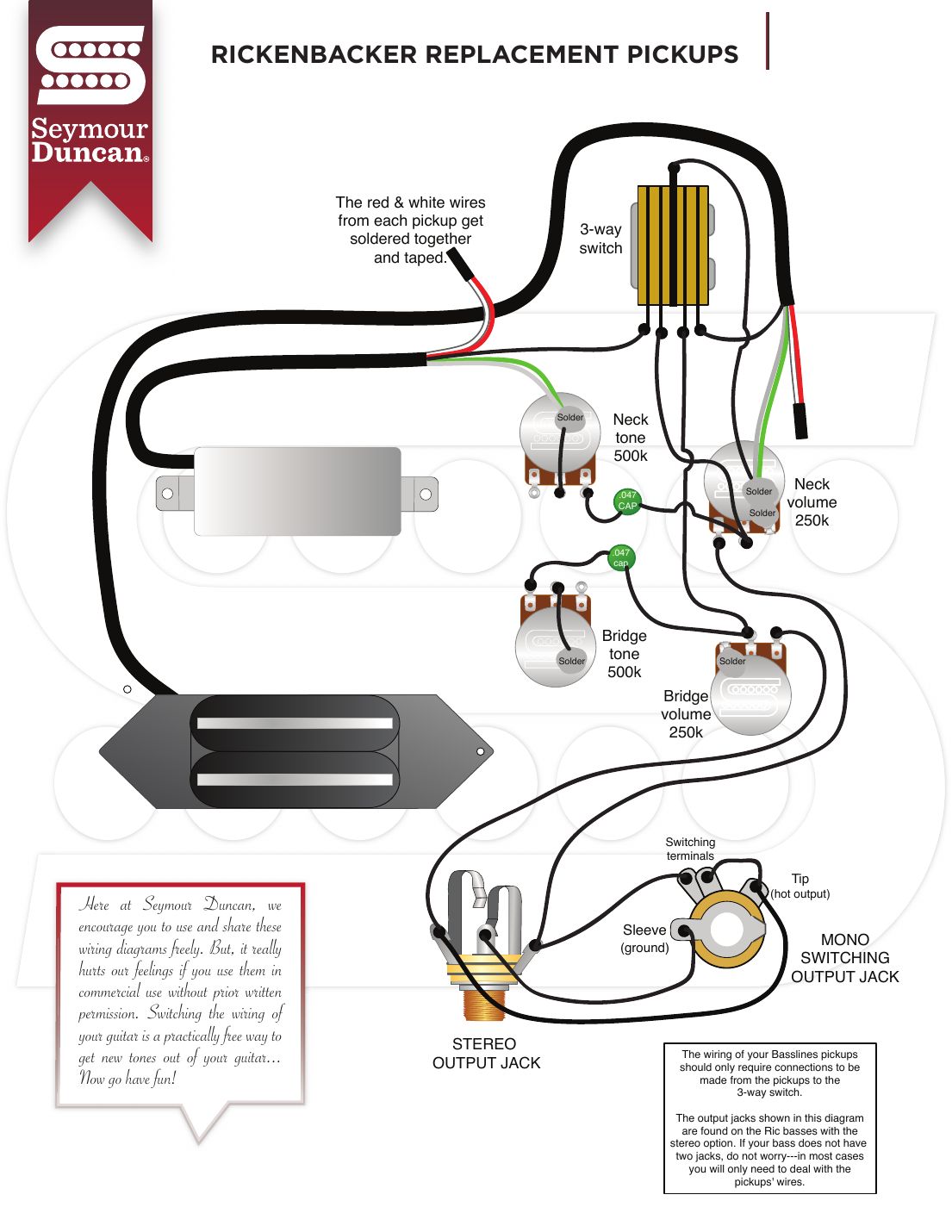
- The pickups-to-switch hookup is written out wire by wire on our SRB-1 Rickenbacker wiring page; this page doesn't repeat it. SD: if your bass doesn't have two jacks, don't worry; in most cases you only deal with the pickups' wires.
Seymour Duncan hookups, wire by wire
Passive, two pickups: volume, volume, master tone
Seymour Duncan's standard two-pickup layout, used on every passive J, P-J, soapbar, stack and Music Man + P sheet. Each pickup has its own volume, the volume outputs are joined (the pickups run in parallel), and one tone pot cuts treble for both.
You need: 2 × 250K audio pots (volumes), 1 × 250K pot (tone), .05 µF cap, mono output jack, hookup wire, bridge ground wire.
| # | From | To | Notes |
|---|---|---|---|
| 1 | Neck pickup: hot (white on SD's J, P and soapbar pickups) | Neck volume: outer input lug | |
| 2 | Neck pickup: ground (black, or bare) | Neck volume: back of the casing | Solder spot on SD's drawing |
| 3 | Bridge pickup: hot | Bridge volume: outer input lug | |
| 4 | Bridge pickup: ground | Bridge volume: back of the casing | |
| 5 | Each volume's other outer lug | Its own casing | Bent back and soldered: the ground end of the track |
| 6 | Neck volume: middle lug | Bridge volume: middle lug | Joins the two volume outputs |
| 7 | Bridge volume: middle lug | Tone pot: outer lug | Signal on to the tone |
| 8 | Tone pot: outer lug (signal) | Output jack: tip | Hot output |
| 9 | .05 µF cap | Tone pot: middle lug to the tone casing | Shown green on the drawing |
| 10 | Ground wire | Neck volume casing to bridge volume casing to tone casing | Links every pot casing |
| 11 | Output jack: sleeve | Tone pot casing | Ground |
| 12 | Ground wire from bridge | A pot casing | String ground |
Step by step
- Fit the pickups and route their leads to the control cavity.
- Solder each pickup's hot lead to an outer lug of its own volume, and its ground lead to the back of that volume's casing. Bend the volume's other outer lug back and solder it to the casing.
- Join the two volume middle lugs with a short wire, then run a wire from the bridge volume's middle lug to an outer lug of the tone pot.
- Solder the .05 µF cap from the tone pot's middle lug to its casing.
- Link all three pot casings with ground wire. Solder the bridge ground wire to a casing.
- Jack: tip to the tone pot's signal lug, sleeve to the tone casing. Test each pickup before closing up.
- SD's drawings use a .05 µF cap. A .047 µF cap is the common value and sounds the same.
- If a knob works backwards (loud at 0), the hot and ground ends of that pot are swapped: move the pickup hot to the other outer lug.
- Sheets that use this hookup: Standard Jazz Bass, Standard P-J Bass, Jazz Bass 2 Stacks, 2 Volume, 1 Tone, P-J Bass with Jazz Bass Stack, Jazz Bass, 2 Volume push/pull series parallel, 1 Tone, 1 Music Man Passive, 2 Volume, 1 Tone, 1 Music Man, 1 P-Bass, 2 Volume, 1 Tone, 2 Passive Soapbars, 2 Volumes, 1 Tone.
Passive, one pickup: volume and tone
One pickup, one volume, one tone: the standard P-Bass layout, also used for the single-coil P, the passive Music Man pickup (1 volume, 1 tone) and the series/parallel P sheets.
You need: 2 × 250K audio pots, .05 µF cap, mono output jack, hookup wire, bridge ground wire.
| # | From | To | Notes |
|---|---|---|---|
| 1 | Pickup: hot (white on SD's P pickups) | Volume: outer input lug | |
| 2 | Pickup: ground (black) | Volume: back of the casing | |
| 3 | Volume: other outer lug | Volume casing | Bent back and soldered |
| 4 | Volume: middle lug | Tone pot: outer lug | Signal on to the tone |
| 5 | Volume: middle lug | Output jack: tip | Hot output (SD draws it from the volume) |
| 6 | .05 µF cap | Tone pot: middle lug to the tone casing | |
| 7 | Ground wire | Volume casing to tone casing | |
| 8 | Output jack: sleeve | Tone pot casing | Ground |
| 9 | Ground wire from bridge | Volume casing | String ground |
Step by step
- Solder the pickup's hot lead to an outer lug of the volume and its ground to the volume casing. Bend the volume's other outer lug to the casing and solder it.
- Run the volume's middle lug to an outer lug of the tone pot, and on to the jack tip.
- Solder the .05 µF cap from the tone pot's middle lug to its casing.
- Link the two pot casings, solder the bridge ground wire to the volume casing, and the jack sleeve to the tone casing. Test before closing up.
- On a split-coil P pickup the two halves are already joined in series by a short black wire between them. Leave it, unless you're adding a series/parallel switch.
- Sheets that use this hookup: Standard P-Bass, P-Bass Single Coil, 1 Volume, 1 Tone, P-Bass, 1 Volume, 1 Tone, 2 Way Mini-toggle series/parallel, P-Bass, 1 Volume push/pull series/parallel, 1 Tone, 1 Music Man Passive, 1 Volume, 1 Tone.
Active pickups (Basslines active and Blackouts): volume, volume, tone, battery and stereo jack
Seymour Duncan's active bass pickups wire like passive ones, plus a red power wire from each pickup and a battery. The jack has to be a stereo jack: its ring switches the battery on when you plug in.
You need: 100K pots for Basslines active pickups (25K for Blackouts): 2 volumes and 1 tone (1 volume and 1 tone for a single pickup), .05 µF cap, stereo output jack, 9 V battery clip.
| # | From | To | Notes |
|---|---|---|---|
| 1 | Each pickup: white (hot) | Its own volume: outer input lug | |
| 2 | Each pickup: bare (ground) | Its own volume: back of the casing | |
| 3 | Each pickup: red | Joined with the battery clip's red | Solder and heat-shrink: "all red wires join here" |
| 4 | Battery clip: black | Output jack: ring | Battery ground. Plugging in a mono cable connects ring to sleeve and turns the pickups on |
| 5 | Neck volume: middle lug | Bridge volume: middle lug | Two pickups only |
| 6 | Bridge volume: middle lug | Tone pot: outer lug | |
| 7 | Tone pot: outer lug (signal) | Output jack: tip | Hot output |
| 8 | .05 µF cap | Tone pot: middle lug to the tone casing | |
| 9 | Output jack: sleeve | Tone pot casing | Ground |
| 10 | Ground wire from bridge | Tone pot casing | Shown on SD's active drawings |
Step by step
- Wire each pickup's white and bare to its volume exactly as for passive pickups, with each volume's spare outer lug grounded to its casing.
- Join the volume middle lugs, then run on to the tone pot and solder the cap from the tone's middle lug to its casing.
- Twist the red wires from every pickup together with the battery clip's red, solder and heat-shrink the joint.
- Fit a stereo jack: tip from the tone's signal lug, sleeve to the tone casing, ring to the battery clip's black.
- Unplug the cable when you're done playing, or the battery keeps running.
- Active pickups want lower-value pots: 100K on SD's Basslines active drawings, 25K on the Blackouts drawings. 250K pots will work but the taper feels wrong.
- Active P-Bass (one pickup): one 100K volume and one 100K tone, same battery and stereo jack.
- Sheets that use this hookup: Active Soapbars, 2 Volumes, 1 Tone, Blackouts for bass, 2 Volumes, 1 Tone, Blackouts for bass, 2 Volumes and STC-BO preamp, Active P-Bass, Active Jazz Bass, Active P-J Bass.
Master volume, blend, master tone (Jazz Bass and P-J)
A blend pot replaces the second volume. Turn it one way for the neck pickup, the other way for the bridge, both full in the centre. Then a master volume and master tone cover both pickups.
You need: 250K master volume, 250K blend pot (dual-gang, SD's drawing shows it from the front), 250K tone, .05 µF cap, mono jack.
| # | From | To | Notes |
|---|---|---|---|
| 1 | Neck pickup: white (hot) | Blend: one section's input lug | Front row on SD's drawing |
| 2 | Bridge pickup: white (hot) | Blend: the other section's input lug | Back row |
| 3 | Neck pickup: black (ground) | Master volume casing | |
| 4 | Bridge pickup: black (ground) | Tone pot casing | |
| 5 | Blend: ground lugs | Blend casing (solder spot) | |
| 6 | Blend: output (both sections' wipers joined) | Master volume: outer input lug | |
| 7 | Master volume: middle lug | Tone pot: outer lug and output jack: tip | Hot output |
| 8 | Master volume: other outer lug | Master volume casing | |
| 9 | .05 µF cap | Tone pot: middle lug to the tone casing | |
| 10 | Output jack: sleeve; ground wire from bridge | Tone pot casing |
Step by step
- Mount the blend so you can see its lugs from the front, as on SD's drawing.
- Solder the neck white to one section's input lug and the bridge white to the other section's input lug. Ground the blend's ground lugs to its casing.
- Join the two sections' wiper lugs and run that to the master volume's input lug.
- Master volume middle lug to the tone pot and the jack tip; cap from the tone's middle lug to its casing.
- Pickup grounds to the casings, all casings linked, jack sleeve and bridge ground to the tone casing.
- Blend pots differ by maker. SD's drawing shows the lug pairs crossing over on the back of the pot: follow the drawing for which lug is which. Our own lug-by-lug version is on the volume, blend, tone page.
- Sheets that use this hookup: Jazz Bass, 1 Volume, 1 Blend, 1 Tone, P-J Bass, 1 Volume, 1 Blend, 1 Tone.
Series/parallel switching: P-Bass (mini-toggle or push-pull) and Jazz Bass (push-pull)
A DPDT switch (a mini-toggle, or the switch on a push/pull pot) changes how the two coils, or the two pickups, are joined. A stock P-Bass is series; a stock Jazz Bass is parallel. Series is louder with more mids; parallel is brighter and lighter.
You need: DPDT mini-toggle, or a 250K push/pull pot in place of a volume; otherwise the usual 250K pots, .05 µF cap and mono jack.
| # | From | To | Notes |
|---|---|---|---|
| 1 | P pickup: the short wire linking the two halves | Cut in the middle: the two new ends go to the switch | SD: "This wire must be cut in the middle to create two new wires" |
| 2 | P pickup: white (hot) and black (ground) | Switch: the remaining lugs, as drawn | The switch then feeds the volume's input lug and ground |
| 3 | Switch outputs | Volume: input lug and casing | The rest is the standard one-pickup hookup |
| 4 | J: neck pickup white and black | Push/pull switch on the neck volume, as drawn | Up = series, down = parallel (SD's sheet) |
| 5 | J: bridge pickup | Bridge volume, as standard |
Step by step
- Note the stock wiring before you cut anything.
- P-Bass: cut the short wire between the two coil halves, strip the two new ends and solder them to the switch where SD's drawing points.
- P-Bass: wire the pickup's white (hot) and black (ground) to the switch, and the switch to the volume, as drawn. Then wire volume, tone and jack as standard.
- Jazz Bass: fit the push/pull as the neck volume and wire the neck pickup through its switch as drawn; the bridge pickup and tone stay standard.
- Test both switch positions. Series should be louder and thicker.
- SD's drawings show the switch lugs but don't spell each one out in text: follow the drawing for the lugs. For the P sheets, SD doesn't say which switch position is series; check by ear (series is louder).
- Our own wire-by-wire Jazz Bass version is on the Jazz Bass series/parallel page.
- Sheets that use this hookup: Jazz Bass, 2 Volume push/pull series parallel, 1 Tone, P-Bass, 1 Volume, 1 Tone, 2 Way Mini-toggle series/parallel, P-Bass, 1 Volume push/pull series/parallel, 1 Tone.
STC-3A, STC-3P, STC-2A and STC-2P preamps: the harness, colour by colour
Seymour Duncan's STC tone circuits come with a colour-coded harness. The STC-3 is 3-band (concentric bass/treble plus mid); the STC-2 drops the mid pot. The A versions are for active pickups, the P versions for passive. Pulling up the master volume switches in the slap contour EQ.
You need: STC preamp with its harness, 10K push/pull master volume, 100K mid (STC-3 only), 100K concentric bass/treble, blend (100K for STC-3A/2A, 250K for STC-3P/2P), stereo output jack, 9 V battery clip.
| # | From | To | Notes |
|---|---|---|---|
| 1 | Neck and bridge pickup hot leads | Blend control: one section each | Pickup grounds to the pot casings |
| 2 | Harness: gray | Blend output | Preamp input |
| 3 | Harness: white | Master volume (10K) | Preamp output to the volume |
| 4 | White from the master volume | Output jack: tip | Hot output to the jack |
| 5 | Harness: green/white striped and brown | Master volume's push/pull switch | Slap contour on/off |
| 6 | Harness: green, yellow, purple | Mid-range pot (yellow on the middle lug) | STC-3 only |
| 7 | Harness: green, blue, orange, purple | Concentric bass/treble pot | |
| 8 | Harness: black | Output jack: sleeve | Ground; pot casings are soldered to ground too |
| 9 | Harness: red | Battery clip red | "Red wires join here" |
| 10 | Battery clip: black | Output jack: ring | Battery ground |
Step by step
- Mount the master volume (push/pull), blend, mid and concentric bass/treble as SD draws them.
- Pickups to the blend, pickup grounds to the casings. Blend output to the gray harness wire.
- Harness white to the master volume, and a white from the master volume to the jack tip. Green/white striped and brown to the push/pull switch.
- Mid pot: green, yellow (middle lug), purple. Concentric: green, blue, orange, purple, following the drawing for each lug.
- Black to the jack sleeve, red to the battery red, battery black to the jack ring. Test with the slap contour up and down.
- With two volumes instead of a blend (the "3 band tone circuit with 2 volumes" sheet), the two volume outputs join to the gray wire, the white goes straight to the jack tip, and the slap contour switch has to move to another push/pull or its own mini-toggle.
- Follow SD's drawing for exactly which lug each colour takes on the concentric pot; the text above gives the colours per control.
- Sheets that use this hookup: 1 Music Man, 1 P-Bass with STC-3P, 2 Passive Soapbars with the STC-3P, 2 Active Soapbars with the STC-3A, Active Jazz Bass with STC-2A preamp, Tone Circuit Basic Wiring, 3 Band Tone Circuit with 2 Volume, 2 Band Tone Circuit Wiring, Jazz Bass with STC-2P or STC-3P.
STC-BO 2-band EQ (the Blackouts preamp) in place of the tone pot
The STC-BO is a 2-band preamp on one concentric 25K pot (bass and treble). It goes where the tone pot was. It has five pads, and a switch on the board sets the treble frequency.
You need: STC-BO board with its concentric 25K bass/treble pot, volume pot(s) (250K for passive pickups, 25K for Blackouts), stereo output jack, 9 V battery clip.
| # | From | To | Notes |
|---|---|---|---|
| 1 | Board: Input (white) | Hot output from the volume pot(s), blend or pickup switch | On SD's drawings: the volume middle lug |
| 2 | Board: Ground, input side (black) | Ground from the pots (a pot casing) | |
| 3 | Board: Output (green) | Output jack: tip | Hot output |
| 4 | Board: Ground, output side (black) | Output jack: sleeve | |
| 5 | Board: +9 V (red) | Battery clip red | Joined with any active pickups' reds |
| 6 | Battery clip: black | Output jack: ring | Stereo jack |
| 7 | Treble frequency switch (on the board) | 3.5 kHz or 6.0 kHz | Set to taste |
Step by step
- Remove the old tone pot and cap, and mount the STC-BO's concentric pot in its hole.
- Wire the pickups to the volume(s) as standard. Run the volume output to the white Input pad and a ground from the pot casings to the black Ground pad next to it.
- Green Output to the jack tip, the other black to the jack sleeve.
- Red +9 V to the battery red (with the pickups' reds, if they're active), battery black to the jack ring.
- Pick the treble frequency on the board's switch, then test.
- SD's drawings for the STC-BO don't show a string ground wire. On passive pickups, ground the bridge to a pot casing as usual.
- Sheets that use this hookup: 2 Passive Soapbars, 2 Volumes, STC-BO preamp, Blackouts for bass, 2 Volumes and STC-BO preamp, Jazz Bass with STC-BO Tone Circuit, P-J Bass with STC-BO Tone Circuit, P-Bass, 1 Volume and STC-BO Tone Circuit.
FAQ
What value pots do Seymour Duncan bass pickups use?
250K for passive pickups, 100K for Basslines active pickups and 25K for Blackouts, as on SD's drawings. The STC preamps use a 10K master volume, 100K mid and 100K concentric bass/treble, with a 100K blend for the active (A) versions and 250K for the passive (P) versions.
Which wire is hot on a Seymour Duncan bass pickup?
White, on SD's P, J, P-J and soapbar pickups, with black or bare as ground. On the stacked J pickups black is hot, green and bare are ground, and red and white are soldered together and taped. On the Music Man pickup, SD's passive sheets join red and black as the hot, with green, white and bare to ground.
Why do the active and STC hookups need a stereo jack?
The battery's black wire goes to the jack's ring. A normal mono cable connects ring to sleeve when it's plugged in, which completes the battery circuit. Unplug and the battery is off.
What does pulling up the master volume do on the STC-3 and STC-2?
It switches in the slap contour EQ. The green/white striped and brown harness wires go to the push/pull switch. If you use two volumes instead of a blend and master volume, the slap contour needs its own push/pull or a mini-toggle.
What's the difference between the STC-3A and STC-3P?
The A version is for active pickups and uses a 100K blend; the P version is for passive pickups and uses a 250K blend. The STC-2A and STC-2P are the same pairs with 2 bands (no mid pot).
Do I solder the bridge ground wire with Seymour Duncan pickups?
Yes on the passive sheets: SD shows the ground wire from the bridge going to a pot casing. SD's active drawings show it too. The STC-BO drawings leave it out; on passive pickups, ground the bridge anyway.
Related
- Seymour Duncan bass pickups
- Seymour Duncan STC-3M3 / STC-3M4 wiring
- Seymour Duncan SRB-1 Rickenbacker wiring
- Jazz Bass series/parallel wiring
- Volume, blend, tone wiring
- All bass wiring diagrams
- EMG bass wiring diagrams
- DiMarzio bass wiring diagrams
Questions about a hookup? Call 877-839-3531 or email sales@bestbassgear.com.